
JOURNAL OF EURASIAN STUDIES
|
|
|
- Kristóf Takács
- 10 évvel ezelőtt
- Látták:
Átírás
1 JOURNAL OF EURASIAN STUDIES Journal of the Gábor Bálint de Szentkatolna Society Founded: Internet: Volume I., Issue 2. / April June 2009 ISSN
2 Publisher Foundation ʹStichting MIKES INTERNATIONALʹ, established in The Hague, Holland. Account: Postbank rek.nr Registered: Stichtingenregister: S Kamer van Koophandel en Fabrieken Den Haag Distribution The periodical can be downloaded from the following Internet address: If you wish to subscribe to the mailing list, you can do it by sending an to the following address: mikes_int [email protected] The publisher has no financial sources. It is supported by many in the form of voluntary work and gifts. We kindly appreciate your gifts. Address The Editors and the Publisher can be contacted at the following addresses: [email protected] Postal address: P.O. Box 10249, 2501 HE, Den Haag, Holland Individual authors are responsible for facts included and views expressed in their articles. ISSN Mikes International, , All Rights Reserved Copyright Mikes International
3 EDITORIAL BOARD Editor in Chief FARKAS, Flórián The Hague, Holland Deputy Editor in Chief OBRUSÁNSZKY, Borbála Budapest, Hungary Editors ALIMBAY, Nursan ARADI, Éva BÉRCZI, Szaniszló BÍRÓ, András CSORNAI, Katalin ERDÉLYI, István HORVÁTH, Izabella KARATAY, Osman MARÁCZ, László MARCANTONIO, Angela SECHENBAATAR UCHIRALTU ZOMBORI, Andor Almaty, Kazakhstan Budapest, Hungary Budapest, Hungary Budapest, Hungary Budapest, Hungary Göd, Hungary Hangzhou, China İzmir, Turkey Amsterdam, Holland Rome, Italy Hohhot, China Hohhot, China Nagoya, Japan Copyright Mikes International
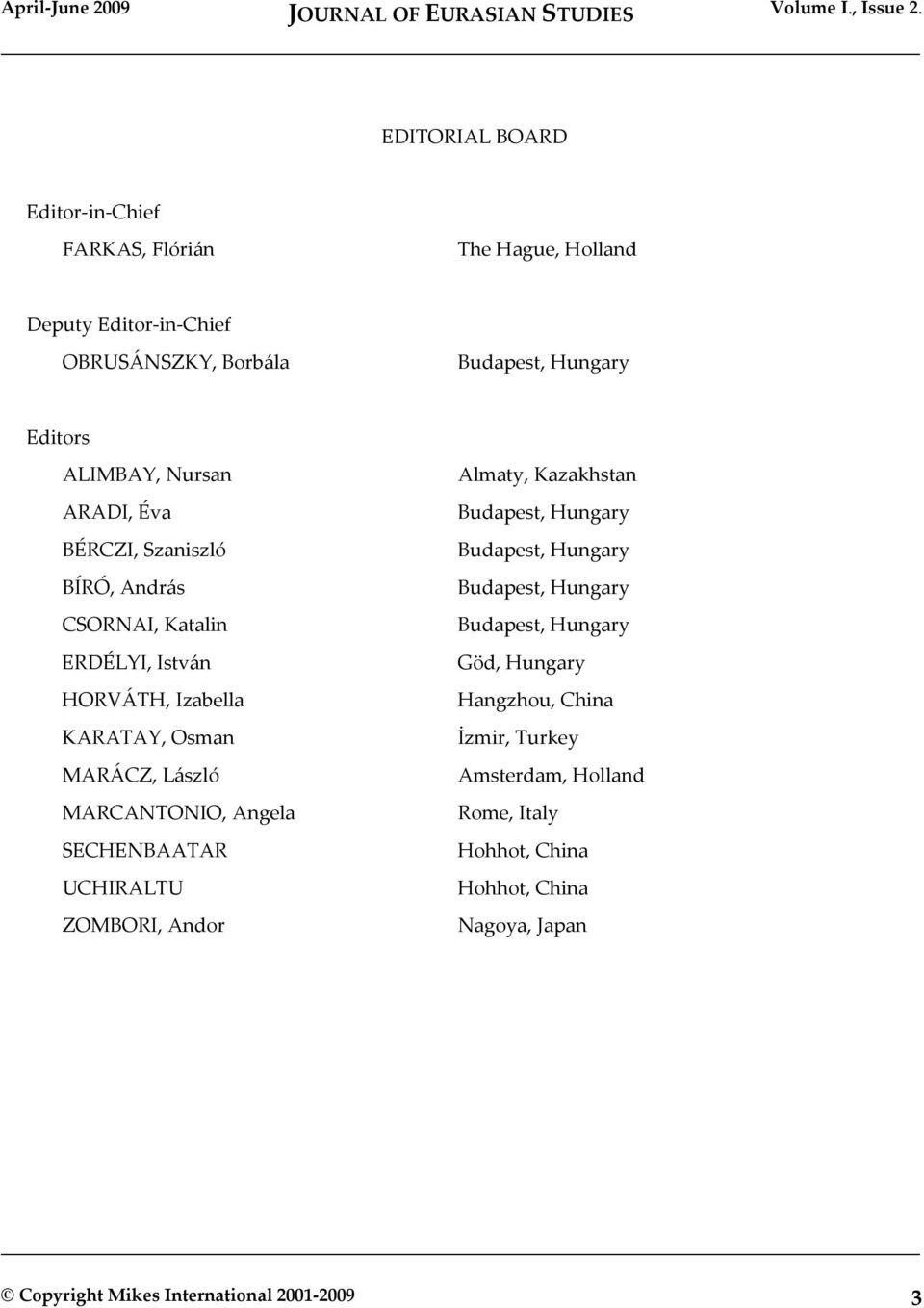
4 CONTENTS Dear Reader, 6 Our Authors 7 CHRONICLE 10 BÉRCZI, Szaniszló Datahorizon from Eurasia in the 1 st Millennium B.C. 11 OBRUSÁNSZKY, Borbála Statue to Gábor Bálint de Szentkatolna 21 HISTORY 23 OBRUSÁNSZKY, Borbála Late Huns in Caucasus 24 ZOMBORI, Andor Heavenly White Castle of Japan 37 LINGUISTICS 40 BÉRCZI, Szaniszló Gábor Czakó: Initiation into the Hungarian Cast of Mind 41 FERENCZI, Enikő New Interpretation of the Ethnic Name Scythian and Its Significance to the Etymology of the Basque 43 MARCANTONIO, Angela Belső ázsiai nyelv e a magyar? 68 IS HUNGARIAN AN INNER ASIAN LANGUAGE? 95 ANCIENT WRITING SYSTEM RESEARCH 97 MELLÁR, Mihály Linear A Deciphered 98 GEOSTRATEGY 120 DEMETER M., Attila TONK, Márton The System of Norms of Minority Protection in the European Union 121 Copyright Mikes International
5 DERRICK, Matthew The Implications of Climate Change for Russian Geopolitics in the Arctic 130 MAHAPATRA, Debidatta Aurobinda India s Central Asian Connections 137 LITERATURE 147 FARKAS, Flórián Mirza a Persian Chronicler on the Polders 148 Copyright Mikes International
6 DEAR READER, It is a great pleasure for the members of the editorial board of our journal that so many readers reacted enthusiastically to the launch of the JOURNAL OF EURASIAN STUDIES. In the meantime some scholars even submitted papers that you can read in this issue. It is our aim to make this journal a vehicle for exchanging ideas, information, and views about the topics covered by it. Therefore we would like to draw the attention of our readers to the following possibilities: We welcome comments, reviews, and criticisms on papers published in this journal or in other scholarly publications, so long as they are constructive and are not meant to hurt or insult. We would like to encourage everybody to submit to the Editorial Board ([email protected]) papers in the fields covered by the Journal. The papers will be assessed solely on their academic merits, and these are the few prerequisites the authors and their papers should adhere to: Can be written in any language. However, if written in a language other than English, please provide an English summary of at least A4 length. A brief (max. 10 sentences long) professional CV in English. Beginning with the next issue we intend to launch a new column entitled News Brief. The news brief section features the latest news from the past three months prior to publication of each Journal of Eurasian Studies issue in the areas of anthropology, archaeology, ethnology, folklore, genetics, and linguistics with a special focus on Asia and the interaction between various European and Asian peoples. News pieces outside the three month period or our scope of focus may also be included if they are found to be of great value and relevance by our editorial board. Please submit a short summary of those newsbytes (max. 100 words) in English to the following address: [email protected], indicating the source as well (also URL if applicable). The column will be edited by one of our editors, Andor Zombori. If the original news is only available in hardcopy, please send us a copy to the following address: Journal of Eurasian Studies, P.O. Box 10249, 2501 HE, Den Haag, Holland. The names of the contributors will be published in the journal unless they ask otherwise. If you wish to subscribe to the electronic mailing list, you can do it by sending an to the following address: mikes_int [email protected] Flórián Farkas Editor in Chief The Hague, June 15, 2009 Copyright Mikes International
7 OUR AUTHORS BÉRCZI, Szaniszló Physicist astronomer who made a new synthesis of evolution of matter according to the material hierarchy versus great structure building periods. This model is a part of his Lecture Note Series Book on the Eötvös University. He also organized a research group on evolution of matter in the Geonomy Scientific Committee of the Hungarian Academy of Scince (with Béla Lukács). He wrote the first book in Hungary about planetary science From Crystals to Planetary Bodies (also he was the first candidate of earth sciences in topics planetology). He built with colleagues on the Eötvös university the Hungarian University Surveyor (Hunveyor) experimental space probe model for teachers training proposes and development of new constructions in measuring technologies. DEMETER M., Attila Senior lecturer at the Babeş Bolyai University in Kolozsvár/Cluj/Clausenburg, focusing on political philosophy. He commenced his academic studies at the Polytechnic Faculty (Mechanics) in Kolozsvár/Cluj/Clausenburg, which was then followed with a BA then MA studies at the Babeş Bolyai University in Philosophy ( ). Mr. Demeter earned his Ph.D. degree from the same university in philosophy in He is chairman of the Pro Philosophia Foundation, founder and member of the editorial board of the philosophy periodical Kellék. Author of several books and articles. DERRICK, Matthew PhD candidate in Geography at the University of Oregon (USA). He also holds two master s degrees, the first in Russian Area Studies and the second in Geography, from the University of Oregon. Focused mainly on the Russian Federation, and especially its non Russian regions, his scholarly interests include ethno territoriality, nationalism, regionalism, and geopolitics. He also nurtures an interest in cartography and geographic information systems (GIS). Most recently, his articles have appeared in the Journal of Central Asian and Caucasian Studies and the Central Eurasian Studies Review. With the support of a Fulbright Hays Fellowship, he is currently conducting fieldwork in Kazan, Russia, where he is investigating the relationship between Islam, nationalism, and territoriality. FARKAS, Flórián Electric engineer; MBA. IT and management consultant. Living in the Netherlands since Copyright Mikes International
8 FERENCZI, Enikő Born in 1955, in Kolozsvár/Cluj/Clausenburg (Romania). In 1979, she obtained her Bachelor Degree in philosophy and history. She was a teacher until she left her homeland for ideological reasons. From 1989, she is living in Sydney, Australia, where she obtained her librarian diploma. Her first writings, philosophical essays, were published in her student years. After two decades of other preoccupations, she has resumed her original profession by participating in historical lectures, about Moldovian Hungarians and Scythians, in different cultural events of the Hungarian community of Sydney. Her poems and essays were published mostly in Transylvanian periodicals. She wrote a novel, A kert (The Garden) about her immigrational experiences, and a memoir, Kincseim városa (The Town of My Treasures), with vast historical background, about her childhood in the ethnical minority cleansing communist era. Currently she is working on her historical novel about Scythians. MAHAPATRA, Debidatta Aurobinda Received a Ph.D. degree from the School of International Studies, Jawaharlal Nehru University, New Delhi. He is currently part of research faculty at Centre for Central Eurasian Studies, University of Mumbai, India. He is also associated with the Institute for Conflict Research, Belfast, International Mediating and Negotiating Operational Agency, Rome, Human Dignity and Humiliation Studies Network, and Journal of Alternative Perspectives in Social Sciences, Florida. Mr. Mahapatra was a research fellow at Moscow University in He has written two books, co authored two and co edited one. He has contributed over hundred papers to various national and international journals and magazines. His prominent works include India Russia Partnership: Kashmir, Chechnya and Issues of Convergence (2006), Central Eurasia: Geopolitics, Compulsions and Connections (2008) and The Peace Process and Prospects for Economic Reconstruction in Kashmir, Peace & Conflict Review (United Nations University of Peace, Fall 2008). His areas of expertise are conflict and peace building, Kashmir, terrorism and strategic aspects of Central Eurasia. MARCANTONIO, Angela Associated professor of historical linguistics and uralic studies at the University of Rome La Sapienza. She is a founder of the so called revolutionary schoolʹ of Finno Ugric/Uralic studies. The results of her research are controversial, because she challenges the foundation of the field, that is, the validity of the conventional Finno Ugric/Uralic theory and related family tree. She is the author of several books and numerous articles (e.g.: The Uralic Language Family: Facts, Myths and Statistics, 2002; A történeti nyelvészet és a magyar nyelv eredete. ( Historical Linguistics and the Origin of Hungarianʹ, 2006). Next to this, she is working on the origin and prehistory of Hungarian in close cooperation with colleagues from the Universities of Budapest and Amsterdam, and she is also publishing in Hungarian periodicals in the Netherlands like Amsterdam Studies and Mikes International. Copyright Mikes International
9 MELLÁR, Mihály Mathematician, Academia of Sciences, Belgrade. Since 1980 he is living in Australia, working as Australian Aboriginal and Papua New Guinean art and craft dealer, researching organic and endogen cultures. OBRUSÁNSZKY, Borbála Historian, orientalist. She completed her studies at the University Eötvös Loránd in Budapest between 1992 and 1997 in history and Mongol civilization. This is followed by a postgradual study at the Mongol State University, where she is awarded a Ph.D. degree in Between 2000 and 2002 she worked as external consultant of the Asia Center at the University of Pécs, and organized the Mongol programs of the Shambala Tibet Center. During this period she participated in several expeditions in Mongolia and China. Ms. Obrusánszky is member and/or founder of several Hungarian scientific associations and she is author of numerous books and articles, and regularly provides analyses on Central Asia in the scientific press. Next to that she is the editor in chief of an educational journal. TONK, Márton Adjunct professor of the Sapientia Transylvanian Hungarian University. Since 2006 he is the Dean of the Faculty of Natural Sciences and Arts in Kolozsvár/Cluj/Clausenburg. Next to that he is the Director of the Pro Philosophia Foundation, also in Kolozsvár and the editor of the journal of philosophy Kellék. His main areas of research include: history of philosophy of modern times, history of the Hungarian philosophy, political philosophy. Mr. Tonk earned his Ph.D. degree with a thesis written on Sándor Tavaszy. He also published a book in this topic. Author of numerous articles. ZOMBORI, Andor Born in Budapest. Living abroad since 1992 with periodical interruptions. First lived in Pennsylvania then moved to California in 1996 where acquired a B.A. degree in Japanese language and international relations in 2003 at the California State University, Long Beach. Next to that he studied Japanese language, culture, and international affairs for one year at the Osaka Gakuin University in Japan and Korean language and culture for another year at the Kyungbuk National University in Korea. Mr. Zombori is living in Japan since 2004 and working at a Japanese automotive industry consulting company as the editor in chief of an English language publication. His primary area of specialization is the Chinese automotive industry and market. Copyright Mikes International
10 CHRONICLE Copyright Mikes International
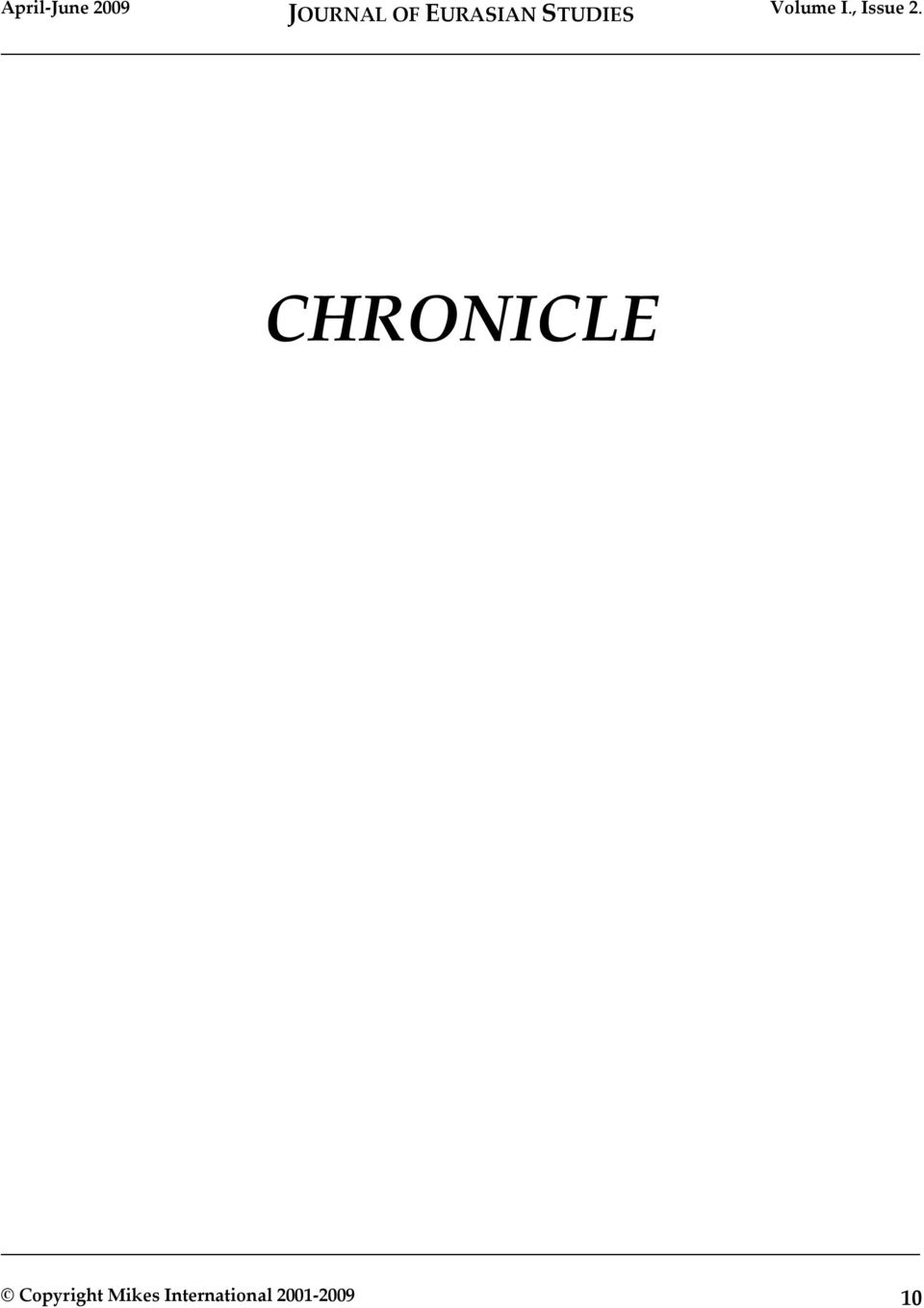
11 BÉRCZI, Szaniszló Datahorizon from Eurasia in the 1 st Millennium B.C. Scythian Archaeological Treasuries in Budapest at the Hungarian National Museum The audience of Budapest and Hungary is indulged in the last two years, because the artistic heritage of the cavalry peoples of the Eurasian steppe was two times exhibited in the Hungarian National Museum. Two years ago the founder of the Mongol Empire, Genghis Khan, was the reason of the great Hun tradition preserving exhibition entitled Genghis Khan and his Heirs and The Mongol Invasion of Hungary (spring early summer 2007). Recently, the greatest ancient Eurasian steppe heritage holders, the Scythians were visited by people who were eager to witness the new excavation treasuries. The title of this exhibition was: Scythian Gold Treasures (25 March 1 June 2009). It was remarkable that such a rich exhibition showed the most significant archaeological finds from the steppe equestrian people. As it was presented in the exhibition guide booklet, this second one was prepared for ten years. First of all we would like to congratulate the organizers for their huge work. The recent Scythian art and cultural treasury includes more than 1,300 artworks collected from museums of Russia, Ukraine, Romania and Germany. The homeland collection of the National Museum finds is also rich, containing well known and less known elements, too. Fig. 1. Beautiful horse mount with 6 horse heads: Phalera from Bratoljubski Kurgan, Ukraine. Copyright Mikes International
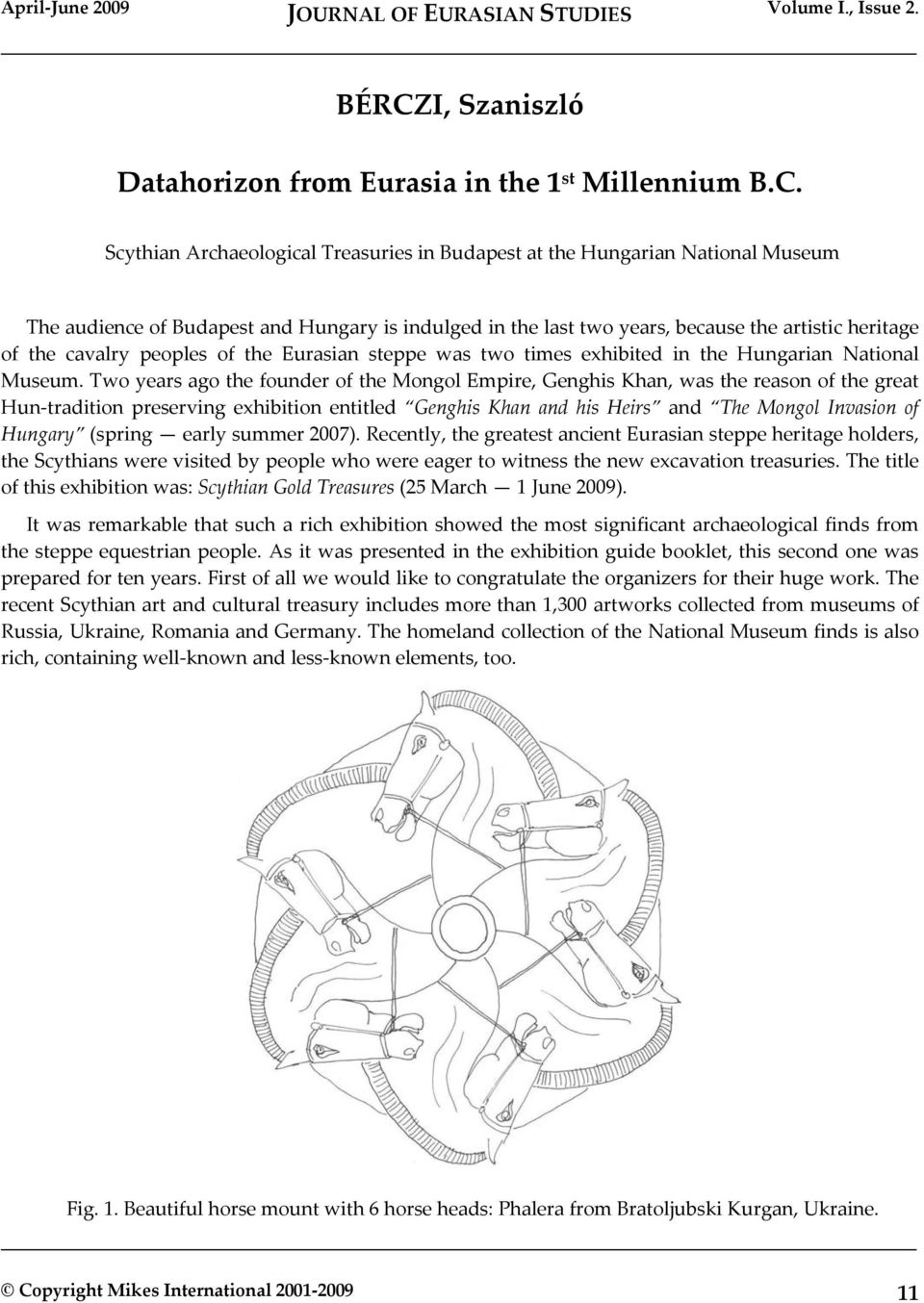
12 The common in these two exhibitions is that their material forms two comprehensive datasets of the Eurasian horizon. The younger horizon is that of Temüjin who created the Mongol Empire and later conquered Central Asia, Persia, parts of Eastern Europe, and Northern China. Later his descendants extended the rule of the empire to Korea, South East India, Indonesia, and whole China where they became the founders of the Yuan Dynasty. However, they considered themselves descendants of the Huns. That is why their exhibition contained so much Hun (Xiongnu) finds; many of them came from the Hopp Ferenc Eastern Asian Museum, Budapest. Fig. 2. Bronze cauldrons (top: Uljap, Russia and bottom: Scortaru, Romania) and swords from the Carpathian Basin (Aldoboly, Doboli de Jos, Transylvania, Romania and Maroscsapó, Pauca, Transylvania, Romania). Copyright Mikes International
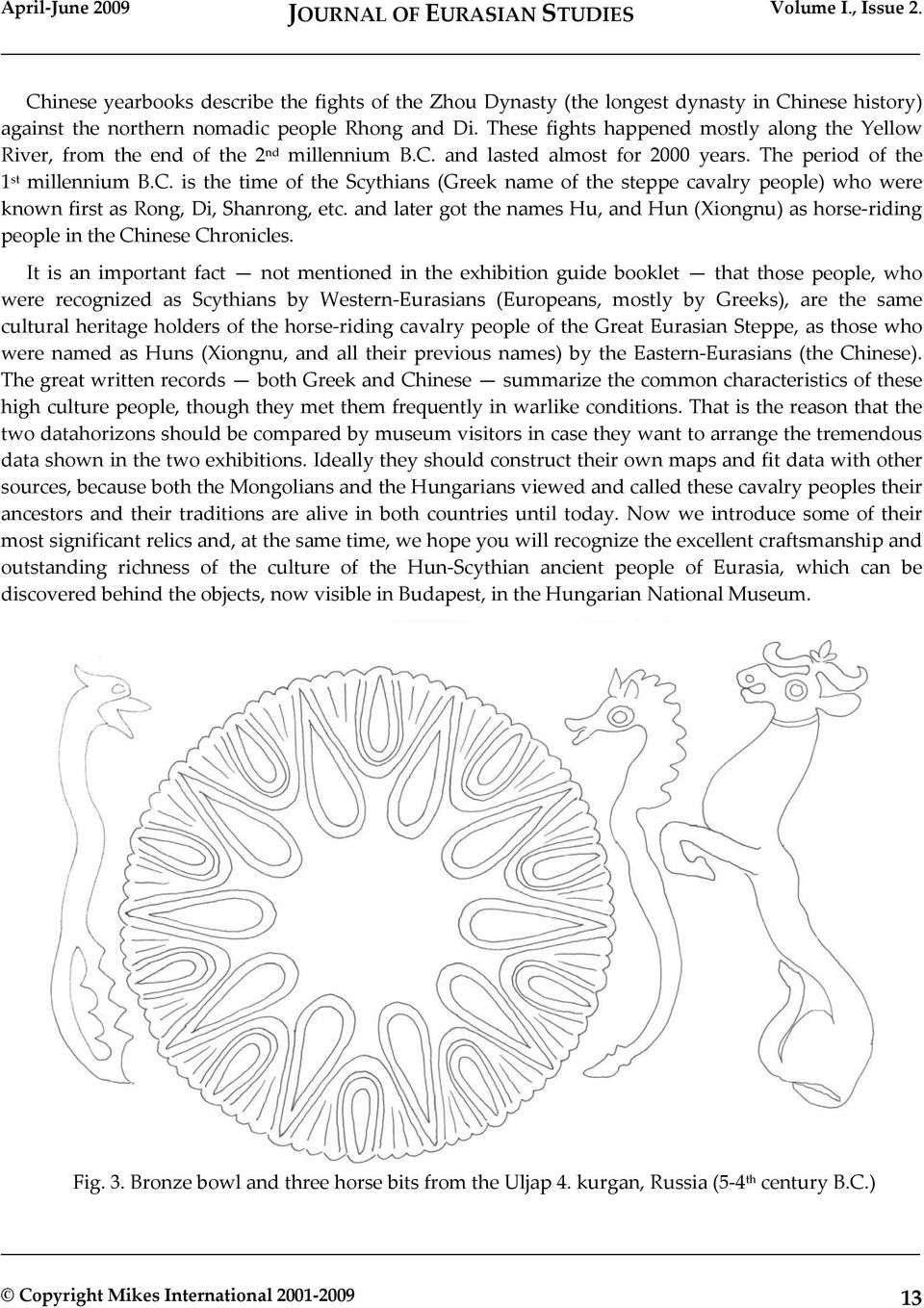
13 Chinese yearbooks describe the fights of the Zhou Dynasty (the longest dynasty in Chinese history) against the northern nomadic people Rhong and Di. These fights happened mostly along the Yellow River, from the end of the 2 nd millennium B.C. and lasted almost for 2000 years. The period of the 1 st millennium B.C. is the time of the Scythians (Greek name of the steppe cavalry people) who were known first as Rong, Di, Shanrong, etc. and later got the names Hu, and Hun (Xiongnu) as horse riding people in the Chinese Chronicles. It is an important fact not mentioned in the exhibition guide booklet that those people, who were recognized as Scythians by Western Eurasians (Europeans, mostly by Greeks), are the same cultural heritage holders of the horse riding cavalry people of the Great Eurasian Steppe, as those who were named as Huns (Xiongnu, and all their previous names) by the Eastern Eurasians (the Chinese). The great written records both Greek and Chinese summarize the common characteristics of these high culture people, though they met them frequently in warlike conditions. That is the reason that the two datahorizons should be compared by museum visitors in case they want to arrange the tremendous data shown in the two exhibitions. Ideally they should construct their own maps and fit data with other sources, because both the Mongolians and the Hungarians viewed and called these cavalry peoples their ancestors and their traditions are alive in both countries until today. Now we introduce some of their most significant relics and, at the same time, we hope you will recognize the excellent craftsmanship and outstanding richness of the culture of the Hun Scythian ancient people of Eurasia, which can be discovered behind the objects, now visible in Budapest, in the Hungarian National Museum. Fig. 3. Bronze bowl and three horse bits from the Uljap 4. kurgan, Russia (5 4 th century B.C.) Copyright Mikes International
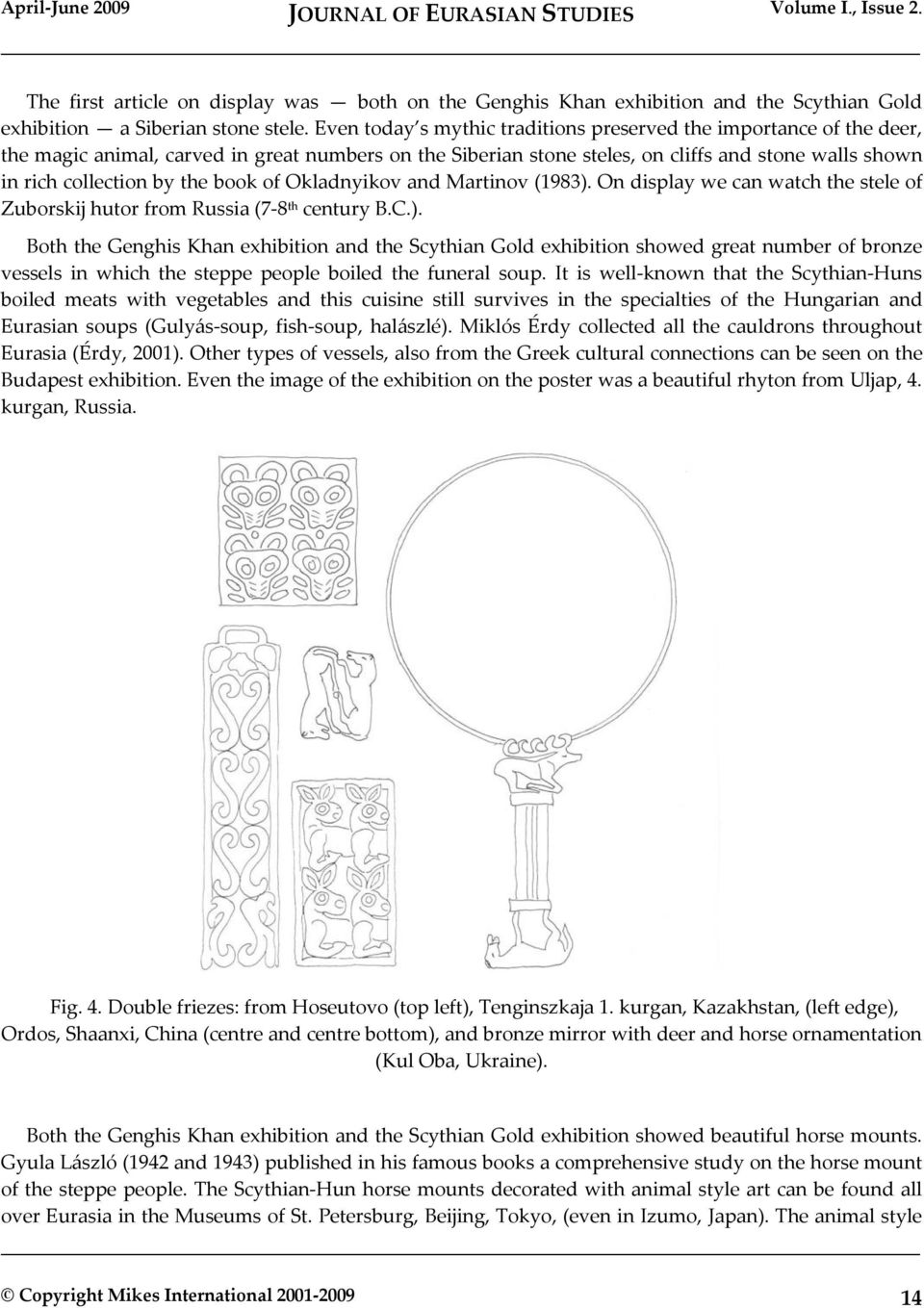
14 The first article on display was both on the Genghis Khan exhibition and the Scythian Gold exhibition a Siberian stone stele. Even today s mythic traditions preserved the importance of the deer, the magic animal, carved in great numbers on the Siberian stone steles, on cliffs and stone walls shown in rich collection by the book of Okladnyikov and Martinov (1983). On display we can watch the stele of Zuborskij hutor from Russia (7 8 th century B.C.). Both the Genghis Khan exhibition and the Scythian Gold exhibition showed great number of bronze vessels in which the steppe people boiled the funeral soup. It is well known that the Scythian Huns boiled meats with vegetables and this cuisine still survives in the specialties of the Hungarian and Eurasian soups (Gulyás soup, fish soup, halászlé). Miklós Érdy collected all the cauldrons throughout Eurasia (Érdy, 2001). Other types of vessels, also from the Greek cultural connections can be seen on the Budapest exhibition. Even the image of the exhibition on the poster was a beautiful rhyton from Uljap, 4. kurgan, Russia. Fig. 4. Double friezes: from Hoseutovo (top left), Tenginszkaja 1. kurgan, Kazakhstan, (left edge), Ordos, Shaanxi, China (centre and centre bottom), and bronze mirror with deer and horse ornamentation (Kul Oba, Ukraine). Both the Genghis Khan exhibition and the Scythian Gold exhibition showed beautiful horse mounts. Gyula László (1942 and 1943) published in his famous books a comprehensive study on the horse mount of the steppe people. The Scythian Hun horse mounts decorated with animal style art can be found all over Eurasia in the Museums of St. Petersburg, Beijing, Tokyo, (even in Izumo, Japan). The animal style Copyright Mikes International
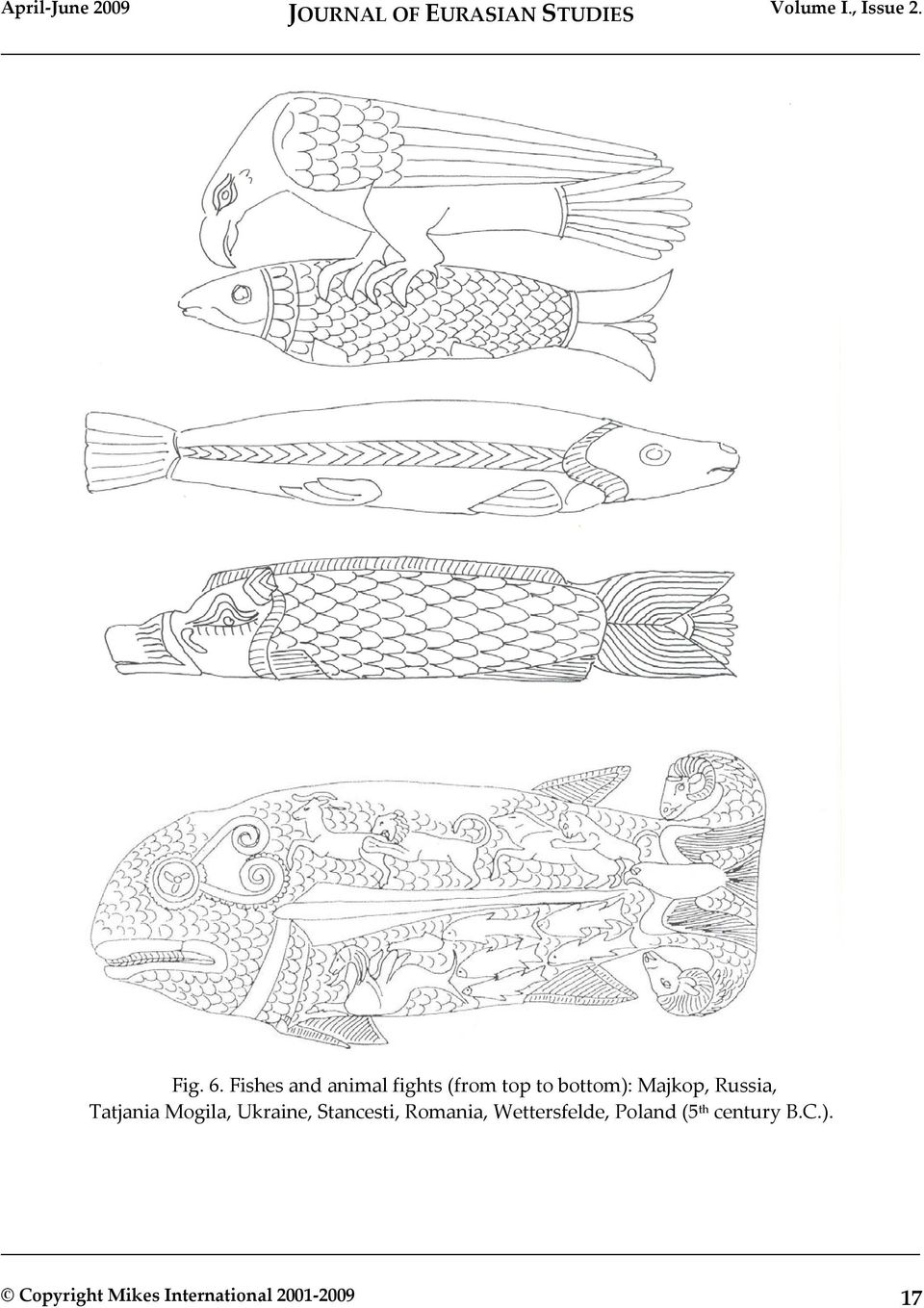
15 decorated horse mounts are the following: phalera, saddle mounts, bits, buckles. The author made drawings about these finds decorated with horse and deer, ibex, camel, bird of prey, fish, beasts as panther, wolf, and mythical beasts all in motion, in dynamism and grace, characteristic to the Scythian precious metal craftsmen. Also the weapons and jewels of the warriors are common in Hun Scythian tomb finds. However, the local fauna was different and that makes distinction between the two large groups. But the sources are common and sometimes mixed, like in the case of the famous belt buckle of the Hermitage, named Scythian, but characteristic Ordos type pair with the Resting scene of the Saint Ladislaus legend. These characteristic finds from ancient Scythian Hun tombs are mostly made of bronze. These finds exhibit rich geometrical variation in their ornamentation which is also characteristic to the steppe arts and ornamental mathematics from the 1 st millennium B.C. until the end of the 1 st millennium A.D. (Bérczi, 2000, 2004). In my view the visitors were mostly impressed by the rich find assembly from the Scythian royal grave mound of Arzhan 2, a huge kurgan from Tuva. The place is world famous since the discovery of the Russian German expedition, which excavated the earthen tumulus of 80 m in diameter in the Valley of Kings. This can be found at the South Western regions of the Sayan Mountains in north Tuva, near the town Turan. Arzhan 2 is the richest Scythian grave found till today in Siberia. Although the visitors can watch all Arzhan 2 events in a movie, they can imagine the richness of the tomb, beneath the stone circle surrounding the kurgan, while they follow the advance of the excavation. The 9,300 pieces of finds of which 5,600 was made of gold, inaugurates this archaeological find as the Tutankhamen of Eurasia. Just after this excavation Western Eurasian archaeologist were astonished by the real time scale and stratification of Eurasian culture. Who borrowed from whom in Scythian art? Fig. 5. The first pintadera, a sealing clay form found in the Carpathian Basin, at Bátaszék, Kálvária hill in Copyright Mikes International
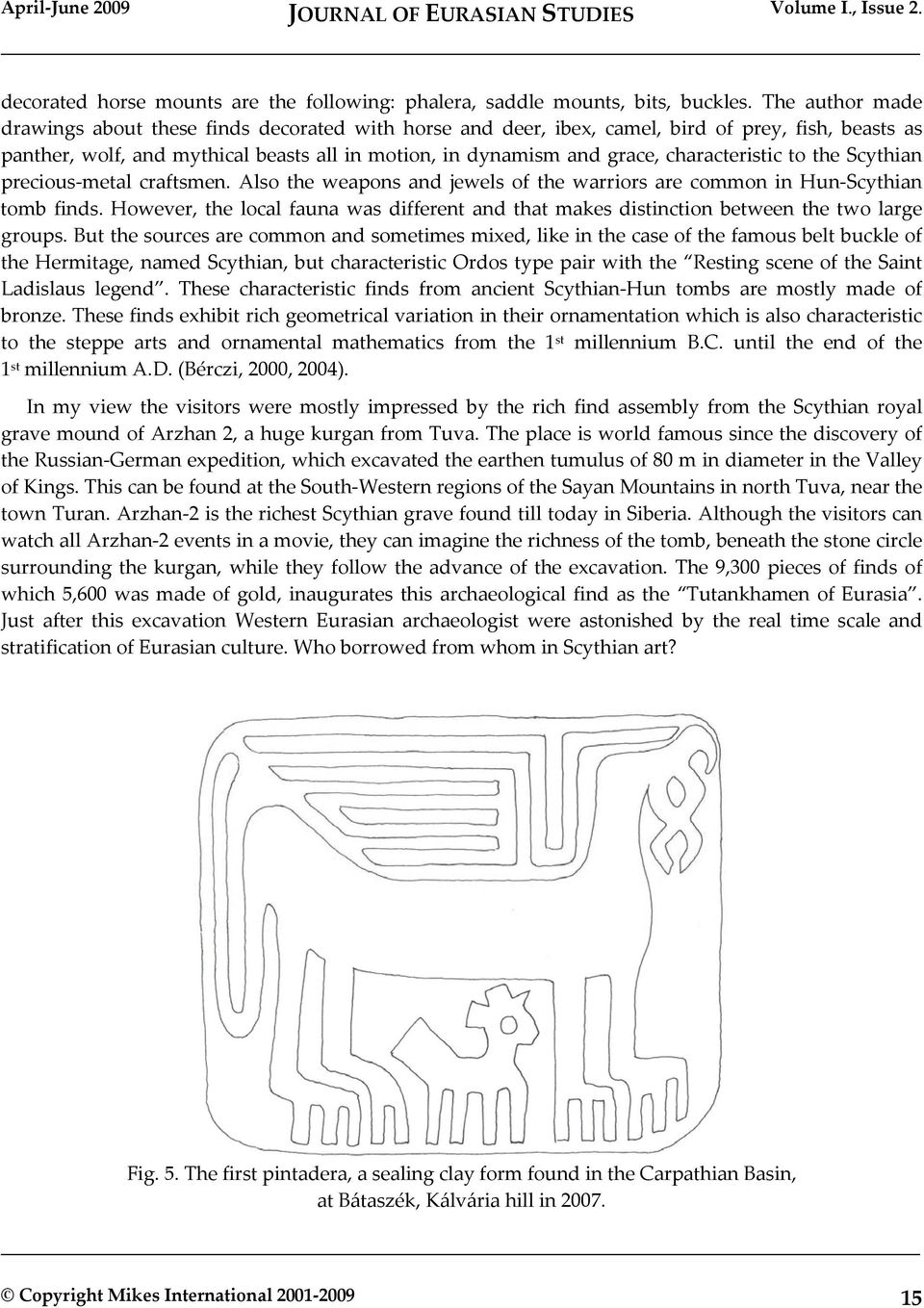
16 Beyond Arzhan, several other new names are to be learned in the Scythian Gold Exhibition, where new finds were excavated; these are: Tagiszken and Ujgarak (Kazakhstan), Aul Uljap, Krasnodar District (Russia), Barsucii Log and Salbik, Hakastan, Krasznojarsk District (Russia), Hoseutovo (Russia), Csasztije Kurgan, Kozel Kurgan, (Russia), Scortaru (Romania), and finally, Bátaszék (Hungary). Common objects of the Scythian Hun art are the bronze mirrors, two of them were decorated with horse and deer (alternating on the handle of the mirror) seen on display. The famous princeps jewels of gold deer were exhibited from Zöldhalompuszta and Tápiószentmárton from Hungary. Their counterparts can be found in Southern Russian and Ukrainian Scythian kurgan excavations. Visitors could see the fabulous sword from Aldoboly, with a handle characteristic to the akinakes styled swords occurring all over Eurasia in the 1 st millennium B.C. (Bakay, 1997). Finally, the jewelry and clothing objects can be mentioned, also displayed in great richness in the exhibition. These are exquisite artifacts unearthed in Scythian burial mounds because they were preserved by the structure of the arrangement of gold ornaments. Decorative beautiful bonnets of the Scythian princesses may find parallels only in the Torockó folk art. For the Hungarian visitors the most exciting it is what can be seen as Scythian heritage in the Carpathian Basin. Beyond the two gold deers we mentioned earlier there are beautiful objects, like: bronze mirror from Pókfalva, Transylvania (Romania), iron dagger from Maroscsapó, Transylvania (Romania), irod sword in akinakes style, Aldoboly, Transylvania (Romania), belt mount from Mátraszele, weapons from Hatvan Boldog, Szirmabesnyő, and the most interesting: a baked clay printing plate with a griffin and its child. It was found in 2007 at Bátaszék, at the Kálvária hill. There are similar Scythian objects named pintadera, however, this is the first from the Carpathian Basin. The rich exhibition was worth to range over. Thanks to the organizers, good maps exhibited the vast Eurasian grassland space, which the horse riding people organized and enriched with their cultural gifts. They could live on the site, because they had the knowledge to live there, with couch, with horse mounting and riding, bronze industry and all other cultural heritage of the ancient language and music, dances and arts known until today. This entire heritage was distributed among the people of Eurasia and they can discover their common roots by this and other beautiful collections as that on display in Budapest in the Hungarian National Museum. Thanks for the organizers, and thanks for the foreign museums loaning their treasures to Budapest: from Saint Petersburg (Hermitage), from Moscow (State History Museum and State Museum of the History of Eastern People), from Kiev (Ukrainian Academy of Science and National History Museum of Ukraine) from Berlin (Museum für Vor und Frühgeschichte und Deutsches Archäologisches Institut), from Bucharest (Romanian National History Museum). The former director of the Hungarian National Museum raised the question in his article in the guide booklet to the exhibition: Are the Scythians our relatives?, and he answered that with skepticism. To this attitude we can only make a proposition: study the rich Eurasian heritage and datasets and complement them with other existing sources. Based on this we may say, Watch the data: from east to west (Greek and Chinese) and you will get the answer, which is: yes. That is why we can be grateful to the organizers: they helped us in reconstructing the true image. May we hope for a next exhibition on Hun Scythian (Xiongnu) art coming from China? Copyright Mikes International
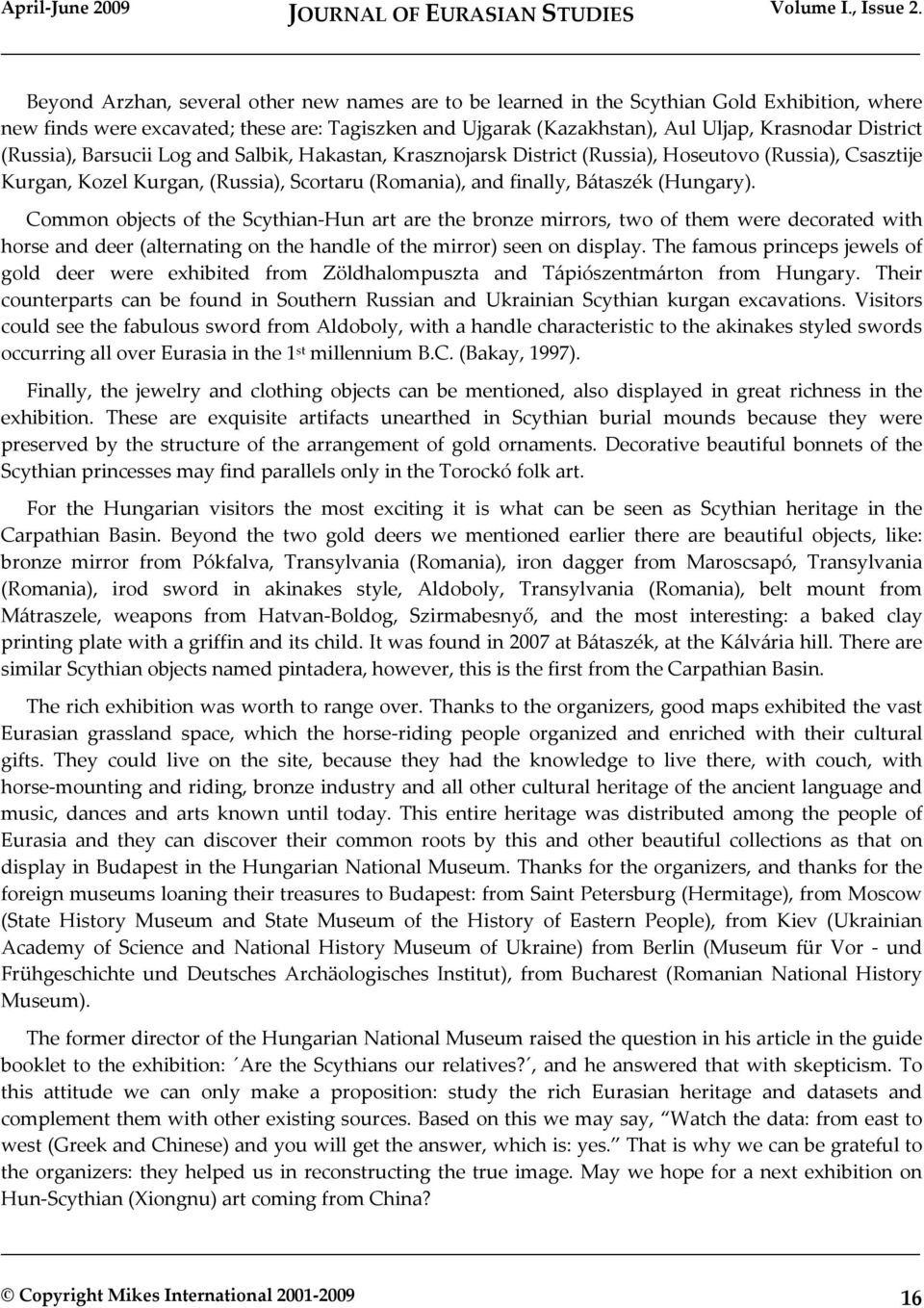
17 Fig. 6. Fishes and animal fights (from top to bottom): Majkop, Russia, Tatjania Mogila, Ukraine, Stancesti, Romania, Wettersfelde, Poland (5 th century B.C.). Copyright Mikes International
18 Bibliography: Artamonow, M., Forman, W. (1970): Goldschatz der Skythen in der Ermitage (Szkíta aranykincsek az Ermitázsban). Artia, Prága és Szovjetszkij Hudozsnyik, Leningrád, 1970; Bakay K. (1997, 1998): Őstörténetünk régészeti forrásai. I. II. Miskolc; Bárdi L. (1993): Őseink nyomában a Távol Keleten. Expedíció a Selyemút mentén. Pannonia K. Pécs; Benkő E. (1984): Székelykeresztúri kályhacsempék. Kriterion, Bukarest; Bérczi Sz. (1986): Escherian and Non Escherian Developments of New Frieze Types in Hanti and Old Hungarian Communal Art. in: M. C. Escher: Art and Science (szerk. H. S. M. Coxeter et al.) old. North Holland, Amsterdam (ISBN ); Bérczi Sz. (1987): Szimmetria és techné a magyar, avar és hanti díszítőművészetben. Leuveni Katolikus Egyetem, Collegium Hungaricum, (Katalógus a kiállításokhoz). 59 old. Leuven; Bérczi Sz. (2000): Katachi U Symmetry in the Ornamental Art of the Last Thousands Years of Eurasia. FORMA, 15/ Tokyo; Bérczi Sz. (2004): The Role of Curie Principle in Understanding Composite Plane Symmetry Patterns: New Ethnomathematic Relations in Ancient Eurasian Ornamental Arts from Archaeologic Finds of the Period 1. M. B. C. and 1. M. A. D. FORMA, 19/3. pp Tokyo; Bérczi Sz. (2005a): Adathorizontok Eurázsiában I. TKTE, Budapest; Bérczi Sz. (2005b): Szibériai művészetek. TKTE, Budapest; Brasinszkij, I. B. (1985): Szkíta kincsek nyomában. Helikon, Budapest; Chavannes, E. (1893): La Sculpture sur pierre en Chine au Temps de doux dinasties Haan. Leroux, Paris; Czeglédy K. (1969): Nomád népek vándorlása Napkelettől Napnyugatig. Körösi Csoma Kiskönyvtár 8. Akadémiai, Budapest; Csihák Gy. (2000): Dunhuang barlangképei és a Sánszi agyagkatonák néma üzenete a Magyar műveltség gyökereiről. ZMTE, Budapest Zürich; Csomor L. (1996): Őfelsége, a Magyar Szent Korona. Székesfehérvár, (ISBN ); Cosmo, N. Di (2002): Ancient China and its Enemies. Cambridge University Press, Cambridge; Diószegi V. (1998): Sámánok nyomában Szibéria földjén. Terebess Kiadó, Budapest; Ecsedy I. (1979): Nomádok és kereskedők Kína határain. Kőrösi Csoma Kiskönyvtár 16. Akadémiai, Budapest; Erdélyi I., Sugár L. (1982): Ázsiai lovas nomádok. Gondolat, Budapest; Érdy, M. (1994): An Overview of the Xiongnu Type Cauldron Finds of Eurasia in Three Media, with Historical Observations. International Symposium, Naples, Istituto Univ Orientale; 1992 Nov ; Érdy, M. (1991): A magyarság finnugor őshazája a történelem társtudományainak térképekre vitt adatainak tükrében. (In: Szatmári elegyes holmi, szerk. Áts J.) Mátészalka; Copyright Mikes International
19 Érdy M. (2001): A hun lovastemetkezések. Magyarországért, Édes Hazánkért Kiadó, Székesfehérvár; FitzGerald, P. (1989): Az ősi Kína. Helikon, Budapest; Fodor I., Kulcsár V. (2009): Szkíta aranykincsek. (Scythian Gold Treasures.) Exhibition Guide for the Hungarian National Museum, Budapest; Gamber O. von (1978): Waffe und Rüstunk Eurasiens. Klinkhardt und Biermann, Braunschweig; Götz L. (1995): Keleten kél a Nap. Püski, Budapest; Groot J. J. M. de (1921): Die Hunnen der vorchristlichen Zeit. Chinesische Urkunden zur Geschichte Asiens. Berlin, Leipzig (Hungarian edition: Bakay, Csornai (2007): László Gyula Történelmi Egyesület, Budapest); Hajdú P., Domokos P. (1978): Uráli nyelvrokonaink. Tankönyvkiadó, Budapest; Hajdú P. (szerk.) (1975): Uráli népek. Corvina, Budapest; Halász Z. (1966): Romvárosok a sivatagban. Stein Aurél belső ázsiai utazásai. Móra Ferenc K., Budapest; Hoppál M. (2005,): Sámánok Eurázsiában. Akadémiai Kiadó, Budapest; Jettmar K. von (1964): Die Frühen Steppenvölker. Baden Baden; Lao Ce: Tao Te King (Az út és Erény Könyve, ford. Weöres S., Tőkei F.) Helikon, Budapest; László Gy. (1974): A népvándorláskor művészete Magyarországon. Corvina, Budapest; László Gy. (1943): A koroncói lelet és a honfoglaló magyarok nyerge. Der Grabfund von Koroncó und der altungarische Sattel. Budapest; László Gy. (1942): Kolozsvári Márton és György Szent György szobrának lószerszámja. Kolozsvár; Lóczy L. (1890): Gróf Széchenyi Béla keletázsiai útjának tudományos eredménye. Budapest; Miniaev, S. (1995): The excavation of Xiongnu Sites in the Buryatia Republic. Orientations, 26, No. 10, Hongkong; Miniaev, S. (1995): New finds of Xiongnu decorative bronzes and a problem of origin of geometrical style in Xiongnu art. Archaeological News, 4. Sankt Petersburg; Miniaev, S. (1996): Xiongnu archaeology in Russia new finds and some problems. Arts Asiatiques, 51, Paris; Miniaev, S. (1981): About definition of Xiongnu sites of Siberia. Proceedings of the Methodical aspects of archaeological researches in Western Siberia conference. Tomsk; Obrusánszky B. (2006): A magyar társadalomszerkezet keleti gyökerei. (The Eastern Roots of the Structure of the Hungarian Society). Turán, IX. évf. 3. sz ; Obrusánszky B. (2008): Hunok a Selyemúton. Masszi Kiadó, Budapest; Okladnyikov A. P., Martinov A. I. (1983): Szibériai sziklarajzok. Gondolat, Budapest; Rolle R. (1980): Die Welt der Skythen. Bucher, Luzern und Frankfurt; Copyright Mikes International
20 Rugyenko Sz. I. (1953): Kultura naszelényija gornava Altaja v szkifszkoje vrémja. Akademija Nauk Sz. Sz. Sz. R. Moszkva i Leningrad; Szász B. (1943): A hunok története. Atilla Nagykirály. (The History of the Huns. Atilla, the Great King.) Bartha Miklós Társaság, Budapest (Szabad Tér K. 1994); Sze ma Csʹien: Történeti feljegyzések.; Talbot Rice, T. (1965): Ancient Arts of Central Asia, Thames and Hudson, New York; Tolsztov Sz. P. (1950): Az ősi Chorezm. Hungária, Budapest. The drawings of this report were created by the author. Ed. Journal of Eurasian Studies Copyright Mikes International
21 OBRUSÁNSZKY, Borbála Statue to Gábor Bálint de Szentkatolna Thanks to the Bálint Gábor Association, which operates in the land of the Szeklers in Transylvania, Gábor Bálint de Szentkatolna, the great explorer and oriental scholar got a bronze statue, which will be erected in the yard of the elementary school in Szentkatolna, the village where Gábor Bálint was borne. The commencement will happen on June 13, 2009 with the participation of the whole cultural community in Szentkatolna. The sculptor, András Vetró knows well Bálint s portrait; previously he made two plaques, too. One can be seen in the Hungarian Language Department of the Babeş Bolyai University in Kolozsvár/Cluj/Clausenburg, where Bálint had worked for a long time as Head of the Ural Altaic Department. The other plaque stands in Bálint s former hometown of Szentkatolna. Inhabitants of Szentkatolna never forgot his famous son. Pál Bakk, a local historian has collected stories and memories about the great scholar during the 1960s and published that in Hungarian journals. After the Romanian revolution, around 1991, the director of the elementary school of that time, Jolán Jakab succeeded in arranging that the school adopted Gábor Bálint s name. Shortly afterwards, at the centenary of Gábor Bálint s birth, the above mentioned Bálint Gábor Association organized the first international Bálint Gábor Conference in Szentkatolna, and collected papers printed in the frame of the Transylvanian Museum Association. Elementary school in Szentatolna. Bust of Gábor Bálint. Copyright Mikes International
22 Commemoration plaque of Gábor Bálint. Copyright Mikes International
23 HISTORY Copyright Mikes International
24 OBRUSÁNSZKY, Borbála Late Huns in Caucasus New Results in Hunnish Research During the past decade it had been accepted by the most historians and professional orientalists that the first state in the steppe region was the Hunnish Empire. 1 Moreover, they recognized the statement of the Shi Ji chronicle that the Huns had a united state around 3 rd century B.C. 2 There are some disputes among scholars from all over the world on some issues, namely when and under which name Huns had appeared in the Chinese chronicles, and when their first state was established. 3 Hereby I only show some craggy opinions. According to Deguignes, the Huns had appeared in the Chinese sources around 1200 B.C., and they lived in Northern and Central China. Gumilyov maintains that the ancestors of Huns appeared only in the 7 th century B.C. Mansag states that the Hun society and the state itself had been created during a long period, between B.C. 4 By virtue of early sources, Chinese historians state 5 that their first dynasty, Xia, was established by Huns; they recorded them as pre or early Huns. 6 The researchers mostly agree with the date of the disruption of the Great Hunnish empire, during the 1 st century A.D. If we take a look at how long small Hunnish states survived in Inner and Central Asia, from Northern China to Caucasus or around the Crimean peninsula, via India, we can see that until the 7 th century A.D., some Hun kingdoms remained in operating throughout the vast steppe region. The history of Late Huns in the Carpathian Basin is also an important and not fully solved question. So is the history of the Huns on the territory of present day Mongolia. Batsaikhan has proved that Huns have not disappeared at the end of 1 st century A.D. there, as previously historians thought, but they had an independent state until the Ruanruan invasion, which took place in The new Mongolian archaeological results contradict the old theory that Xianbei tribes would have ruled over Mongolia. Archaeologists have not found Xianbei graves or settlements at all in Mongolia, but the Chinese found huge amount of Xianbei relics in Inner Mongolia. It is very likely, that the Xianbei ruled that region. The newest results of Chinese scholars proved, that the Southern Huns, who joined the Han dynasty, have 1 Obrusánszky, Shi Ji. 110, Barfield s theory. In: Barfield, Lots of theories existed about the origin of the Huns. Chinese scholars think that the Xia dynasty, as most Chinese dynasties, belonged to Huns. On these theories: Obrusánszky, b. 4 Mansag, From Shi Ji 110: Xiongnu (Huns). Their ancestor was descendant of Xia dynasty, namely Chun wei. DeGroot, In Suo yin commentary we can read: The Emperor of the Xia dynasty, Jie had no tao, that s why Tang exiled Him to Mingtiao. In the next three years He died. His son, Xun yun married wives and escaped northward and settled there, where wandered with herds. DeGroot, By Jin shu (5 th century AD) Hun Helian Bobo was descendant of Xia dynasty. Jin shu In: Wen Wu, The Mongol archaeologist proved his theory by using archaeological sources and historical sources. Batsaihan, Copyright Mikes International
25 not disappeared suddenly; moreover they lived in tribe alliance system until the 8 th century around the big bend of the Yellow River. Chinese sources of that time 8 proved, that the Southern Huns, under the leadership of Helian Bobo, the great Hunnish Emperor of the Da Xia kingdom, flourished in the Ordos region, at the same time, when Attila spread his authority to Eastern and Western Europe. 9 In the past most historians and professional orientalists did not consider the relics of Central Asia and India, despite the fact that with the help of the local historical sources, and numismatic finds the history of Huns can be traced and dated very precisely. Therefore, it is clear that the Huns had states around the Lake Aral, Khorasan and Kashmir until the 7 th century. 10 This means, that the Huns interconnected the vast Eurasian steppe from the Ordos to the Carpathian Basin from ancient times to the medieval period, and some states survived even the Turkic invasion, which took place in the middle of the 6 th century. Concerning the Huns, I am interested in how long they had survived in the forefront of Caucasus after Attila s death. In order to investigate the question, I investigate contemporary historical sources mostly Armenian and Byzantine ones. Huns in Caucasus Sometimes we learn from the literature, that after Attila s death, the Huns had been defeated by the Goths and their allies, and the former Hun territory the Carpathian Basin became Goth and Gepid land, and the Huns suddenly disappeared from there. According to the ancient Hungarian tradition, Attila s sons were defeated by enemies and that is the reason why his two sons returned to their ancestors land: Dengizik, settled down in Little Scythia, or present day Dobruja, his younger brother, or Attila s third son, Hernac (Irnek, or Hungarian Chaba) settled down in another Little Scythia, which means present day Dagestan. 11 It is known from historical sources that Hun inhabitants remained in the Carpathian Basin, and some of them lived under the authority of other peoples. 12 Recently, Russian and Romanian archaeologists analyzed the traces of the Huns in the eastern part of the former Hungarian Kingdom. The Romanians accept the ancient Hungarian Székely historical tradition, i.e. the Székelys are the direct descendants of the Huns, who remained in the eastern part of the Carpathian Mountains. 13 Not only archaeologists found data supporting the Hun Hungarian relationship, but historians, too. Authorized Merovingsources recorded that Hungarians (Hungari) lived in Pannonia in the year of 561/562, which proved two 8 Data of Jin shu, Bei shu, Wei shu, etc. 9 Today Xi an. Helian Bobo sent His son to Chang an to become governor, he stayed in Tongwancheng. 10 Nezak Hun Kingdom existed until Strabon recorded that there were two types of Scythians: their original land can be located in present-day Dagestan, but when they moved to the lower-danube region, they called that place as Little-Scythia, too. Thus, the Scythians brought geographic names to foreign places. Strabon VII. III. 5. Attila s third son has various names in historical sources. In Priscos fragment we find Hernac, but the Hungarian chronicles know him as Chaba, which refers to his title choban. Hernac must be his historical name. 12 Christian, According to the author, as well as to other scholars, Attila s sons returned to the Ponti-steppe, Dengizik settled down in Little-Scythia or Dobruja and most of the Hun tribes lived in the region surrounding the Black Sea. 13 Sergei Botalov, a Russian archaeologist began to research Hun relics in the Carpathian Basin. Romanian scholars presented papers at the International Hun conference, which was held in Speyer. Copyright Mikes International
26 things: first of all, Huns lived in their former center, secondly, Hungarians, who are the descendants of Huns, lived there 300 years earlier, than Hungarian historians had thought. 14 We have other substantial data to the history of that region. Wolfram has written a monograph on the history of the Goths, in which he recorded that the Goths became Scythians, or learned the Scythian way of life and customs, during their stay on the Eastern European steppes, and when they settled down in the Carpathian Basin or even more westward, they followed the Hun fashion, even after Attila s death. The Austrian scholar paid attention to the fact that the Gepids did not rule the whole Carpathian Basin from the second half of the 5 th century, and in the 6 th century they controlled only present day Voyvodina. 15 The Huns left traces on their former center the Carpathian Basin for at least one century; their material culture clearly can be shown in some findings, which are regarded as Gepid treasures. 16 It is likely that independent Hun tribes and tribal alliances remained in the Carpathian Basin, as Eastern and Western sources mention them. 17 Other important theme to be researched is the land, where Hernak or the Hungarian Chaba returned to. That is the northern part of the Caucasus Mountain. For some historians the great migration in 463 which brought entirely new inhabitants to that region is a hinge when dealing with the Hun s late history. They count that date as the moment in time when Huns disappeared from the historical sources and they link to this the appearance on the scene of the Turkic speaking tribes, the Ogurs. Let us investigate, whether new tribes or peoples indeed had arrived there from Central Asia. Huns and Ogurs In the literature dissimilar opinions can be read concerning the late history of the Huns and Ogurs. Most scholars agree that the Huns played a significant role until the 7 th century in the Caucasus region, right there, from where the Hungarian chronicles originated the Huns and Hungarians. Fortunately, we have many written sources from that period and places, which make easier our research. If Hun Kingdoms controlled the vast territories of Central Asia and some parts of Eastern Europe, how was it possible for new tribes namely Ogurs to arrive into that region? If they did venture into a big migration and won a victory over the Huns, especially the strong Hephtalite Kingdom, why the written sources of that time had not recorded that? Even more, who were the Ogurs and where did they come from? If we want to answer these questions very shortly, we have to look only at the Byzantine sources about Ogurs. They say that the Ogurs belonged to the Huns, but the Persians later identified them with the Turks, as Hunnish people. 18 Most probably, the Persian sources and Priscos s fragment disordered 14 Király, In 568 Bayan Avarian khagan battled at Sirmium with Gepid powers, which means that the Gepids were not able to stop the Avars in Transylvania or Low Danube. Wolfram, The Gepids had lived only on a part of the Carpathian Basin; they were concentrated in a region, which is present-day Voyvodina, Tiszántúl (Beyond Tisa River) and Mezőség; Gepidian graves can be found there. They had no independent Gepidian culture, but the Hun arts and fashion survived among them. But it is sure that they had left no artistic or linguistic traces behind in the Carpathian Basin. 17 Sources recorded that the Sarmatians had a kingdom on Alföld (Hungarian Great Plain), and they also mention Hun chieftains, who allied with Eastern Goths against the Gepids. Wolfram, Examples in Shahname (Firdausi) Aradi, Copyright Mikes International
27 the scholars the following way. Priscos described that around 463 new peoples Saragurs, Ogurs, and Onogurs appeared in Byzantine and stated that they migrated from their homeland, because they battled with the Sabirs, who were chased by Avars. 19 Historians thought that this was an element of a new big migration, and related those events to the appearance of the Turkic speaking Ogurs in the Northern Caucasus. Scholars from the 19 th century created an Eastern connection for the Ogur tribes and identified them with the Tie le tribes, which lived in present day Mongolia and around the Lake Baikal in early Middle Ages. According to the explanation, Ogurs lived on the Kazakh steppe in 350 and from there departed westward after First of all, we must investigate, whether the Ogurs equal to the Tie le people. In the literature it is taken for granted that these two peoples are the same, despite historian sources of that time contradict this theory. Let us investigate the origin of the Turks. According to the Chinese sources, the ancestors of the Turks were the Dingling, who lived around the Lake Baikal and they belonged to the Donghu alliance. It is likely that they were a tribe of the later Xianbei people. 21 The above mentioned Tie le alliance system appeared in written sources only in the 5 th century, when they lived around the Lake Baikal. One significant group moved southward, and they got a new name as Gao che, or people of high couch. Presumably, there were tight connections between the Dingling and the Tie le, because they lived in one place, but we do not know, whether they belonged to the same ethnic group. Now, let us take a look at the Tie le question, and investigate some sources about them. The Wei shu recorded that they were Huns on his mother side. They spoke the Hun language, but they had a small accent. 22 Tang shu wrote that the Tie le consisted of 15 tribe alliance, and contained the ancestors of Turks and Uyghurs. 23 It is sure, that the Tie le and the Gao che people lived until the 5 th century A.D. in Eastern Inner Asia, they did not equal to the Ogurs in the Caucasus region. The Chinese sources wrote about the history of the Turks very thoroughly. They lived in present day Gansu province and their royal house, Ashina was of Hun origin, which belonged to the Northern Liang dynasty, which controlled one significant sector of the Silk Road. 24 That dynasty itself was of Hun origin, but they were not member of the royal clans of the Huns, so their kings wore only the title wang 25 instead of danhu or shanyu. Sui shu wrote that the ancestors of the Turks were mixed Huns, and the Ashina clan was a Hunnish tribe. 26 Regarding the Gao che, Wei shu writes that their ancestor was Hong (Red) Di and Dingling; their languages was very similar to the Huns, but there are some differences, because they were the grandchildren of Huns on the daughter lineage. 27 The Northern Liang dynasty had been beaten by Ruanruan and escaped to the Altai Mountain and after one century, or around 550 they attacked the 19 Győrffy, Czeglédy, Erdemtü, Erdemtü, Author refers to Shiratori. 23 Erdemtü, Hexi corridor or Canyon of Yellow River in present day Gansu province. 25 The title wang (king) originally was a Hunnic one; it is an unknown title in ancient Chinese history. It has relation with Persian ban or Hungarian bán. Obrusánszky, Sui shu, 84. In: Erdemtü, Erdemtü, Copyright Mikes International
28 Ruanruans and got the authority over the steppes. As we see, the Turks just moved from the Altai to the Mongolian steppe in the middle of the 6 th century, they did not appear near the Caucasus. Regarding the so called Ogur migration, besides Priscos, other relevant sources had not written of new people, even we can not find new archaeological culture around Pontus, which contradicts the migration theory. The fragments of Priscos text is not an original record, it remained in copy from the Suda lexicon of the 10 th century, under the name Abaris. 28 The copy makers inserted there the old date, but we do not know, whether they altered it, because the Avars appeared only around 558 in Northern Caucasus, not in 463. Some historians paid attention to this mistake, but they tried to explain it by saying that Priscos date referred to the event of This theory is also false, because during that period the Huns occupied the vast territories of Central Asia from the 2 nd century A.D. 30 under the name Kidarita or Hionita. Hindi and Persian sources recorded that around 350 the Huns spread their control over Bactria and Tokharistan. 31 If new people did not arrive, then only one solution remained the Ogurs, Saragurs, Ugors, etc had lived there before. This theory is supported by Jafarov and Haussig. 32 If we do not know of new people in Northern Caucasus after 453, Ogurs could only be people belonging to the Hun alliance, who after Attila s death in 453, although appeared under independent tribe names as Ogurs, or Saragurs, Sabirs, etc, used the united name of Hun, too. 33 As some scholars thought before, the steppe society tribes used at least two names for themselves. First of all they had an own tribe name, as Ogur, and if they belonged to a big alliance, they used that, too. Some authors realized that in the history of Scythians. As Gábor Bálint said, Mendander s Ugur and Priscos Urog (Urug) were equal to the Hunuguri people. 34 It is clear that the Ogurs were not Empire creators, names refer their function: they were tribes or clans, as Győrffy previously pointed out. 35 Dobrev also stated that Ogurs were not independent tribe alliance, as historians thought, that is why he does not accept the solution for Onogur as ten ogurs 36 He thinks that Hungar, which meant only Hungarians, had the root of Hung. 37 Thúry stated that Ogur meant Huns and unugroi, onoguroi, etc. names meant»belong to Huns.«38 Huns had Hung or Honk form in the historian sources of that time. We can read in the Dasxuranci s chronicle, that the ancestor of the Onogurs was Honagurs, who belonged to the Huns, which shows that the tribe name previously could have been a personal name. We find other examples of that custom, for example in Herodotus work. The Greek historian recorded that Scythians got their name after their first king, Skolotos. 39 As did Byzantine sources, when described, that Avar were Ugni or Huns, but after their 28 Győrffy, Czeglédi, Tolstov, Tolstov, Jafarov, Dzsafarov, He refered to Haussig. Christian, also states that Ogurs arrived with Huns to Caucasus. 34 Bálint, Győrffy, Dobrev, Dobrev, Thúry, Hérodotosz, IV. 71. Copyright Mikes International
29 leader they were called Avar. 40 The same situation had happened to Khazars, whose leader s name was Khazarig. Finally we must clarify one more question, the name and meaning of so called Ugors. This kind of name did not exist in historical sources; it originated only in the 19 th century, when linguists created this scientific expression 41 in order to create a fictive Uralic phylum, and one branch became the Ugors, or Hanti Mansi and Hungarian sub divisions. As a matter of fact, the Ugors or the original form Ogur only meant Hungarians in Eastern sources. 42 We can not say Ugric tribes at all, because the peoples living in the woods of Siberia were not able to establish political organizations, they remained in systems of clans or families, because their way of life prohibited the development of higher political and social organizations. 43 Historical processes By virtue of the above mentioned dates and sources we can see that contemporary historian sources did not mention any new migration from the East in the middle of the 5 th century. Now let us have a look at the historical processes of the Eurasian region. There were some events in the steppe of Central Asia in the end of Antiquity. We know that the people of Yue chi (Scythians) pressed by the Huns moved to Central Asia in the 2 nd century B.C., where they created a powerful state. After that event, in the 3 rd century A.D. some significant political realignment had happened; firstly, the Parthian Empire collapsed and the Sassanid took command over the Middle East and Central Asia. At the same time, the Kushan Empire also declined, which affected vast territories around Northern India and Gandhara. 44 The next big changes had happened in the middle of the 4 th century, when the Huns occupied vast territories of Central Asia, and settled down around the Lake Aral. They were called as Hion or Kidarita, where the last one would refer to the royal clan. But we have no information about migration around 450. Only the White Huns, under the leadership of Heftal invaded the Indus Valley and created an Empire, using the old Kushan tradition. Regarding the historical dates, it is impossible that new people appeared in the northern part of the Caucasus, but as Haussig and Jafarov referred to that, only one explanation remained, tribes under own clan or tribe names became independent from the Huns, and they used those ones in diplomatic matters. By the way, in the history of the Caucasus two significant events were recorded. One is the revolt of the Albanian people in 463, when new a Hunnish tribe, the Sabirs emerged. 45 The second is the migration of the Huns to the Crimean peninsula, where the Scythians and related people 46 had lived. Some Russian and Ukrainian historians showed that cave 40 Isiodorus Hispalensis, Etymologiae sive origenes, IX Of the Obi ugors it is important to note that the expression Ugor commanly denominating the three languges namely the Hungarian, Vogul and Ostyak does not relate to the external denomination of Hungarians either; it is a fictive, scientific artificial term, that denotes one branch of the Uralic language tree. In: 42 Király, Vlagyimircov, Tolstov, Jafarov, Sarmatians and Alans. Goths also lived there, who learned and applied the Scythian customs and way of life. Copyright Mikes International
30 dwellings surrounded Bakhchisaray came into existence because of the Hun attacks. 47 Their populations remained there for centuries. Some people survived until the Mongolian invasion in the 13 th century. In the course of the 5 th century not only the great Hun Empire brake up, soon after Attila s death, or in 476, the Western Roman Empire officially collapsed, and on its territories small Gothic, Alan, etc. Kingdoms were established. The Eastern Roman Empire, or Byzantine Empire existed, but it was weakened. We can say that that century was the end of the great united powers. Only in the course of the 6 th century some powers wanted to unite the former Roman Empire again, under the leadership I. Justinian ( ) Byzantine Emperor and Theodoric, the Eastern Gothic King in Italy. The preceding was successful and recovered control the former Roman territories, even spread authority over some of the steppe belt Western Caucasus and Crimea. Justinian used allied Huns against the Persians. Despite the European transformations, in the Central Asian regions big Empires Persian and White Huns survived, and fought with each other for the control over the commercial routes. When the Turks appeared in the middle of the 6 th century, they replaced the Huns, but there was a big metamorphosis because of the same origin of civilization (bow bended people). Metamorphosis happened also after the Arab invasion, when new cultural and religious tradition appeared in the steppe, and the invaders did not belong to the bow bended people, so they counted as foreign elements among the late Huns and Turks. Huns and Hungarians It is known from various kinds of sources that the Huns appeared in Eastern Europe in the 2 nd century A.D. 48 Firstly, they settled down at the Caspian Sea, then gradually moved westward, and reached the mountains of the Caucasus. Their royal center was located at the Meotis swamps, which was the court of the Royal Scythians and Scythiced Goths before. The Huns first occupied the royal center, but when they occupied Western European lands, they had to choose another royal center in order to organize the whole big empire from Eastern Europe to the River Rhone. The new center was established in the Carpathian Basin. When Attila died in 453, his youngest son returned to that old land, as I mentioned earlier. Irnek or Chaba, is the ancestor of Hungarians. Their tribes kept this place in memory. According to some old theories, Hungarians had connection to Onogurs, but they did not belong to the Huns. 49 If we investigate the old sources, as I showed above, we could see that the Hun and the Onogurs (or Hunuguri) joined forces. Bolgars, who also originated from the Huns, accepted that they got Hunnish heritage. 50 Besides the ancient Hungarian tradition, the tight connection between Huns and Hungarians were proved by Byzantine sources, too. Theophanes recorded that in the city of Kerch there was a Hun Kingdom, where two brothers lived. Ogurda was the king and his brother name was Muageris The Goths for instance lived until the 15 th century in the Mangup kale Castle. 48 Anke, Obrusánszky, Győrffy, Dobrev, In Theophanes and Malalas chronicles. In: Moravcsik, Copyright Mikes International
31 Scholars showed that that was the first record of the present day name of Magyars (Hungarians). So did Derbentname a Persian source, too, who recorded that on the territory of present day Dagestan, there were two big Magyar cities (Ulu Majar and Kichi Majar). 52 A Byzantine source also recorded that Hungarians had another name in the past; they were called as Savartoi Asphalu, which meant Sabir. As we know Sabirs belonged to Huns and ruled big territories above the city of Derbent, present day Dagestan. Thúry stated in the end of the 19 th century that Hungarians appeared in the local sources as Ungur, Kuda magar. 53 Hence, the above mentioned sources had drawn the old territory of Hungarians, from present day Dagestan to the Meotis swamp. Hungarian historians, Turkologists debated that Hungarians had an independent state before the 9 th century, and that was a powerful state around the Caucasus. The sources of that time contradicted that, because of early appearance of the name Hungarians as Majar or any variants from the 6 th century. The name refers to that being a leading tribe among them, who were direct descendants of Attila. As regard the steppe tradition, they had the privilege to elect the king. 54 Due to lack of sources we can not know for sure, when the Magyar tribes established for the first time an independent state under name of Majar. As Constantine VII stated, Hungarians were divided among voivodas, and the first voivoda was Levedi. 55 As the Emperor said, that ruling system existed before the invasion of Bechenegs. As we know, after the first so called Pecheneg attack, Savartoi Asphalu separated from other Hungarians, and settled down in the territory of Persia, in present day Azerbaijan. The author also said, after the Pecheneg attack, Khazars occupied the land of Hungarians. 56 Probably, the location of this event was Dagestan, which was the center of the Sabirs, Huns and other Hunnish people. 57 Regarding the Khazars, we know that their first capital was Samandar, in present day Dagestan, right there, where Sabirs and Hungarians previously lived. If the Khazars occupied that land from Hungarians, where they previously lived, as the Derbentname and above mentioned sources proved. The so called Pecheneg attack occurred not in the 9 th century but in the 6 7 th centuries, when Arab troops strongly attacked that region. 58 They tried to invade Eastern Europe through the Caucasus, the first war happened around 650, when they ruined the Sassanid Empire and the Middle Eastern territory, the second one happened after 711, when they occupied vast lands of Central Asia. Only the Khazars stopped them in bloody battles. As Botalov pointed out, in the Eastern European area big change happened in the 8 th century. 59 So, probably, most Hungarians departed from present day Dagestan and Meotis swamp, or legendary Levedia, and gradually reached the Carpathian Basin, the former Hunnish center. As Western sources proved, before 52 Helilov Nyitray, Kmoskó, Chinese sources and steppe tradition preserved well the coronation system of the Huns and their descendants. The tribes must elect their first man from the Royal clan. 55 DAI. 38. In: Pauler Szilágyi, DAI Moravcsik, Helilov Nyitrai, Sergei Botalov s presentation. 18 August Hungarians and the East II. Conference (Magyarság és Kelet II. Konferencia), Budapest. Copyright Mikes International
32 the Avar settlements, sparsed Hungarians also lived under the name Ungarus, Ungari, 60 and they settled there with Huns. Previously, Géza Nagy and István Zichy thought that Hungarians were there at the time of the Avars. The so called double homeland conquest or relative connections between the Hungarians and the Avars were published by Gyula László. Summary In my brief article I just referred to such kinds of questions, which can be of importance when dealing with the history of Late Huns in Eastern Europe. According to the huge sources (archaeological, historical, historical ethnography, etc.) we must reexamine and revalidate the history of Late Huns in Europe and the Caucasus region. We must investigate the history of Ogurs again, because they had not been Turkic people but they belonged to the Huns. Further, linguistics must think over theories, and due to the historical facts, we must speak of a Late Hun language instead of Bulgarian Turkic one. Moreover, we must acknowledge that the Late Hunnish states determined the history of Eastern Europe in the Early Middle Ages and influenced the way of live of those who lived around these territories. Bibliography ANKE, Bodo Frühgeschichte reiternomadische Völker in Mittelasien aus historischer Sicht. In: Hunnen zwischen Asien und Europa. Aktuelle Forschungen zur Archaologie und Kultur der Hunnen. Herausgegeben vom Historischen Museum der Pfalz Speyer. Beier&Beran, Archaologische Fachliteratur, Langenweissbach ARADI, Éva A hunok Indiában. Hun Idea, Budapest Egy szkíta nép: a kusánok. Hun Idea, Budapest BARFIELD, T. J The Hsiung nu imperial confederacy: organisation and foreign policy. In: JAS BATSAIHAN, Zagd A hun népek története. Fordította: Obrusánszky Borbála. Farkas Lőrinc Imre, Budapest 60 Király, gathered in 2006 the Western sources regarding Hungarians, which mention them (Hungari) continuously since 561 in the Carpathian Basin. Copyright Mikes International
33 BELLUS, Ibolya (ford.) Képes Krónika. Európa Könyvkiadó, Budapest BOODBERG, Peter Selected paper of Peter A. Boodberg. University of California Press, Berkeley and Los Angeles. BURNHAM, Philip Spatial Mobility and Political Centralization in Pastoral Societies. In: Pastoral Production and society. L Equipe écologie et anthropologie des societies pastorals. Cambridge University Press, New York Cambridge CHRISTIAN, David A History of Russia, Central Asia and Mongolia. Vol. I. Inner Eurasia from Prehistory to the Mongol empire. Blackwell, Massachusetts CIUPERCA, Bogdan MAGUREANU, Andrei Huns and other peoples archaeological evidence in present day Romania. In: Hunnen zwischen Asien und Europa. Aktuelle Forschungen zur Archaologie und Kultur der Hunnen. Herausgegeben vom Historischen Museum der Pfalz Speyer. Beier&Beran, Archaologische Fachliteratur, Langenweissbach CSORNAI, Katalin Négy égtájon barbár csillag ragyog. Az ázsiai hunok a kínai forrásokban. László Gyula Egyesület, Budapest DeGROOT J. J. M Hunok és kínaiak. A hunok története a Kr. sz. előtti évszázadokban kínai források alapján. Közzéteszi: Bakay Kornél Csornai Katalin. Raspenna, Budapest. DOBREV, Ivan Zlatnoto Szirovise na Bilgarstkite Hanove ot Atila do Szimeon. Riva, Szofia JAFAROV, Yusuf Gunni v Azerbajdzsane. Elm, Baku. ERDÉLYI, István Régészeti kutatóúton a Góbi sivatagban. In: Keletkutatás. ősz Archaeological expeditions in Mongolia. Mundus Press, Budapest Scythia Hungarica. A honfoglalás előtti magyarság régészeti emlékei. Mundus Kiadó, Budapest ERDEMTÜ (főszerk.) Donghucsuudin tuuh ba szojol. Belső Mongol Kulturális Kiadó, Höhhot. Copyright Mikes International
34 GOLDEN, PETER B The peoples of the South Russian steppes. In: SINOR, Denis (ed) The Cambridge History of Early Inner Asia. Cambridge Universtiy Press, London GHIRSHMAN, Roman Az ókori Irán. Médek, perzsák, pártusok. Gondolat, Budapest. FÖLDY, József (ford.) 1977 Strabon: Geógraphica. Gondolat, Budapest. GROUSSET, René The Empire of the Steppes. A History of Central Asia. Translated from the French by Naomi Walford. Rutgers University Press, New Jersey. GYÖRFFY, György (szerk.) A magyarok elődeiről és a honfoglalásáról. Gondolat, Budapest Krónikáink és magyar őstörténet. Régi kérdések új válaszok. Balassi, Budapest. HELILOV, Mübariz NYITRAI, Szabolcs Ősmagyarok Azerbajdzsánban. Hun Idea, Budapest. JAGUB, Mahmudov Az azerbajdzsánok és a magyarok: közös visszatekintés az etnogenetikai kapcsolatok történetére. In: Magyarország és Azerbajdzsán: A kultúrák párbeszéde. II. Nemzetközi Tudományos konferencia. Azerbajdzsáni Nagykövetség, Budapest KHAZANOV, A. M Nomads and the outside world. Translated by Julia Crookenden. Cambridge Universty Press. Cambridge. KIRÁLY, Péter A honalapítás vitás eseményei. Nyíregyházi Főiskola Ukrán és Ruszin Tanszéke, Nyíregyháza. KMOSKÓ, Mihály Szír írók a steppe népeiről. Szerkesztette: Felföldi Szabolcs. Balassi Kiadó, Budapest KOCH, Alexander Boma ein reiternomadisch hunnisher Fundkomplex in Nordwest China. In: Hunnen zwischen Asien und Europa. Aktuelle Forschungen zur Archaologie und Kultur der Hunnen. Herausgegeben vom Historischen Museum der Pfalz Speyer. Beier&Beran, Archaologische Fachliteratur, Langenweissbach Copyright Mikes International
35 MA, Li Qin Yuan xiong nu, xiong nu. Nei Meng guo Da Xue, Huhehaote. MAENCHEN HELFEN, Otto The world of Huns. University of California Press, Berkeley, Los Angeles and London. MANSAG, Ertniy mongolchuudin övög. Mongol Ardin Hevlelt. Hohhot. MORAVCSIK, Gyula Muagerisz király. In: Magyar Nyelv XXIII Byzantinoturcica I II. die Byzantinischen quellen der Geschichte Der Türkvölker. Pázmány Péter Tudományegyetemi Görög Filozófiai Intézet, Budapest Az Árpád kori magyar történet bizánci forrásai. Akadémiai Kiadó, Budapest. MURAKÖZI Gyula (ford.) 2002 Hérodotosz: Görög perzsa háborúk. Budapest, Osiris Kiadó NÉMETH, Gyula Attila és hunjai. Budapest, Akadémiai Kiadó. 2. kiadás OBRUSÁNSZKY, Borbála Four Assumable Hunnic Chinese Names of Dignitaries in the Hungarian and Slavic Medieval Tradition in Central Europe. In: Eurasian Studies Yearbook Hunok a Selyemúton. Masszi, Budapest. PAULER, Gyula SZILÁGYI, Sándor A magyar honfoglalás kútfői. Magyar Tudományos akadémia, Budapest PETRIK, István Rejtélyek országa. Napkút, Budapest. PRITSAK, Omeljan Kultur und Schprache der Hunnen. In: Festschrift Dmytro Chyzhewskiy zum 60. Geburstag. Berlin, Harrasowitz, PRUSEK, Jaroslav Chinese Stateless and the Northern Barbarian in the period BC. Dordrecht, Reidel. SINOR, Denis (ed) 1994 The Cambridge History of Early Inner Asia. Cambridge Universtiy Press, London Copyright Mikes International
36 SZENTKATOLNAI, Bálint Gábor A honfoglalás revíziója. Gombos Ferencz Könyvnyomdája, Kolozsvár. THURY, József A magyarok eredete, őshazája és vándorlása. Athenaeum, Budapest. TOLSTOV, SZ. P Drevnije Horezm. Moszkva. Nauk. VÁSÁRY, István A régi Belső Ázsia története. Szeged. VLAGYIMIRCOV, B. J Obshestvenniy stroy mongolov. Nauka, Leningrád. VONDROVEC, Klaus Numismatic Evidence of the Alchon Huns reconsidered. Hunnen zwischen Asien und Europa. Aktuelle Forschungen zur Archaologie und Kultur der Hunnen. Herausgegeben vom Historischen Museum der Pfalz Speyer. Beier&Beran, Archaologische Fachliteratur, Langenweissbach WATSON, Burton Records of the Grand historian of China. Translated from the Shih chi of Ssu ma Chien. New York London, I II. YAMADA, Nobuo The formation of the Hsiung nu nomadic state. The case of Hsiung nu. In: Historical studies of nomadic peoples in North Asia. Tokyo University Press, Tokyo WITTFOGEL, K FENG, Ch 1946 Liao shi. History of Liao dynasty. Philadelphia. WOLFRAM, Herwig History of the Goths. Translated by Thomas J. Dunlap. University of California Press. Berkeley Los Angeles London. WU, Mu Zhu Xiong nu shi yan ju. Key Research Institute in University. Lanzhou University, Lanzhou Copyright Mikes International
37 ZOMBORI, Andor Heavenly White Castle of Japan In this writing I would like to give a brief overview on place names having the meaning of white castle in Japan. This subject has aroused my attention after hearing about Borbála Obrusánszky s research in relation to Tongwancheng, the Hunnish White Castle and I was curious whether there are any localities in Japan named white castle. In recent years, several books and articles have been published in Hungary about the interpretation of the white castle place names in the Carpathian Basin and other places in Eurasia. While there are some who trace the meaning of these place names merely to the white color of the castle walls, there are others who emphasize the sacred significance of the white color in these names. The Castle Guide of Japan s Council of National Castle Superintendents informs in its introductory that generally speaking approximately 25,000 castles have been built in Japan since the country s existence. This includes all structures starting from defense fortifications and moats built in ancient times through noble castles, fortresses, and temple towns surrounded by moats in the middle ages to citadels built until the end of the 19 th century. However, strictly speaking, the word castle refers to those castles which were built mostly at the end of the 16 th century and the beginning of the 17 th century and served the country s military unification and consolidation. These castles are numbered around 3,000. Traditionally Japanese castles are built from stone and wood. Basically, the wooden structure is built on a massive stone mound, and the walls are covered with plaster to improve their fireproof property. The plaster gives the characteristic white color of Japanese castles 1. I would like to say a few words about the significance of the white color in Japan s two main religions, Buddhism which reached Japan from China through Korea, and Shinto, Japan s native religion. Most of the population follows the traditions of both religions. In Japanese Buddhism, the white color symbolizes the pure heart which cleanses from evil deeds and from the pain of desires and passions. In Shinto, the white color symbolizes cleansing and is used for the marking of consecrated objects and places. For instance, the 祓 串 (haraigushi) or purification wand, is a wooden stick with white paper steamers and hemp strands attached to one of its ends. With this wand, the Shinto priest symbolically purifies shrine goers and objects. Another tool is 注 連 縄 (shimenawa) or border marker rope, which is a straw rope decorated with white zigzagged sheets of paper. The shimenawa is used to mark holy places, structures or even trees and stones 2. White is also one of the colors of the 五 色 旗 (goshikibata) or five color flags or five colored flag which originally was used to be offered as a gift to the gods in Shinto religion. The goshikibata may be a group of flags each of which is a different color or a single five colored flag whose colors are blue, red, yellow, white, and purple. Their origin can be traced back to China to the 1 城 のしおり(Shiro no shiori) Castle Guide, Zenkoku Jōkaku Kanrisha Kyōgikai, Kyōto, Dr. Ono Sokyo: Shinto The Kami Way, Tuttle Publishing, Boston Rutland, Vermont Tokyo, Copyright Mikes International
38 philosophy of the 五 行 (wu xing) or Five Elements in which the metal element represents the color white and the direction west. Apart from the goshikibata, white is also one of the colors of the 四 神 旗 (shijinki) or flags of the four gods which symbolize the four sacred beasts personifying the four directions. Here the color white represents 白 虎 (Byakko) or the White Tiger who is the ruler of the western heavens. Similarly to the goshikibata, the tradition of the shijinki came from China to Japan 3. Now let us take a look at the occurrence of the 白 城 or white castle term in Japan. This character pair is made up of the white and castle characters each of which has various readings depending on the context. In original Japanese ( 大 和 言 葉 yamato kotoba), it is to be read as shiroki or shiraki, in which shiro (shira is a variant of shiro and has the same meaning) means white and ki stand for castle. It does not appear in this form in any Japanese place name, according to the National Place Names Reading Dictionary, which includes all current place names of Japan 4. However, it is used as a family name. According to the National Family Names website 5, the Shiroki/Shiraki family name is the 26,201 st out of nearly 105,000 Japanese family names and is used by 36 households. The Shiroki/Shiraki name does not necessarily stem from a now non existent place name because until the second half of the 19 th century common people had only one name and it was only during the country s reform period when the state mandated everyone to adopt a family name. While some named themselves after famous families or their place of residence, others simply made up their own family name. This is why Japan with a population of 127 million has so many family names while the two Koreas with 79 million people and a long tradition of family name use have only about 250. Besides family names, there are two Shinto shrines which are called 白 城 神 社 (shiraki jinja) or White Castle Shrine. One is in Fukui Prefecture s Tsuruga City, but this shrine s name was originally written by another character pair ( 新 羅 ) pronounced in the same way. Therefore, although the shrine s name sounds shiraki, it originally had a different meaning. The other shrine is in Kurashiki City, Okayama Prefecture. Apart from the fact that it is a small concrete structure nothing else is known about it. The reason I previously emphasized the Japanese origin of the words is because 60 percent of the Japanese vocabulary is borrowed from Chinese and most Japanese characters have original Japanese and Sino Japanese ( 漢 語 kango) readings as well. In Sino Japanese reading, 白 城 sounds hakujō, in which haku means white and jō stands for castle. I will return to this topic later. Just to complicate matters, it also has a mixed reading, shirajō, where the first character is read in original Japanese and the second in Sino Japanese. Shirajō, to be exact, Azashirajō ( 字 白 城 ), is an administrative unit in Akita Prefecture s Oga City and the 字 (aza) prefix indicates village section. With the help of the Japanese Castles website, I have examined 3,000 castle names and found only two whose names included the 白 城 or white castle character pair 6. These are the following: 藤 白 城 (Fujishirojō) and 天 白 城 (Tenpakujō). In the second castle name, 白 城 is in the Sino Japanese form of hakujō, more exactly pakujō because following the 天 (ten) prefix s n ending sound the voiceless h sound on the beginning of 白 (haku) changes to the half voiced p sound. At first glance, both castle names seem 3 神 道 いろは (Shinto iroha) Shinto ABC, 4 全 国 地 名 読 みがな 辞 典 (Zenkoku chimei yomigana jiten) National Place Names Reading Dictionary, Seikōsha, Ōsaka, 全 国 の 名 字 (Zenkoku no myōji) National Family Names, 6 日 本 のお 城 (Nihon no oshiro) Japanese Castles, Copyright Mikes International
39 to be similar to the Eurasian white castle place names. However, Fujishirojō, located in Wakayama Prefecture s Nanhai City, was named after Prince Fujishiro who used to live in this area, therefore the castle s name in English is not Fuji White Castle but Fujishiro Castle. Thus, Tenpakujō or Heavenly White Castle is the only castle whose name parallels with the Eurasian white castle place names. The castle is located on top of a 150 meter high mountain in Nagano Prefecture s Ueda City. The structure is in a completely ruined and neglected condition and only piles of stones indicate that once there was a castle. The history and building date of the castle are unknown, although some believe that it was erected by the Sanada clan ( 真 田 氏 ) in the 16 th century along with the nearby Sanadajō ( 真 田 城 ) 7. In conclusion, I would like to draw the attention to the tendency that, although there are some who trace back the origin of the Eurasian white castle place names to the color of the castle walls, which is certainly possible, but it is worthy of note that out of 3,000 Japanese castle names, there is only one, the above mentioned 天 白 城 (Tenpakujō), which is called white castle despite the fact that the majority of Japanese castles are white in color. Out of the 48 Japanese castles under the management of the Council of National Castle Superintendents, 31 are white, 15 are partially white and partially black or dark brown, one is red, and one is a castle ruin with undefineable color. The question immediately comes to mind: If castles called white castle are solely named after their color in the Eurasian continent, then why are not more white castle named castles in Japan despite the fact that relying on the above mentioned survey more than 60 percent of Japanese castles are completely white. Further Reading Borbála Obrusánszky: Tongwancheng, the City of the Southern Huns, Journal of Eurasian Studies, 2009, January March, pp or 7 長 野 の 城 (Nagano no oshiro) Castles of Nagano, Copyright Mikes International
40 LINGUISTICS Copyright Mikes International
41 BÉRCZI, Szaniszló Gábor Czakó: Initiation into the Hungarian Cast of Mind Title: Initiation into the Hungarian Cast of Mind Author: Gábor Czakó Language: Hungarian Publisher: CzSimon Books, Budapest. Year of publishing: 2008 Number of pages: 224 E mail: czakone.eva@t online.hu Web: The author of writings of several genre, almost 50 books and dramas Gábor Czakó s new Initiation book member of a longer series is the first Hungarian language archaeological book. The archaeologist excavates (unearths) the objects or their fragments, but the finds of the linguistic archaeology are commonly used in the spoken everday language and the abundance of the words or expressions, and their relations to each other might have been escaped observations. In the living language the existence of understandings, meanings, religious reminiscences, customs, casts of mind, worldviews, all preserved in words, grammatical structures and in other linguistic elements have not been recognized till today. The linguist archaeologist cleans up the words and idioms (phrases) from the dust of habitual use. One of the finds of the book is the presence of the mathematics named about Pythagoras (6 th century B.C.), and existing generally in Ancient Europe, it has been also present in the old and recently used Hungarian language. The members of the school of Pythagoras considered that the number is the ancient image of every objects, and the numbers are quantity like qualities, and to all numbers some standard is connected. In the Hungarian language the world number (szám) has ontological meaning, in accord with the Pythagorean conception: things with positive cardinalities are existing, things with negative cardinalities do not exist. One is the number of God: this number unifies, joins, levels and equalizes everything: in the Hungarian language this richness is witnessed by at least 600 words and expressions. Copyright Mikes International
42 The Two is not two One, but it is the breach (disunion) of the One, that is why it is bad ( wrong ), see for example: doubt (kétely), insincerity (kétszínűség), secondary (másodlagos), wacky (félnótás). This is known for almost 200 of our words. The Three is the unity which had been found again, it is the number of the perfection, that is why it is said that the two halves unite in wedding (half = fél in Hungarian). Csángós, who speak the old Hungarian language, call the man with the same word as the wife: feleség, or half. In our folk tales the year consists of three days, there are 3 tests (probation), in the Hungarian coat of arms the double cross stands on the triple hill. The Four is the number of the completeness (fullness): this is the number of the ancient elements, of the quarters of a day, and of the seasons. The Pythagoreans considered that all the other numbers coming after four are the combinations of the first four numbers. They refused the zero, refused the infinity, the irrational numbers and instead they believed in nature, in the eternal revolution of the Existence. In the Hungarian names the things are in the same way numbered: from one to one (egytől egyig). The circle (kör) and the cross (kereszt) are the images of the same world view they origin from the same word root, not only in the Indo European languages but in the Hungarian, too. As a summary: the existence and working of this ancient number concept in the Hungarian is witnessed by about 2000 words till today. The new words are composed by this logic, too. The author digests the finds together with many other relations and shows them for us, but he leaves the evaluation to the experts. Over the essays on linguistic archaeology, the new book of Gábor Czakó deeply analyzes the root system (worked out by Gergely Czuczor, member of the Hungarian Academy of Sciences, in the 19 th century), which constitutes the essence and approach of the Hungarian language. This root system continuously novelizes the language, but preserves its stability and forms solid basis to the peculiar Hungarian cast of mind, which is able to make great discoveries. It is an endowment of the Hungarian Language that We see the same as all the others, but we observe some other things, too. (Albert Szent Györgyi). Czakó deduces that the Hungarian language and thinking is conceptual, and analogous simultaneously, it sees the oppositions in synthesis, it starts from the essential, it is holistic, and even the illiterate Hungarians are able to understand many hundred thousands of vocabulary. The Hungarian language is in unity with the Hungarian folk music, tradition, folk tale world etc. From the Appendix we learn that the Hungarian knows more than 1150 own words about the locomotion, more than 450 own words about the speaking, and the longest palindrom till today consists of 185 words and 916 letters. The book is closed by the screenplay of a funny linguistic play. Copyright Mikes International
43 FERENCZI, Enikő New Interpretation of the Ethnic Name Scythian and Its Significance to the Etymology of the Basque To the memory of my father who opened up Scythian tombs in Csombord, Transylvania In this study, an attempt is made to prove that the Hungarian language may partially be the modern equivalent of the ancient Scythian. According to the mediaeval chronicles 1 of the Hungarian people (the first had been based on a primary gesta which encapsulated a centuries long oral tradition, and it either has been destroyed throughout centuries or is still hidden somewhere), Hungarians have always considered themselves as Scythian descendants. This consciousness of origin 2 has two aspects: A Proto Hungarian speaking population 3 with possible Scythian 4 mixture had been formed in the Carpathian Basin, much earlier than the so called homeland occupation of the Magyars 5 had taken 1 Anonymus: Gesta Hungarorum, Szcítia; Kézai Simon mester Magyar krónikája, I.5; A. Bonfini: A magyar történelem tizedei I.1; Tárih i Üngürüsz In their chronicles, Hungarians always considered their nation to be composed of two closely related branches whose mythical ancestors were the biblical Nimrud s sons: Hunor and Magor. The Turkish chronicle s (Tárihi i Üngürüsz) author, Terdzsüman Mahmúd, identified a Latin gesta, found in Belgrade, as source (3) of his writing. He retold the double occupation of the Carpathian Basin: firstly by Hunor who was the king of Dzsidijja (the region between Samarkand and the Black Sea) and the Üngürüsz people. The date of the event was unspecified but in the historical chronology, it was set before Alexander the Great s reign (7 12). The source clearly stated that the earlier settlers of Pannonia also spoke Hunor s language before this transmigration. (8). Secondly, the Carpathian basin was occupied by Árpád of Magor s branch centuries later ( ). Having two or more different denominations (one of them being Indo European) for many things, the H. language in itself may be a proof of the myth. 3 According to Ákos Nagy (A vércsoportok jelentősége a magyar őstörténet kutatásában), the Hungarian people was probably formed in the Carpathian Basin having the highest level of AB blood group and showing similar dispersion of blood groups in archaic times. Lajos Darai & Ferenc Cser added that Hungarians have the highest proportion of M17 (Eu19) gene marker, the second highest of M35 (Eu4) Y chromosome marker after the Balkan, however they lack of TAT marker, which means that basically they are part of the archaic population of Europe. (A Kárpát medencébe gyökerező magyar folytonosság, from Magyarságtudományi tanulmányok, 2008, p. 254.) 4 From ancient times, the native population of the Carpathian basin had been assimilating different Kurgan cultures from the east. Herodotus (History IV.104) placed the Scythian tribe of the Agathurs in Transylvania. 5 Hungarians self denomination. Copyright Mikes International
44 place, who gave name to many of the rivers and in their settlement names, they preserved the names of ancient tribes 6 they lived with. The seven Magyar tribes united by taking mutual oath of allegiance on the eve of entering the Carpathian region at the end of the 9 th century, were descendants of the Asian Scythians. It is very probable that they knew, before occupying the land, that people with similar language and culture were living there 7. For this reason, they did not settle down west from the Carpathian Basin; however, they had the military potential to do so 8. Archaeological finds 9 also indicate a peaceful coexistence between the new comers and the previous settlers. The interpretation will follow up two courses. By analyzing several characteristics of the Scythian way of life described in ancient texts, some possible meanings of the morpheme scyth will be pointed out. Finding the linguistic links based on the similarities of some ancient cultures, the Indo European substratum of the Hungarian language will be revealed. 1. According to etymological dictionaries 10, the meaning carrying morpheme scyth is identified with English shoot 11 from the hypothetical Proto Indo European (PIE) base *skeud to shoot, to throw, to chase. Oswald Szemerényi 12 attributed a very similar meaning to it denoting skuda shooter, archer as root. (To explain the Assyrian z, his proposed base is a prototype 13 of these two loan forms in which the final consonant was voiced and not occlusive. The present Hungarian interpretation is also a combination of the two terms. Phonetically, it is closer to the Assyrian ethnic name, but semantically, it is linked to the Greek one. At the same time, the Hungarian interchangeable voiced and voiceless sibilant fricatives, z and sz 14, may eliminate the phonetical problem occurring between the two ethnonyms.) He pointed out that Assyrian sources must have obtained the name Aškuza(i) or Iškuza(i) from the invading Scythians themselves, and that the ethnic name, Σκύθης, appeared first 15 in Greek sources Basque, Celts and Celtiberians. 7 According to Anonymus (Id., Hung vára), Magyars had been called Hungarus (Western European denomination of the nation) after meeting people who had been already living in the surroundings of Ungvár (Ukraine); in Transylvania (Az erdőntúli föld, Tétény okossága), the Magyars met Blachs (or Bulachs who were Turkic people according to the linguist Dezső Pais and Turkologist László Rásonyi) and Slavs who both accepted them by taking the oath. 8 Kornél Bakay: Magyarnak lenni: büszke gyönyörűség, 2004 p.35; Xenophon had a similar statement about Scythians referring to their homeland, the steppes north of the Black Sea. (Cyropaedia Book I.I.4) 9 Gyula László: A honfoglaló magyar nép élete, 1997, p Online Etymological Dictionary (0ED) based on various etymological dictionaries. 11 From Old English (O.E.) sceotan, Anglo Saxon (A. S.) scot. 12 Four Old Iranian Ethnic Names: Scythian Skudra Sogdian Saka, p O. Szemerényi, Id. p H. linguist, J. Aczél, considered Gr. θ phonetically close to H. sz (Ősgörög eredetünk és a kun szkíta nyelv, 1924, p. 34.) 15 Jan Bouzek (Iranian Peoples: The Scythians online) stated that the Assyrian records dating to the reign of Sargon II (prior to 713 B.C.) are the earliest mentions of the Scythians. Copyright Mikes International
45 These interpretations were well founded as Scythian bows were different from those which were used by neighbouring peoples. The horn wood sinew composite short bow had re curved tips and set back centre sections, assuring more convenience in handling and usage on horseback. Its quiver, the gorytus, was a combined type; it also contained the bow thus enabling easier mounting without stirrups, and a larger number of arrows could be stored in it. 17 The arrows had mainly bronze three edged heads. It was a Scythian invention which rapidly spread in the close and far cultures. It is known from Herodotus that Scythians were renowned archers in ancient times as the king of Media, Cyaxares, sent children to them to learn the art of archery as well as their language. 18 Although in German 19 and Baltic 20 languages the morpheme may be linked to shooter, the Greek denotation of the word root is other than that of the archer. Firstly, because Xenophon used a special term f or Scythian bowman, that of σκυθοτοξότης 21. If the morpheme meant archer, the known meaning would not be doubled. Secondly, the Ancient Greek derivations 22 of the morpheme prove other semantical connections. Thirdly, the definiens was not distinctive enough, as the bow had been used by almost all the people of the world from a very early stage of history. And at the same time, Scythians were not the only mounted horsemen to shoot their bows from their horseback. In case of an exonym, the neighbouring tribes had to call Scythians in a more specific way in order to identify and distinguish them from themselves. In case of an endonym, they would not have called themselves by the name of archers as archery was natural for them. 2. As the PIE root *skeud has another connotation, that of the chase 23 (to chase and being chased), it needs to be applied to the Scythians way of facing (or avoiding) the enemy. Herodotus described in detail the Persian invasion of Scythia 24, and the Scythian response to it. Although some brother tribes 16 According to O.Szemerényi, Hesiod mentioned firstly (around 700 B.C.) the ethnic name: ιδέ Σκύθης ιππεμολγούς and the mare milking Scythians in a verse (fragment 132). Online Encyclopedia Iranica adds that it was quoted by Homer (Iliad, 13, 6 7), by Aeschylus (fragment 74), and later by Strabo (VII.3.7) solely as evidence of the fact that the ancient epic poets already described the Scythians by this epithet. 17 Bede Dweyer: Scythian Style Bows Discovered in Xingjiang. 18 Hist. I German (Ger.) Schießen, Old Saxon (O.S.) skiotan, Old Norse (O.N.) skjota. 20 Lithuanian (Lit.) sauti and Old Prussian sythi (J. Télfy: Magyarok őstörténete Görög források a szkíták történetéhez, 2001, p. 56; translation from Ch.&Th. Müller: Fragmenta historicorum graecorum, 1841) 21 Anabasis III.4.15 (all Ancient Greek words are cited from A Greek English Lexicon compiled by H. G. Liddell and R. Scott, 1940) 22 Σκύθικος Scythian, person with ruddy complexion, σκυθης rude, rough person, σκυθάριον Scythian wood, σκυτος skin, hide, dressed or tanned hide, leather thong, whip, shield ; σκυτίον leather amulet ; σκυτινος made of leather, of leather ; σκυτόω cover and guard with leather, σκύτη part of the neck, spinal marrow, scalp ; σκυτείν shoemaking ; σκυτικός skilled in shoemaking ; σκύθισμός shaving head ; σκυτάλον Spartan staff or baton made of wood and leather, used as cypher for writing dispatches, etc. 23 Basque (Bas.) ehiza, eiz hunting (from R. L. Trask: Etymological Dictionary of Basque and Morris English Basque Dictionary online), Scottish Gaelic (Ga.) sealg (from the Dictionary of the Gaelic Language, N. Macleod, D. Dewar, J. Grant, 1909), Hungarian (H.) űz, kerget, iszkol scoot away, Irish (Ir.) sealgaim (from Irish English Dictionary Dinneen, compiled by R. P. S. Dinneen, 1924), Persian (Per.) ishkar prey, chase (from F. Steingass: A Comprehensive Persian English Dictionary, 1977) 24 Id. IV Copyright Mikes International
46 helped them, they were short in number. This was one of the possible reasons why they did not fight the Persian army and why they continuously kept one day s distance from them. Allowing Persians to chase them was a peculiar, but not scornful war tactic as it may have also suggested the manipulation of the enemy. It could have been easily one of their usual tactics, applied whenever was necessary. Pretending to flee 25, they led the Persians throughout each of their subjects lands so that theirs were not ravaged. At the same time, their flight was done with so much care that scarce food and spring water were left behind them. However, when it was convenient, the Scythians made many surprise attacks upon their enemy, mostly at mealtime. (From these and similar maneuvers of the Scythians or Scythian related peoples, it might have evolved the Parthian shot 26, the Cantabrian circle and other war tactics.) For their mobility, Herodotus considered them 27 invincible. 3. Pillaging was a characteristic way of life in ancient times. Chase can be easily related to such activities as well. Different terms derived from PIE roots *(s)keg move away 28, *sket to injure, to scathe 29, *skot dark, shade 30, and words with so far undefined PIE bases, such as: to scale (H. kapaszkodik), to scamble (H. kapkod, habarál), scamp (Bas. harrapakin H. garázda, haramia, Ir. sciurdaim scamper ), scarce (H. szűkös), to scare [Bas. uxatu, Ga. sgànradh, H. riaszt, Ir. scaurú, Scot 31 (Sc.) skair], to scoot (H. eliszkol, Ir. scubaim liom), scorn (H. ócsárol, Ir. scigire scorner ), screak (Ga. sgal, sgairt, H. sikoly, Ir. scread), scud (H. száguld, Ir. sciurdaim), search (Bas. ikusi, H. kurkász, cserkész, Ir. siortaím) may refer to the circumstances and the act of looting. The widely accepted PIE root *skeud is very similar to other bases such as: *sked, *skheid and *skaith all with similar meanings ( divide, split ) which can have two connotations. One is the act following the pillage: dividing or sharing 32 (latter from PIE base*sker to cut ) the loot. 25 Analyzing the topic of courage, Plato (Laches XVII.191) stated with a certain degree of contempt that Scythians fought by running away and not by opposing face to face the enemy; Tacitus (Germania I.6) considered withdrawing a more prudent than coward act. 26 Mounted on light horses, Parthian archers (Plutarch called them the best sweepback archers after the Scythians in the Life of Crassus, 24) would feint retreat, then while at a full gallop, turned their bodies back to shoot at the pursuing enemy. The maneuver required excellent equestrian skills, since the riders hands were occupied by their bows, leaving only pressure from their legs to guide their horses. This tactic was used as well by the Huns, Magyars, Turks and Mongols. 27 The Scythians indeed have in one respect, and that the very most important of all of those that fall under man s control, shown themselves wiser than any nation upon the face of the earth. (...) The one thing of which I speak is the contrivance whereby they make it impossible for the enemy who invades them to escape destruction, while they themselves are entirely out of reach, unless it pleases them to engage with him. (Id. IV.46) 28 [cf. Bas. bizkor fast, quick, H. iszkol, iszkiri go, Ir. scaradh, Welsh (W.) ysgogi to move, iska is the Northumbrian shepherd s call to his dog ] 29 H. sebez 30 [cf. Albanian kot, Bas. histu to fade, Breton (Br.) squeut, Ga. sgàil cover, Ger. Schatten, Gr. σκότος, σκία shadow, H. sötétség, Ir. scáth, O.E. sceadu, O.W. scod] 31 From Chamber s Scots Dictionary, A. Warrach, (cf. Bas. zati share, Ga. sgealbach to break into pieces, H. szaggat, szakίt, Ir. scaraimle share, Sc. skair, O. Ir. scaraim I separate, O.E. sceran, scieran, A. S. sceádán Copyright Mikes International
47 4. The other is related to the Scythian (possibly to Cimmerian and Celtic as well) husbandry. They were famous for cottage cheese making 33, made by separating the whey from the curds. Interestingly, but not surprisingly, there is a phonetic and semantic similarity among English curd (from O.E. crudan to press, drive from PIE base *greut press, coagulate ) Gr. τυρός, H. túró 34, Ir. gruth, Polish (Po.) twarog and Czech (Cz.) tvarok. The above mentioned PIE roots are probably in relationship with each other. In many of them, the sk consonant group is found. Even the Scythians alternative names, the Persian Saka 35 and Skolotoi 36 contain it. 5. Some authors believed that the morpheme is linked to the Scythian stock breeder nomadism 37. This interpretation also has a firm base; however, constant moving was naturally associated with pastoralism by many other ancient peoples. 6. As σκύτη (or σκύτα) denotes scalp 38, beside part of the neck and spinal marrow, the meaning of the ethnonym might be also related to it. Mostly, as the number of scalps was the measurement 39 of their bravery. This interpretation is partly linked to the next one. 7. The simplest s and k containing PIE root is *sek to cut, section (which converges with Bas. sega scythe, xoko, zoko corner ; Ga. sgath, sgud; Gr. σηκη closed or enclosable space, H. szaggat to rip, szeg corner, angle, szügy brisket, szak, szék section, zug nook, szakad to tear, to cut, szakít to cut, to tear off, szűk tight, kasza scythe, kés knife ) reveals a neglected skill, until now, of 33 Herodotus, Id. IV.2; Hippocrates: About Illnesses, Nicolaus Damascenus called them γαλακτοφαγoς milk eaters (Collection of Magnificent Customs, 123) adding that these people were hard to conquer as they kept their food permanently with themselves. 34 H. túró is a derivation of the verb túr dig, rummaging, but it has other connotations as well: round and saddle gall. 35 Herodotus (Id. VII.64) stated that Persians called all Scythians Saka; O. Szemerényi (Id. p. 13.) also pointed out that not just Asian Scythians were called Sakas but Western ones as well according to an inscription of Darius (of Naqš i Rustam) 36 According to Herodotus (Id. IV.6), the mythical king s, Targitaus nickname was Skolotoi, from whom the name was passed on to his three sons the youngest being the Scythians ancestor. (In Hungarian folktales, always the king s youngest son inherits the throne as the elders go to war.) The corrupted name of Targitaus might be preserved in a mountain name (Hargita) in Transylvania, but might appear in ancient Irish surnames as well [Ó harrachtain (Harrington or O Harraughton), Ó hartagáin (Hartigan) Ireland s History in Maps, Surnames online]. From the Scythian king s three sons, Lipoxais, Arpoxais and Kolaxais, three gens were originated: Auchatas, Katiars and Traspis, two of them might be possibly traced in the ethnonyms of the Ossetians (Caucasus), Ausci or Ausetani (France), Autheini and Cruithni (Ireland) and in settlement name of Katoira (Gallicia, Spain). In the historical Galicia (Ukraine), there are two toponyms, Skalat and Stary Skalat which correspond to the mythical ancestor s name, Skolotoi. As La Téne foundings were discovered in the region, it is more likely that the nickname is related to Celts. (A detailed map of Celtic settlements. The Celts in the East online) Skolotoi shows phonetical resemblence with Κελτοι. 37 Ger. ziehen to move, to pull or the Illyric skitati wandering (J. Télfy: Id.) 38 Gr. κοπάς pruned, H. kalap hat, kopasz bald, kopáncs outer layer of a ripe seed, Ir. scairt, W. copa 39 The Scyth were proud of these scalps, and hangs them from his bridle rein; the greater the number of such napkins that a man can show, the more highly is he esteemed among them. Many make themselves cloaks, like the capotes of our peasants, by sewing a quantity of these scalps together. (Herodotus: Id. IV.64) Copyright Mikes International
48 the Scythians that of being quality rawhide makers. Other roots like: *ska(i) to shine 40 (both H. sík, sima and Ir. séimh mean smooth ), *skabh to shave 41 (from O.E. sceafan), *skat dung (Gr. σκάτος, H. szemét, ganéj), *(s)kel to cut, cleave, split (H. szel), *(s)kem to cover, shame (Ga. sgàil, H. takar, szégyen, Ir. scáth), *(s)kep to scrap (H. kapar, vakar), *sker for both cut and sharp 42 (O.E. scearp), *skub scoop (H. kapar, Ir. scaob), and terms with undefined bases like: scar 43 (from Gr. εσχαρα), scarf (H. szabdalás, Ir. scarbhalt, W. sgarff), scent (Bas. suma, H. szag), scob (H. kaparék, Ir. scamh), to scold (Bas. zigor stick, its transferred sense is punishment, H. szid), to scorch (Bas. xakatu, Br. sec h, Cornish (Cor.) seygh, Ga. seac, Gr. σκελιφρός parched, H. szikkad, W. sych, O.Ir. secce, seccaim), scrag (Ga. sgrag, H. gebe, gehercs, Ir. scrogaire), scrap (H. töredék), scrape (Ga. sgrìob, H. karc, Ir. scríob), to scrub (Bas. igurtzi, Ga. sgùr, H. sikál, súrol, Ir. sciúraim), scurf (H. korpa, Ir. screamh), etc. trace the linguistic relationship between ancient peoples. According to OED, the skin itself is derived from word root *sek (cut). The Latin scapula 44 ( shoulder blade ) might got its name due to its efficient function during cleaning the animal skin off flesh. Even the English adjective short (Bas. eskas lacking enough, Ga. and Ir. gearr, H. kurta, Per. kát, O.E. sceort, scort) has a proven link to rawhide or wool 45. To avoid consonant clusters, the Hungarian language uses different phonetical alterations: eliminates s or k from the beginning of words as in kaparni to scratch, kapaszkodni to scale, szel cut, etc.; inserts a vowel in between sk as in súrolás scour, szike scalpel etc; changing sk into cs (English ch ) or zs (French j ) and/or introducing a vowel to the beginning of the word, like ócsárlás scorner, csér scray, csavar screw, morzsa scran etc. As the Hungarian language has similar denotations for leather preparation as Celtic and Basque languages, it is very likely that these common roots were formed in a certain historical period, when some Celtic, Basque and Proto Hungarian speaking peoples lived in the neighbourhood of each other. (It has to be added that centuries later, the Hungarians tanners became so famous for their smooth and white rawhides, called hongrieur or hongroyeur 46 by the French that Colbert, the French minister of that time, sent a tanner to Hungary to learn the skills and methods of leather preparation.) 8. The actual pronunciation of the morpheme σκυθ, scyth differs from the ancient one as the close front rounded vowel υ (upsilon) went through iotacism, a process by which the Ancient Greek 40 Now the skin of a man is thick and glossy, and would in whiteness surpass almost all other hides. Some even flay the entire body of their enemy, and stretching it upon a frame carries it about with them wherever they ride. Such are the Scythian customs with respect to scalps and skins. (Herodotus: Id.) 41 Ga. rùisg, H. kacoroz, Ir. scamhaim, W.siafio 42 Bas. zorrotz, Ga. sgairteil, H. szúros, Ir. géar 43 Ga. scòrr, sgòrr, H. heg 44 Herodotus mentioned ox ribs for this purpose. (Id.) 45 Strabo described a Gaul custom in Geography (from Chronicles of the Barbarians, 1998, p. 8.), a kind of punishment at an assembly: if somebody interrupted the speaker for the third time, so large piece would be cut off from his sagum (woolen cloak) that the remainder would become useless. 46 J. J. de La Lande in L art de l Hongroyeur (series: Description des arts et métiers) described in details the procedure of French tanning based on Hungarian skills. Copyright Mikes International
49 pronunciation was converged to sound like ι (iota) in Modern Greek. This phonetic change might be insignificant for an English speaker but it is very important to a Hungarian, even if consonants are the value markers of a word. This difference is the reason why the author of the present study may realize the possible connection spots between ancient Indo European and non Indo European languages, and might have also contributed to the etymology of the Basque. The taking of oath 47 was that conspicuous characteristic which differentiated Scythians from neighbouring peoples customs and linked together some related 48 ancient peoples, Basques, Celts and Scythians 49 ; however, it has primary connotations to Indo European word roots related to rawhide and the process of its preparation. As the principal raw material, the animal hide (sometimes even the human) is omnipresent in everyday life, and thus in the act of the oath taking of these settled 50, semi nomadic and nomadic people, the semantic and phonetic linkage is ascertained among the denominations of leather processing, oath and ethnonym. The proposed morpheme is the esku oath. By analyzing and comparing the relics of the Basque and some Celtic languages, as well as their Hungarian equivalents concerning specific domains of a stockbreeder and warrior type society, it is most likely that the ethnic name was an endonym. It was probably used before the Scythians contacted the Greek world as the Greek term for oath was όρκος 51. Scythians may have called themselves by a name which can be reconstructed from modern Hungarian 52 as esküsző(k) or esküző(k) 53 and the meaning might be close to that of the person who takes an oath or the people of oath. The original ethnonym is unknown, only the corrupted names 54 by neighbouring 47 Bas. eskaini offering, eskondu to marry, to reach, esku, eskü (Zuberoan dial.) hand, right hand, eskuin right hand, eskubi right (side); Ga. èasgaidh willing to oblige ready, ascaoin curse, H. eskü, Ir. eascaine; L. auscultare to obey. 48 Gomar and Ashkenazi in Genesis 10:3, 1Chronicles 1:6; Gomar and Magog in Josephus Flavius: Antiquities of the Jews, Book I When dividing the world into four people according to the four cardinal points, Strabo mentioned (Geography Book I.2.27) two contracted terms, those of Celtiberians and Celtscythians, used by ancient Greeks refering to the mixed population among Iberians, Celts and Scythians. (For lack of evidence, Celtscythians remains an ethnonym without reference.) Knowing the Scythians unwillingness to give up their traditions from ancient sources, this could have happened due to their similar traditions. At the same time, J. Bouzek (Id.) stated that the earliest Scythian finds from Kelermes kurgan, dated to mid seventh B.C., strongly resembles that of the late Cimmerians (known from Novocherkassk hoard). 50 In the 6th and 5th centuries B.C., Hecataeus from Miletus had already listed Scythian town names as Carcinitis, Cardesos, Caspapyros (fragments 153, 157, 179), Herodotus also added one that of Gelon (Id. 108). 51 ~ object by which one swears, oath ; the literary account of the oath is found in Aeschylus play, Seven against Thebe: it is told by an eyewitness messenger, who spied out the ceremony between the Seven led by Polynices, one son of Oedipus, against his brother Eteocles, king of Thebe, who broke his promise of sharing the throne with him. The ceremony of oath might be introduced by outlanders, as the city was founded by a Phoenician prince, Cadmus. 52 Hungarian language is based on an archaic root system which has changed slowly during centuries. The earliest religious poem Ómagyar Mária siralom Old Hungarian Lamentations of Mary (early 14 th c.) can be more or less understood by today s reader. 53 Word root: eskü (oath), verbal derivation: esküsz(+ik sing.3.person), verbal noun: esküsz(z)ő, plural: esküsz(z)ők 54 זוכשא* Gr. Σκύθης, Σκύθοι, Assyrian Aškuza(i) or Iškuza(i) and biblical Hebrew Ashkenaz (it is generally accepted that original škuz got misspelled as זנכשא šknz). According to a map from Coleman s Historical Textbook and Atlas of Biblical Geography (1854), Scythians were located in the north western part of Anatolia by the mosaic account. From Herodotus (Id. I.105), we know that they lived in Near East as well. The Bible (1Mos 10,3; 1Chron 1,6; Jer 51,27 etc.) also mentioned them. Copyright Mikes International
50 peoples are known. Most likely, the Assyrian variant, the Aškuza(i) or Iškuza(i) is the closest to the proposed ethnic name built from Hungarian language. Oath was the foundation of the Scythian tribal confederation very possible that of Celtic and Germanic as well on a traditional, but voluntary basis for the purpose of organizing common defence and division of lands, pastures, and it was also the backbone of their spirituality and morality. The latter is well presented on many of their artefacts, showing their commitments to comradeship in different aspects of everyday life. For example, one golden plaque (found in Kul Oba, Crimea, Ukraine) depicts two Scythians, who pledge everlasting brotherhood by drinking, nose by nose, drops of their blood mixed with wine from an ox horn vessel. The second, from the same locality, is an electrum vase representing men involved in a number of comradely activities, like wound dressing, tooth extraction. They wanted to be portrayed with these peaceful and help giving human bonds, as these might have been extremely significant for them: they set examples 55 for the whole community. Ancient Greek sources had often used or took over from earlier authors the expression Scythians governed by good laws or very similar phrases 56 refering to the oath in two meanings: as the base of their military and moral strengths and as the reason of refusal other people s traditions 57. Few ancient historians understood the significance of the oath, that at the same time oath taking is an engagement 58 and a conditional self cursing in the event of oath breaking, hence for Greeks (and for other cultures in the following centuries), Scythians became the epitome of cruelty 59 because of their behaviour with the enemy and of their human sacrificial rituals. In fact, the Scythian morals had two faces: their relationship with their sworn friends and enemies was in direct opposition. However, there were some bridges between these extremities: they were ready to accept non Scythians if they considered them to be exemplary 60. Lucian of Samosata caught their spirituality in the most complex way in two of his writings: The Scythian or the Consul and Toxaris or Friendship, the latter being a dialogue between a Scythian and a Greek about friendship. He presented Scythian willingness to accept other people s customs just in case those would have converged with their polarized value hierarchy 61 in which 55 Lucian mentioned that Scythians used to gather around illustrious men to learn from them (Toxaris XXXVII). 56 Homer: Iliad 13, 5 6; Aeschylus: fragment 74; Choeril: fragment 3; Nicolaus Damascenus: Collection of Magnificent Customs 123; Strabo: Book XI, 8, 7; Arrian: fragment 53; Lucian: Id. IX, Aristotle presented Scythians as law abiding people, who were chanting their laws (Problemata 19 20). 57 Herodotus: Hist. IV. 76; Lucian: Toxaris VII. 58 In the Basque language, askatu or eskatu has the meaning of to liberate, to let go of which may refer to the lift of a ban or the release from an oath, aske means free, untie. In the Gipuzkoan dialect, lazkatu means to loose (the H. equivalent, lazít, has a great resemblence to both Bas. and English expressions. Furthermore, lázít to incite is almost identical with the former term and it explains itself: only loose persons of a community can be incited). 59 Even the Biblical account (2Macc 12, 29 31) contradicts the Scythians bad reputation by telling that they dealt lovingly with the Jews of Scythopolis entreated them kindly in the time of their adversity (30), and Judas thanked and desiring them to be friendly still. (31) Furthermore, in the New Testament (Colos 3:11) Scythians represent the antonym of the Barbars in a period when Christianity existed just in patches. Probably, the Asian mission of some disciples of Jesus made this happen. 60 For example, the cult of Solon among Scythians (Lucian: The Scythian and the Consul, VIII). It is probable that the settlement Solontsy of Kherson Province (Ukraine) preserved the cult in its name. 61 Toxaris VI. Copyright Mikes International
51 brotherhood was the greatest virtue and the betrayal of it was the maximum shame 62. This was the reason why they worshipped the Greek Orestes and Pylades, one Classical Greek example of true friendship 63. The Hungarian eskü is unanymously related to 64 the Ancient Greek ίσχυς strength, motive force, power and ίσχω to keep back, to restrain terms. The two languages share many common words together from ancient times 65. When and how could this linguistic interchange had happened, is not the subject of the present study. The demostration of the new etymology will follow up three courses: the first (A.) is the analyses of the components of the ritual of oath described by Herodotus 66 in a broader linguistic background; the second (B.) lists some toponyms, containing the proposed morpheme, which might be in relation with tribal oath. The third (C.) is the etymology of the name Basque. A. There were certain accessories of the ceremony of the adopted brotherhood such as the claygoblet (1), blood (2), wine (3), and different weapons, the latter for self cutting and blessing, magical purposes (4). 1. Greek κύπελλον 67 was a big bellied drinking vessel. 68 The ceremonial wine cup, used by regional tribal leaders, was the κύλιξ (French calice, Ger. Kelch, H. kehely, Pol. kielich, L. calix). A more archaic denomination of this particular vessel was κευω 69, preserved as kehüja in the Cuman dialect 70 which is 62 English shame originated from O.E. sceamu, sceomu feeling of guilt or disgrace which cognotes with A. S. sceand, O.S. skama [cf. Gr. αίσχος disgrace, dishonor, αίσχύνη shameful, H. szégyen ( sk has been changed into cs in related terms like honour becsület, a derivation of becs price, value, which antonym is ocsú chuff, scum ), Ir. Scannal. 63 Toxaris II VIII. 64 J. Aczél: Id.p According to J. Bouzek (Id.), some early archaeological finds were identified as Scythian in the Lydian Sardis and Ionian Ephesus. The mythological ancestors (Heracles and the Amazons) of both places are connected with Scythians. The more, H. patak rivulet cognates with the name of the Pactolus River, which accrossed Sardeis. H. vocabulary contains many expressions which are phonetically and semantically linked to the mythological forefather, Heracles: harc war, harag rage, hergel irritate to pair as animals, horkol to snor, hörög to rattle, a dühtől hörög fuming with anger. H. toponyms converging with Hercules are Haraklány, Haraly (Transylvania) Héreg, Harka (Hungary). Without any political reasons, only H. toponyms are used in this study as most of them are much older than the Slav and Romanian equivalents. (K. Bakay: Id. p. 37) 66 Hist. IV A diminutive form of κύπη hole, hollow. (cf. Ir. cupán, H. kupa, Per. ka b, O.E. cuppe, L. cup filling the vessel ) 68 According to the OED, English vessel container originates from Old French (O.F.) vaisseau, which ultimately comes from dim. vasculum of the word root: vas. Catalan (Cat.), Galego (Gal.) and Spanish (Sp.) use the original morpheme vas, vaso for the designation of vessel in which a Hungarian speaker immediately recognizes the iron, one probable prime material of vase, but they use the Latin terms ferro, hierro for the denomination of the particular metal. 69 J. Atzél: Id. p. 88. Copyright Mikes International
52 almost identical with the archaic expression. Herodotus described a specific kind of drinking cup 71, made of the cranium of the killed enemy 72. He presented two variants of them: the simple one, that of a poor Scythian, covered with ox hide from the outside, and a more fancy one, that of a rich warrior, with a gold guilded interior beside the outer ox hide. According to personal successes 73, men who killed foes 74 in a military act or looting were invited to drink a wine and water mixture from the decanter 75 of the district governor; the biggest shame was to sit aside and not to drink from the vessel due to lack of achievement 76. Scythians who slayed a very large number of foes had two cups instead of one, and drink from both. 77 It is important to add that the Szekler 78 dialect has a compound term for the slightly sourish tasted water, the borvíz, which means, word by word, wine water. It might be the linguistic recollection of the rewarding Scythian drink. 2. At an early stage, man had realized the significance of blood: its presence represented the vital force of life, its excessive lost meant death. Thus, he considered red to be the most important colour endowed with life giving powers and used in many ways for different magical purposes. Bathing a newly born in the blood of a strong animal, drinking the blood of the enemy 79, painting weapons and human bodies with the blood of slain animals became magical acts in different distant cultures: that of taking over the strenght of the dead. Red objects also had magical powers assuring fertility and protecting against illnesses. Through colour resemblence, the power of blood was transferred to the earthstone, red ochre 80, and it was placed into graves of deceased relatives in hope of a life beyond death. Earthstone was also found in Scythian tombs. 70 Atzél (Id. p.105) used the Magyar tájszótár ( Dictionary of Hungarian Dialects ) of the famous linguist, Szinnyei József, consisting a Cuman vocabulary of 40 thousand words, based on specific dialects spoken in the two Cuman regions of Hungary, respectively Greater Cumania and Little Cumania, both located in the Great Hungarian Plain. 71 derived probably from Greek kephali head (Ir. scairt scalp, cean head, Sc. ceann, H. koponya skull, Ger. Kopf head, Cat. and Romanian (R.) cap; Sp. and Gal. cabeza L. caput; the Kuban river name from the Caucasus region, an ancient Scythian stronghold, also may carry this meaning. 72 Hist. IV.65; Strabo: Book VII Whatever number he slays, he cuts off all their heads, and carries them to the king; since he is thus entitled to a share of the booty, whereto he forfeits all claim if he does not produce a head. (Id. IV.64) 74 The proof of the act was the scalp fixed to the bit of the horse. (Herodotus: Id. IV.64) A number of severed heads alternating with galloping horses are depicted on a carved stone frieze from Nages, Provence. It calls to mind the practice of Celts of collecting the scalps of their defeated enemies and attaching them to their horses when riding away from battles. (Dictionary of the Celts, 1997, p. 133.) 75 Derived from L. canthus, from Gr. κανθος meaning corner of the eye referring to the beak of the jug. The H. equivalent is kanta. 76 Aristotle (Politics, VII.2.6) also confirmed this. 77 Herodotus: Id. IV Hungarian dialect spoken in Transylvania. 79 The Scythian soldier drinks the blood of the first man he overthrows in battle. (Herodotus: Hist. IV.64); The more plump of these sucking babes the Gauls killed, drinking their blood and eating their flesh. (Pausanias: Description of Greece 10, 23) 80 Phonetically, Gr. ώχρας is almost identical with όρκος oath or the object by which one swears Copyright Mikes International
53 During an oath ceremony, drinking from their own and each other s blood meant the unification of tribal or individual strength 81. For Scythians, brotherhood was more important than kinship 82. The German word for ʺmagicʺ, Zauber, translates to Old Norse taufr and A. S. teafor both meaning ʺred ochreʺ. Estonian and Finnish veri, H. vér 83, Pol. krew, Cz. krev are similar to Gr. εάρ or είαρ 84 blood, juice and springtime 85. The Latin ver, is springtime is semantically probably linked to the latter, if not to the Hungarian one. 3. In different cultures, there was an analogy between blood and red wine for two physical resemblences, both were juices of living, growing bodies and had similar colours the myth of Dionysus and Ampelus is the first European account of this organic linkage. The alcoholic content of the beverage gave courage to the man who drank it, and he felt himself grow stronger. The stupor arising from its consumption could easily be identified with the phenomenon of magic. This is a possible reason why the ancients appreciated wine so much and why Scythians mixed it together with their own blood and drank it at the ceremony of the oath. Greeks were the greatest wine exporters of the ancient world. They kept wine in raw hide flasks called áσκος skin made into a bag. The synonym for this is φλάσκη flask. Etruscan aska (aska eleivana for the olive oil one) 86 and Bas. zagi have the same denotation 87. The extinct Cuman dialect also preserved a similarly sounding term: acskó. 88 What is more, Hungarian language maintains this semantic link by expressing bőr skin and bor wine by two identical consonants. Phonetically and semantically speaking, askos is very similar to sack or bag (cf. Bas. zaku, asko many, Ga. sachc, H. zsák, iszák knapsack, Ir. sacáil, Swedish väska, W. sach, L. saccus, Gr. σάκκος or σάκος 89 ) and was made of rawhide which was very important accessory to ancient peoples as they store their belongings or booty in it. The English sack has other connotations as well, one of them is looting. By acquiring a nominal suffix, H. zsákmány booty is a direct derivation of zsák sac. Basque zakuratzaile looter also contains the tool, the zaku, for the action. 81 This is the reason why the Hungarian eskü oath is related to the Gr. ίσχυς power, strength. 82 Lucian: Id. LXI. 83 H. language consists of many one syllabe words connected to vér blood : var scar, vár wait, ver beat ; words derived from them showing links with the magical power of rebirth: virul blooming, virág flower, virrad dawn, virgonc agile ; colour: vörös or veres red ; terms related to warfare and death: vért armour, verseny compatition, vergődik whithering, vereség defeat, verejték sweat etc. 84 Gr. alphabet lacks the letter and sound v (Bas. language does also not pronounce the sound v at the beginning of the words, uses b instead of v ) 85 Ga. and Ir. earrach 86 W. Keller: The Etruscans, p Per. uskura dish is similar sounding. 88 Atzél József Id. p At Hesiod (The Shield of Hercules) and Aeschylus (Seven against Thebes), it has the meaning of shield too, which, being concave, was used to hold liquid as a vessel. Other meanings: coarse cloth of (goat) hair (H. szőr hair, szűr cloak similar to Gr. σισύρα goat hair cloak ), sack, sieve or strainer (H. szűrő) especially for wine, coarse beard (cf. H. szakáll) Copyright Mikes International
54 Lacking cauldrons 90, some of the Scythian tribes used pelt skin to prepare their sacrificial meal in the skin after pelting the animal and putting back the meat cut off the bones 91 in it. 4. The weapons dipped in the blood and wine mixture in the goblet listed by Herodotus were: the akinakes (some English translations uses scimitar, which is very different in length and shape from the Scythian short sword), some arrows, the battle axe (double edged blades) and javelin. Akinakes, a type of dagger, was short in length but could be used for both cutting and thrusting. It was of Scythian origin, adopted by both Medes and Persians from at least the seventh century until the second century B.C. It was stored in a sheath 92, a scabbard, which was suspended from a leather belt on the wearer s right side. Scabbards have been made mainly of leather, wood and metal. Arrows (Ga. and Ir. saighead, W. saeth) were also stored in quiver 93 made of rawhide. Their small size allowed Scythians to use them while on foot or mounted. The bowstring was pulled back with the index and middle fingers of their right hand, with the end of the arrow rested between these two fingers. This was the method used by the Scythians, Persians and others throughout the Mediterranean. Sagaris 94 (Bas. axkora, haizkora, H. szekerce 95 ), the battle axe of the Sakas, was described as either single or double bladed. It had a long slender handle with a blade and point made for heavy cutting and/or striking. It was a lightweight weapon that could be used effectively single handed, but was still able to penetrate scaled armor (Ga. asgall bosom, shelter, Ga. & Ir. scabal breast plate ) which was often made of small leather or metal plates sewn together on a leather shirt. Other weapons could not do this. Sagaris, Scythian in origin, was commonly used throughout Asia and the Middle East, and it appeared to have been favoured in battle by some Persian subject nations and by Persians themselves. Javalin (Bas. gezi 96, Ga. sleigh, H. kelevéz, Ir. ga, Lit. akstis, Pol. oszczep, A. S. scot) is a light spear which is almost always thrown by hand unlike the arrow and slingshot from a mechanism. To increase throwing distance, some spears had leather straps at the ends. 90 There are phonetical similarities in the denomination of cauldron : Br. kaoter is alike with H. kád tube, smaller katlan kettle. In vessel theme, W. tegell kettle is similar to the H. tégely melting pot. 91 Hist. IV O.E. sceað, scæð, O.S. scethia, O.Fris. skethe, O.H.G. skaida, possibly from base *skaith divide, split similar to H. kéz hand. According to OED, L. vagina sheath, scabbard is derived from base *wag to break, split, bite. H. vág cut converges with it. (The Latin term was not used in anatomical sense in classical times.) The ancient notion is probably of a sheath made from a split piece of wood. 93 Bas. gezitoki and Hungarian tegez show strong resemblence, toki, tok in both languges refer to room, inner space (cf. Gr. θήκη case ) 94 Hist. VII H. language has more than 10 synomyms for axe. 96 According to Trask, it originates from L. gaesum Gaulish javelin. The author s opinion is that Bas. gezi and H. kézi by hand show a basic link, which indicates a very early connection between these two languages. Proper names Géza (father of the first H. king, St Stephan), Keszi (one tribe of the homeland occupying Hungarians) and Keith s resemble them, the latter s Ir. meaning is warrior descendant, the Sc. one s is from the battleground. Copyright Mikes International
55 Rawhide 97 was used for multiple purposes: cloth like cloak (Bas. kapa, Danish käbe, Ga. sgàil, H. hátibőr, guba, szűr, Ir. úr), shoes 98 (Bas. oski 99, Cor. eskis, H. bocskor, It. scarpa, Gr. άσκέρα, O.E. scoh, O.N. skor etc.), straps (Bas. soka string, rope 100, Gr. σχοινί, H. gúzs withe ), harness (Ga. armaich, Gr. χάμουρα, H. hám, A. S. scerran to harness an animal to something ), bridle (H. kantár), stirrup (H. kengyel), scourge (Bas. usta, zigor, Ga. sgiùrsadh, H. ostor, Sw. gissel), helmet (Ga. sgaball), tent (Gr. σκάλλω) and musical instruments like bagpipe (ascaules 101 ). Not mentioned, but probable accessories of the ceremony of oath based on linguistical footprints : 5. Although Herodotus did not mention the presence of the shield 102 in the oath ceremony, this defensive weapon might give the specific Greek interpretation 103 of the scyth, whilst also having connections with hide. It is known from Strabo 104 that Scythians covered or made their shields of rawhide. Aelian 105 was more specific when wrote that Scythians covered their shields with tarandus 106 hide as they considered it impenetrable. 97 It is a noun composed of raw (Bas. eihar, ihar, Ga. amh, amhaidh, Ger. roh, Gr. σκύλος rawhide, H. irha, O. E. hreaw) plus hide (Bas. ezkutu shield, hiding place, secret, Ga. seiche, seic, Gr. κύτος hollow, H. takar cover, W. cuddio to hide, L. scorteus, cutis skin ) 98 Cothurnus (buskin) was a distinctive boot worn by hunters and horsemen in ancient Phrygia, originally it had a thin layer of leather sole, later had been introduced to the Gr. stage; soccus was a Roman loose leather slipper; galosh is a Gaulish shoe made of leather upper and carved wooden sole. 99 Morris Basque English Dictionary online. 100 Abarka is a traditional footwear, of rawhide with soles of rope, in the Pyrenees; the H. barka has two meanings possibly related to the Bas. term: the first is the catkin (mostly of the willow), ancient Greeks made sandals (baxae the name itself shows phonetical resemblance with the ethnonym of the Basques) of willow twigs and leaves calling them calones according to Isidor (Orig. XIX.33.); the second meaning contain two terms of leather preparation: barka full grain leather, barkázás to grain ; there is a phonetic resemblance between bas. abarka and H. varga shoemaker. 101 The first definite mention of the bag applied to reed pipers comes from Dio Chrysostom in the first century AD. Its Gr. name (αυλος pipe + ασκος sack ) was given by Martial. (F. J. Timoney: The Concise History of the Bagpipe; J. Vallverdú: Bagpipes in literature, p.2). 102 O.E. scield, A. S. scild, scyl, from PIE base *(s)kel ʺto cut.ʺ (cf. Ir. sciath, L. scutum) Shield bears a morphological and functional resemblance with the shell of a tortoise. Both Sp. tortuga and H. tok, teknő tube, carapace contain the t and k or g consonants which occur in Bas. keatu, keitu smoke, Gr. σκυτος to hide, W. cudd hidden. In Aeschylus tragedy, Seven against Thebes, the Seven killed a bull, gathered its blood in a black shield, dipped their hands in it, asked for the help of Ares and his companions and finally took the oath of alliance. Referring to German tribes, Tacitus (Germania I.6) wrote that abandoning one s shield is the basest of crimes; nor may a man thus disgraced be present at the sacred rites or enter their council. Having similar cultures, it is very likely that this statement was true for Scythians as well. 103 The two denominations of the shield, σκουτα or σκυτος and σάκκος or σάκος might contain both ethnic names, Scythian and Saka. 104 Geo. Book VII On the Characteristics of Animals II Reindeer, probably the L. Rangifer tarandus fennicus subspecies which is still found in Russian Karelia Copyright Mikes International
56 Many European languages 107 borrowed the Latin denotation of this defensive device, scutum (derived from cutis 108 skin, derived from Gr. equivalents) which converges with the proposed morpheme esku oath. A ritual described centuries later is one of the proof of the present presumption. Based on eyewitness accounts, the Byzantine emperor and historian, Constantine VII 109, had written down the raisal on shield of a Hungarian prince 110. (Related to the same event in his chronicle, Anonymus 111 had given details of the pact of the seven Hungarian tribes sealed with blood.) This ceremony was not an isolated case; Germanic tribes also performed this when the lineage of hereditary leadership was disrupted and when they had to elect a new tribal leader. Even the newly announced Byzantine emperors were raised on shields. More proof of the presumed link between oath and shield comes from an English word. English is one among the few languages which has retained two terms for the denomination of the shield. The escutcheon used in heraldry for the shield displayed in a coat of arms also contains the meaning of the morpheme. As the shield was a physical defensive weapon from which a wall could be built if every bearer put together his own, the oath had to be a spiritual one for it symbolized unity, power and honour. English people have an old saying connected to it: blot on the escutcheon meaning lost honour. Honour represents kept promises and unbroken treaties. Escuage or scutage was an old English law, the service of the shield. Tenants, who hold their land by escuage, were held by service performed by the knight. These linguistical fingerprints prove that the tradition of subordinating to the oath taken has already existed earlier among the Celtic or Gaulic tribes too as traditions based on spiritual beliefs change the slowest. This is why many remote and well preserved cultural pockets of the present time (way of life of Kirghiz, Turkmen, Tajik, Mongol etc. tribes) can help anthropologists to understand and reconstruct the past. We may also have a toponym evidence which links the oath with the shield and that is Üsküdar 112, one of the suburbs of Istambul, residential area since 410 B.C., which has been called Scutari earlier. The meaning of the latter name was defined as raw tanned leather 113 and it was a probable corruption of the Gr. σκυτος. A written ancient source states: stepping on oxhide 114 means to make an oath. 115 It points out the word which has to be spelt when asking for favour from the enemy, that was zirin 116. (cf. Bas. zin oath, Etr. cer to make, H. szer 117 mean, Komy zarin, Kurdish zêr, Zazaki zern gold ) 107 Cat. escut, It. scudo, Lit. skydas, etc. 108 Similar to Gr. κύτος hollow, κεύθω to cover, to hide (specially of graves); H. kátyú, kotu (dialec. term) hollow, kút well, kád tube (for tanning), köd fog 109 De administrando imperio. 110 Árpád, forefather of the first H. royal dynasty. 111 Gesta Hungarorum, chap: Esküjük. 112 Per. askudar or uskudar has the meaning of a relay of post horses or letter carriers. 113 Üsküdar Belediyesi Kurumsal Internet Portali. 114 It is a possible phonetical and semantical link between ox and oath. Copyright Mikes International
57 Symbolizing the tribal unity taken by oath, it is very likely that the H. pajzs shield has an intrinsic, hidden connotation with the Indo European peace 118 (Bas. bake, H. béke): the balance and stability between contracting parties. 6. There are purely linguistic (L. aeskulus, Sw. eksläktet, Aragon caxico oak ) and mythological 119 analogies and proofs about the necessity of the presence of the oak 120 in the ceremony. In the steppe, they had to remove one from a former sacral location, as Celts did, or to find a substitute for it, such as poles, etc. This tree symbolised the honour for the tribal ancestors 121, following ancient traditions 122 as well as unity, security, power and courage. In Classical Greek mythology the oak was a symbol of Zeus and his sacred tree. In Etruscan, Celtic 123 and Germanic mythology, oak also had a distinct role. Galatians councils were held in oak woods 124. The Old German laws gave ferocious penalty for peeling the bark off any standing tree 125. Oak has a significant role in Hungarian mythology and heraldry as well. As for the Basque people, the oak of Guernica symbolizes traditional freedoms for centuries. In 1476, Ferdinand and Isabella swore to the Biscayans to maintain their privileges under an oak. 7. Besides oak, water might be the another unmentioned element of the ceremony. Ga. uisge, early Ir. esc, O. British iska water, fen, Per. usqur water used for religious ablutions, Sc. easg ditch, fen, W. wysg rivulet possibly have a common root with Hungarian víz water. The derived terms of these denotations, which tend to have an oath related meaning of ready, willing, are: Br. escuit, early Ir. escid, Sc. èasgaidh, W. esgud. Usk Afon Wysg (Wales), Exe (England), four Esk named rivers in Scotland, and two in England might be also linked to the morpheme (e)sku. Worship and sacrifice at pools, springs and rivers had a long tradition, stratching back into the Bronze Age. This was no uniquely Celtic phenomenon...the Germans sacrificed goods and people in bogs and pools until the early centuries AD Lucian: Toxaris XLVIII 116 Meaning the protection of the enemy (Id. XL) 117 Root of many terms referring to multiply something (szerencse luck, szeretet love etc.); mean. 118 Cf. Anglo Norman pas, Fr. paix, It. & R. pace, Portuguese and Sp. paz, Sicilian paci, L. pax. 119 György Szabó: Európai mitoszok és mondák, 1977, p According to OED, the O.E. ac ʺoak tree,ʺ from P.Gmc. *aiks of uncertain origin have no cognates outside Gmc. languages. But Azeri fac tree, Bas. adar branch, horn, limb, H. ág branch and ég sky, T. ağaç tree, O.Ir. adarc prove that there are many eligible cognates outside Germanic languages. 121 In the text of Herodotus (Id. IV. 127), we find a passage where king of the Scythians, Idanthuros said to the messanger of Darius that they would change their fight tactics if the Persians destroyed their ancestral tombs. 122 Some ancient authors (Herodotus: Id, IV.76, 80; Lucian: Toxaris, I; Origenes: Against Celsus V.36) repeatedly pointed out that Scythians were loyal to their traditions and punished those who gave them up. 123 Localities like Derventa (Bosnia Herzegovina), Derbend (Turkey), Derbent (Dagestan) bears the memory of the Celtic oak. Pol. drzewo, Bulgarian дьрбо tree are possibly borrowed words from Celts. 124 György Surányi: A görög hitvilág növényei. 125 J. G. Frazer: The Golden Bough, p Simon James: Exploring the world of the Celts, 1993, p.94. Copyright Mikes International
58 8. Presumably, the oath rituals had to have special hand placements, as they have today, for hands in Basque 127 are called esku. The Hungarian equivalent for hand is kéz which is phonetically and semantically linked to the Basque one. In the tragedy of Aeschylus, the oath taking parties placed their hands in the blood of a bull. B. Some toponyms with probable oath related morphemes are: the Canaan city of Ashkelon (L. Ascalon); Ashkâniân, the Middle Persian name of Parthia, the Scythian Parni kingdom; Ashkhagat (town in former Parthian kingdom, present Turkmenistan); Lake Ascanius (lznik Gölü) in ancient Anatolia; ancient Macedonian Uskana (present Kicevo); ancient Oescus river (present Iskar in Bulgaria); Oskol river in Russia; Askania Nova, Ukrainian settlement, which assumes an older one with the same name; river Ezka, a tributary of Aragon (Spain), ancient Osca, capital of the Ilergetes tribe (present Huesca, Spain); ancient Asculum (present Ascoli, Italy). It is very likely that Isca Dumnoniorum (Devon, UK) and Isca Silorum 128 (Wales, Uk), Celtic settlements in Roman Britain, were the meeting places of Celtic tribes, where they took the oath of brotherhood. Later, they came together regularly for economical (goods exchange etc.) and cultural purposes. Interestingly, both Usk and Exe rivers, in the vicinity of these places, are phonetically related to them. Ancient Uscenum 129 (present Vác, Hungary); Esküllő, Kis és Nagyesküllő (Romania), Iszkáz, Oszkó, Öskü, Uszka (Hungary), Iske (Slovakia) names also belong to the same group. It is probable that these toponyms are connected to ancient tribes like Ausci, Oscans, Scots, Sequani 130, Szeklers, Vascones, and they have a common spiritual root. C. The variants of the morpheme escu are still present in the designations of European ethnical groups such as the Basques, the Scots and the Szeklers. The present study focuses on the first. Corresponding ancient ethnic names related to the Basque people are the Vascones (1) and the Bascunes or Barskunes (2). 1. Earlier theories linked the Vascones 131 with wooded land, derived either from Latin (boscus or buscus wooded area ) or Basque (basoko, baso forest plus ko genitive ending) words. These etymologies have been discredited by researchers as both proved to be relatively new terms. Nowadays, it is generally accepted that the Latin Vasco (sing. of the Vascones) comes from a Basque and/or Aquitanian root, with unknown meaning, used by these people to refer to themselves. This root would be *eusk which corresponds to an Aquitanian tribal name recorded as Ausci by ancient sources On the flag of Abkhazia and of the Abazin people there is a hand, which might have a similar significance to that of the Basque one. 128 Ptolemy: Geo. II.2, Tacitus: The Annales XII Ptolemy mentioned it as a Sarmatian Iazyg settlement. 130 Considered being a Gallic tribe with capital Besançon which converge with Bas. settlement name of Bizanos from Pyrénées Atlantique Dept., France. 131 Ούασκώνες in Strabo: Geography III ; Pliny: Natural History III.22; 132 One of them is Ptolemy: Geography II.6. Copyright Mikes International
59 2. Several coins 133 from the first centuries B.C., found in the north east of Spain, bear the inscription of Barskunes or Bascunes, written in Iberian alphabet, and the image of a galloping horseman with brandishing short sword or a hurling spear revealing the military character 134 of the population. On the other side of some of these coins, there is the image of a bearded head with the inscription of the personal name Bencoda or Bencota 135. Ancient sources listed three similarly sounding tribal names, among Celts, in Lower Pannonia: Aravisci 136, Eravisci 137 and Arabiskoi 138. Omitting the Ara and Era prefixes 139, they all correspond to the denominations of the Province Bizcaia, and the ancient tribal names of the Vascones and/or Vescetani. The Era or Ara prefixes of the listed names might also easily denote a subgroup 140 of the Vascones and/or Vescetani. They were specified by Tacitus as speakers of a Pannonian language. As many of settlement names indicate Basque ancestral presence in the Carpathian Basin, an affiliation may be presumed between Iberian and Central European Basque sounding tribal names. (There are analogies in other nations history that tribes that arrived later and mixed with the native population gave name to the newly formed people, and the previous name of the natives was lost.) According to toponym evidence and the specific Hungarian meaning of the Basques, the present study s author presumes that a significant part of the Basque ancestors have migrated 141 from Asia to their present homeland, 133 Digital Historia Numorum. 134 The inscription of the bronze plate found in Ascoli recorded the name of 30 Iberian mercenaries who were granted Roman citizenship. Most of these names cognates with Basque toponyms. 135 These two variants correspond to Western Romanian settlement name of Pankota. 136 Tacitus: Germania 1.28, Ptolemy: II Pliny: NH, 3.148; inscriptions of military diplomas and tomb from Lower Pannonia. 138 Pliny: Id; Ptolemy: Id. 139 They show resemblance to the name of a Basque province, that of Araba which might get its name after Araba River (present Rába or Raab) of Hungary and Austria. Another possible interpretation may be the T. araba and the Russian арба terms meaning of wagon (cf. Per. arba (sing. rab) houses or arbab (sing. rabb) possessors ). Both languages were partly formed in the geographical regions where Cimmerian, Celtic, Scythian and Sarmatian tribal remains could have been left behind. We know from ancient sources that shepherd Scythians (possible some Celtic tribes too) lived in wagons covered with rush mats. 140 Bas. abar branch, residue, remains by metathesis could be changed into Araba; the two variants of possibly same prefix may refer to tribes left behind. 141 Turkish toponyms, like Başgötüren, Başkonak, twenty Başköy settlement names, Başkuyu, Beşkonak, Sorgun, and Sorkun etc. might prove this. The present study s author presumes that archaic Basque, Celtic and Proto Hungarian languages contributed considerably to present day Turkish toponymy. [For exam: Erdemli s (town in Mersin Province) etymology might be Erdem virtue +li toponymic suffix, H.érdem means merit ) Copyright Mikes International
60 simultaneously with Celtiberians and Celts 142, and during their migration, smaller parts were probably broken off from the main body, as well as new ethnical elements 143 were added, possibly the Ilergetes. The Carpathian Basin 144 has a great number of toponyms corresponding to both ancient names of the Basques: for Barskunes: Baracska, Berkesd, Berkesz, Berzence, Berzék, Boroksa, Börzönce (Hungary), Berekszó, Varsolc (Romania) etc; for Vascones: Bácska region (Serbia), Baksa, Baskó, Becske, Bicske, Besence, Veszkény, Viszák, Vöckönd (Hungary), Bocskó, Viszka (Romania), Vasonca river (Slovakia), Veskóc (Ukraine) etc. The presence of the Basque tribes is concentrated in mountainous regions, where ironstone was mined since ancient times. The meaning of the Vascones, which has been forgotten over the centuries, was probably given by that Proto Hungarian speaking people who lived in the basin at the time when Basque tribes were present in the region as none of the surrounding languages preserved the meaning of it, except the Hungarian one. Once, the ethnic name of the Vascones was probably associated with ironstone, H. vaskő 145 and/or a possible derivation of it: iron forge vaskoh 146 or vaskohó. Vaskó has another connotation as well, that of the blade. These two linguistical footprints denote Basques as ancient iron culture carriers besides Celts and Celtiberians, and they converge with the Basque people s historical and actual trade 147. There are other Hungarian dialect terms 148, which might be related to the Basques as well, such as: balaska or valaska is an axe used by swineherds; bicke is a strong thick stick, with an ironhook ending, which has been used for towing ships; baksa or boksa in Szekler dialect refers to the stack of wood where charcoal for ore smelting is burnt; váska is the name for the pole 142 Possible Scythian sounding toponyms wedged in among Celtic or Basque tribal names might be: Szacsal, Száka, Szakadás,Szakalár, Szakamás, Szalacs, Sikula, Székás, Szigetfalu, Szikesfalu, Szita, Szitány, Szokány, etc. (Romania); Sáta, Sitke, Szakáld, Szakály, Szakony, Szatta, Szegi, Székely etc. (Hungary), Saca, Szakolca, Szkacsány (Slovakia).The names might be given by the natives. 143 Citing the German anthropologist, W. Radloff, Gy. Németh (A honfoglaló magyarság kialakulása, 1991, p ) depicts the repeated rise of new clan subgroups, the frequent military restructurings of nomadic societies and the constant changing of tribal names. 144 As the Balkan. 145 The second element of the compound word, kő stone is the root for kova flint, kovácsol to hammer and kovács smith. 146 In one of the western local basins of the Transylvanian Ore Mountains, there are settlements like Vaskoh, Vaskohaszód, and Vaskohsziklás etc. Although in historical documents these toponyms were recorded relatively late and originally, they appeared under other names (Nagyhko, Zohodol, and Skej, from Tekintő Erdélyi helynévkönyv III. p by A. J. Vistai), they preserved the name of the Vascones tribe as other ancient tribal names, mostly Celtic are also identifiable. There are other toponym evidence in the vicinity of the above mentioned basin which support the statement: Riény village (similar to the Rioni river name of Georgia and the Spanish La Rioja Province where Basque tribes lived in Roman times, and cognates with the denotation of the Spanish rio river ), Kaluger village (surprising resemblance with present Calahorra, ancient Calagurris called city of the Vasconians by Strabo Geo. III ) and Gaina, the name of a mountain peak. (Bas. gaina top ) The neighbouring basin, Belényes, might also bear the ancient Celtiberian tribe, the Berones name; however it has a Hungarian connotation as well (H. bölény buffalo ). 147 The first known ironworks in the Spanish Basque Country date from Roman times and burned the local brown hematite ore and charcoal fuel in an open hearth to produce simple casting for tools, weapons and adornments. (Northern Spain, Insight Guide series, p. 83) 148 Online Magyar Néprajzi Lexikon. Copyright Mikes International
61 or bar put at the back of the shoulder with two water containers at the egde, viskó 149 small house made of twig and rush matting. Aquitanian, Basque and other tribal names considered to be pre Indo European can be traced in many toponyms mostly from mountainous regions of Hungary, Romania, Slovakia, Serbia, Ukraine: a. Ausci: Ózd, Ózdfalu, Ocsa, Ócsárd (Hungary), Osziko, Eszkáros (Slovakia), etc.; b. Autrigones: Otrokocs (Slovakia); c. Bigerrones: Bigér (Romania), etc.; d. Caristii: the compounding toponyms, with Kőrös element in them, of Kőrös river region (Romania), etc.; e.ceretes: Cered, Csaroda (Hungary), Csíkszereda, Nyárádszereda (Romania), Nagyszered, Kisszered (Serbia), etc.; f. Conveni: Noszvaj (Hungary), Noszoly (Romania), etc.; g. Eluzates: Olcsva, Belezna, (Hungary), Lőcse (Slovakia), etc.; h. Sibuzates: Bozita, Buzita (Slovakia), Buzita (Romania), etc. ; i. Sotiates: Szágy (Hungary), Szegyesd, Szód (Romania), Szucsány, Szucsi (Slovakia), etc.; j. Tarbelli 150 : Tarpa (Hungary), Túrterebes (strong resemblance with the French Tarbes near Adour river, in the Hungarian toponym the first element, Túr, is also a river name), Rákosterebes, Krasznaterebes, Kisterebes (Romania), Tőketerebes (Slovakia), etc.; k. Varduli: Kisvárad (Slovakia), Kisvárda, Várad (Hungary), Nagyvárad and the surrounding compounding toponyms with Várad element in them (Romania), etc.; l. Vasates: Vázsec, Vézsa (Slovakia), Vasztély, Bosta (Hungary), etc.; m. Vascones: Besence, Bicske, Vaskút, Veszkény, Visznek, Visnye (Hungary), Veskóc (Ukraine) etc.; n. Vescetani (the toponyms are difficult to be differentiated from those of the Vascones tribe): Viszák (Hungary), Visk (Ukraine), etc; o. Volcates: Vajkóc (Ukraine), Valkonya, Vejke, Valkó, Völcsej, Vokány, Vékény (Hungary), Válkány (Romania), etc. The list is far from complete as further comparative studies are required. At this stage of research, the relationship between the ancient Basque and Proto Hungarian speaking people of the Carpathian Basin is not yet clarified. 149 Ga. baskaid, Ir. bascaed basket might refer to the weaving skills of the ancient Basque tribe, which might constitute the specific Celtic meaning of the ethnonym. Some Scythians lived on wagons, which were covered with rush mats (Aeschylus: Prometheus, ); against the wind, they also placed mats around their wagons (Hippocrates: Airs, Waters, Places, 27) 150 Corresponding Turkish settlement names: Torba, Torbali Copyright Mikes International
62 The actual names of the Basque provinces are also preserved in the toponyms like Rába river (L. Araba) and compound toponyms with the river name in them (Austria, Hungary), Abara (Slovakia) for Araba; Kapos and Gyepes hydronyms and other compound toponyms with the river names in them (Hungary, Romania) for Gipuzkoa; river Laborc and Laborcfalva (Slovakia) for Lapurdi; Novoly (Romania), Never (Slovakia) for Nafarroa; settlement names like Szapáriliget, Zabar, Zádor, (Hungary), Zuberec (Slovakia) for Zuberoa; Veszkény for Bizkaia. Iparalde is the name of the northern Basque region. The first element ipar north cognates with the name of Ipoly river and settlement names such as Ipolytölgyes, Ipolyvisk, Ipolybél etc. from Hungary and Slovakia. From archaeological finds, it is well known that this region has been inhabited by prehistoric times. The fact that the Hungarian language preserved the Basque term ipar as the denomination of industry, it reinforces two facts: firstly, a Proto Hungarian speaking population lived there from at least Celtic times; secondly, as the region called Ipoly mente 151 was rich in iron ore, had to be many forges and busy blacksmith workshops there. Toponyms like Lábatlan ( without legs ), Lábod 152 (Hungary), Lábas, Lábfalva, Vasláb ( iron leg )(Romania) prove this fact as Bas. labe, laba 153 oven furnace 154 cognates with H. láb leg, lábos legged pot. In the eastern slope 155 of the Transylvanian Ore Mountain, settlements with Gáld 156 element in them (Havasgáld, Mezőgáld etc.) proves also the existence of ancient ironworks. There is an analogy between some actual Basque and Hungarian toponyms from the historical Hungary 157 : Basque Hungarian Similarly sounding toponyms from other regions Biarritz (Lapurdia) Biharóc (Slovakia) Bihar (India) Errigoiti Egrestő (Rom.) Egrisi, ancient kingdom in Caucasus, Eğerci, Eğriağaç (Turkey) Garay Gara (Hun.) Galdakao Gáld (Rom.) Çaldere, Çaldiran (Turkey) 151 Mente, toponymic suffix referring to the succesive settlements on the river banks, shows great resemblence with the Bas. mende mountains, H. menedék slope. 152 Süttő, Kemence, Ókemence, Új Kemence, etc. toponyms of the Carpathian Basin are the Hungarian equivalents. It has to be added that Gaelic làban means mine, dirt work. 153 Converging Bas. toponyms: Labatut, Labaien, Labacolla. 154 Ancient Greeks also used portable legged ovens, Gr. λαβή means grip, hold. 155 Archaeological finds of the regions were identified as Celtic ones (Erdély története, I. p.30.) 156 Bas. galtzairu steel, Ga. sgaldta scalded, burnt with hot water, H. acél steel. 157 Present time truncated Hungary, Slovakia, western Ukraine, Transylvania and western Romania, northern Serbia, eastern Austria, a part of Slovenia and Croatia. Copyright Mikes International
63 Irun Iriny (Rom.) Iran, land of Aryans La Haranne, Karrantza Kerencs (Hun.), Gelence (Slovakia) ancient Harran (Turkey) Cuqueron, Kukuari Lekeitio Meñaka Mundaka Navarra Küküllő river (Romania), Kukerics (Hungary) Rekitta, Rekettyő, Reketó (Rom.), Rakaca (Hun.) Monok (Hun.) Mándok (Hun.) Never, Alsó, Felsőelefánt (Slo.) Kerkyra (Greece) Kükür, Kükürtlü, Küklüce (Turkey), Ancient Colchys (Caucasus), Colchester, Keekle (England) Racha region in Caucasus Levante Near East region, Levent, Navruz (Turkey), Hibernia the Latin name of Ireland Pamplona Pamlény (Hun.) Pamphylia, province in ancient Turkey Sondika Szanda (Hun.), Szindi rivulet (Rom.) ancient Sindok (Caucasus), Sündköy, Sandik (Turkey) Sopuerta Sukarrieta Szaporca, Szerep, (Hun.), Szapárifalva (Rom.) Szarakszó (Rom.), Szokolya (Hun.) Sarp (Turkey) ancient Sakarya river, Sakarca, Sakarli etc. (Turkey), Zala, Zalain, Zalla Zala region (Hun.) Zile (Turkey), ancient Lazistan (Caucasus) Ubide Abód, Abda (Hun.) Abdi, Abdioğlu, Abide (Turkey) Some other Transylvanian toponyms may be associated with Basque terms such as bihar 158 (Bihar is a county name of the historical region of Partium, once Hungary, and it is a frequent element in compound toponyms of the region), banatu (region name of the historical South Hungary, with the possible Basque meaning of separated by a river, in this case the Maros, which is a tributary of the Tisza), ortzi (Hungarian toponyms of Orci, Orczi and Orczifalva are the possible equivalents of archaic 158 Other similar Bas. terms: behor mare, behartu obliged, behera low, bihurtu return, twisted (Trask). Copyright Mikes International
64 Basque name of the sky ), gaina top (a peak of the Transylvanian Ore Mountains), gorri 159 (bald mountain tops are called so in Hungarian). It must be added that these expressions have Hungarian equivalents as well. There are a few, but very significant corresponding words 160 in Basque and Hungarian, such as: Basque English Hungarian English agure old man agg aggódik old man to worry alde region oldal slope, side (g)altzairu steel acél steel as, aba ancestor ős ancestor ate door ajtó door bago beech bükk beech bil round bél core, kernel beaza threat vész danger, peril biroki twins iker twins egatz long feather tegez quiver egiaz truely igazán truly eme female ünő emse female deer sow erditu give birth ered to originate erreka brook ér brook ezer anything ezer thousand gaizto naughty gaz wicked garate mountain pass garat torok funnel throat 159 Bas. meaning is red. 160 Besides the Trask s and the Morris Basque English online dictionaries, some words were used from The Common Mesopotamian Substrate of Hungarian and Basque of Alfréd Tóth. (Mikes International, The Hague, 2007; Copyright Mikes International
65 gerezi cherry gerezd bunch gorde to keep kordában tart keep a tight hand gudu battle had csata hegi, egi edge border hegy ég army battle mountain, sky hatu baggage hát back ihar withered irha raw hide iturri spring feltör to break out izu to fear izgul to fear jaitzi milk tej milk kabarro mixture kavar to mix keatu smoke köd fog labe legged oven furnace láb lábos leg pot (the early ones had legs) lapur thieve lop to steal lo sleep alszik to sleep ortzi sky, thunder arc face segail slim sekély shallow su, sute fire süt bake sutegi fireplace zaldi Horse áldoz to offer zigor stick, scourge punishment szigor severity There are two phonetically and semantically corresponding terms of mythology: Basque sorgin 161 witch might be related to the Hungarian boszorkány witch and sárkány 162 dragon, Bas. Basajaun, 161 Ger. Zauber magic cognates with the Bas. zuberi witch and the name of the Bas. region, Zuberoan (Souletin), Ancient Gr. βασκανια cast a spell over somebody, βασκανος one who bewitches, βασκαίνο bewitch by evil eye, βασκανιον charm, amulet might also contain a hint of ethnicity. Arab sources referred to the Basque as wizards (Trask: Id. p.13) 162 Cf. Gr. σάρξ flesh, σάρξή flesh side of leather, σάρκοφογ eat flesh Copyright Mikes International
66 the old man of the wood to the H. Vasjankó Iron John, the hero of an archaic European tale collected by Grimm brothers. The H. Kontyu, Vadöreg and Tápió 163 denote similarly wild creatures of the wood. Basque dialectical terms for the denotation of the neighbourhoods 164 are inguru, üngürü, unguru 165 which correspond to the (mostly) Western European denomination of the Hungarians and to the settlement name of Ung(v)ar (in the valley of Ung 166, Ukraine), which existed before 167 the Magyars arrival in the Carpathian Basin. This denomination is of considerable significance for the Hungarians in proving their continuity in the Carpathian Basin as it was probably alluded to them. There are some similar ethnic names 168 presumingly referring to the Hungarians: Un(u)gur, Ug(u)r of Zachary rhetor, Hunnuguri 169 of Iordanes, both from the 6th century, as well as Unkroi 170 of a Byzantine source from the 10 th century. Conclusions: 1. This study reveals the Scythian legacy of the Hungarians, but does not exclude other nations from sharing a common Scythian ancestry. 2. It does not state that all Scythians were Indo Europeans 171, although, it tries to prove that the Hungarian language is built up on a certain amount of Indo European words from ancient times. 3. The Hungarians and their language cannot be excluded from Scythian studies or PIE root reconstructions as very often a relevant Hungarian word is the clue for unsolved linguistic mysteries. 163 Magyar Néprajzi Lexikon 164 Cf. Ga. coimhearsnachd, Ir. chomharsanacht, T. cumhuriyet republic has the same root. 165 Trask (Id. p.225) originates them from L. in gyru in circle (cf. Gr. γυρος circle, ring, rounded and H. kör circle and gyűrű ring ); The Latin expression also denotes a place, where horses are trained. In western Hungary, there is a settlement, Gyűrűs, which was inhabited from Stone Age, and where a native horse species was bred. Interestingly, the region belonged to the Hungarian Ják gens which corresponds to the Iberian tribe name of Iacetanos or Ιακκητανίας (Strabo: Id.III ) and settlement name Jaca in the Aragon valley, Spain. corresponding Turkish toponyms: Üngür, Engürücuk. 166 In one of the Celtic languages, the Gaelic Highlander, ung has a denotation that of the anointed. The Turkic oη (uη) means good or better. (Gy. Németh: Id.p.380). In western Ukraine, in vicinity of the Ung rivulet, there are toponyms like Pálóc, Palló and Pallágy which cognate with one of the brother s name, Palus, from another Scythian mythology recorded this time by Diodorus Siculus (II.43). According to his recount, Palus and Napes were the descendents of Scythes, Jupiter s son, and they conquered large territories from the Nile to Thracia, from the land of the Medes to Asia Minor. 167 Anonymus: Gesta Hungarorum, Hung vára. 168 Living in Caucasus. 169 Jenő Darkó: Hunno Hungaro Bolgarica, from Turán, II old. 170 J. Darkó: A magyarság és kelet, from Eleink, II.1.p There are many Caucasian peoples with inflectional languages. Copyright Mikes International
67 4. There is an archaic linguistic relationship between Basque, some Celtic and Hungarian languages; however, the relationship of the people who have spoken them is not yet clarified. 5. The fact that some old Hungarian gens 172 names coincide with Basque and Celtic tribal names or terms referring to forefather prove that there were much closer bonds between them as it is acknowledged at present. 6. The ancestors of a portion of the present Hungarian people lived in Carpathian Basin from at least Celtic times. 172 Bas. aita father, aiton grandfather, wise ; Ga. àite part, region, aiteam tribe, folk, àithne command, direction, aithne knowledge ; Ir. athair father, cognate with Hungarian Ajtony gens; Bas. as, aba ancestor (cf. H. ős with the same meaning), Ga. ab, aba father is similar to the H. Aba gens; Celtic Icenii tribe cognates with Hungarian Je(sze)nő gens; Celtiberian Iacetanos (Gr. Ιακκητανίας ) with Hungarian Ják gens. Copyright Mikes International
68 MARCANTONIO, Angela Belső ázsiai nyelv e a magyar? 1 Cím: A TÖRTÉNETI NYELVÉSZET ÉS A MAGYAR NYELV EREDETE Angela Marcantonio válogatott tanulmányai Szerző: Angela Marcantonio Kiadó: HUN idea, Budapest idea.com/ Kiadás éve: ISBN: A könyv bemutatása Az Uráli nyelvcsalád (2006a) című könyvem magyar fordításának meleg fogadtatása a magyar olvasóközönség (legalábbis egy részének) körében indított arra, hogy lefordítsam magyarra, és egyetlen kötetbe összegyűjtsem azon írásaimat, amelyeknek közös témája az úgynevezett finnugor/uráli elmélet kritikai ismertetése és elvetése. E kedvező fogadtatás nagyon meghatott, és hálás vagyok érte. Az előző könyvemhez hasonlóan a jelen munkámban is megvizsgálom és megkérdőjelezem a finnugor/uráli elmélet érvényességét, miközben olyan témát is tárgyalok, amely csak említésszerűen került elő az előző könyvemben: lehetséges módszereket fogok javasolni olyan új modell, új elmélet kereséséhez, amely esetleg fényt deríthet a magyar nyelv eredetére. Az uráli elmélet szerint a finn, az észt, a lapp (számi), a mordvin, a zürjén, a vogul, az osztják, a szamojéd és természetesen a magyar egy nyelvcsaládot alkot, vagyis leánynyelvek olyan csoportját, amelyek állítólag mind egyazon közös ősnyelvből, az úgynevezett ős finnugor/ős uráli nyelvből származnak. Ez az elmélet, azon kívül, hogy jól ismert a nyelvészek és más humán tudományok tudósai körében, minden magyar számára is ismerős, hiszen ez a hivatalos elmélet, amely magyarázatot ad nyelvük, és ezzel együtt népük eredetére is. Szintén közismert tény a nyelvészek és általában a magyar 1 Jelen írás a szóban fordó kötet első tanulmánya. Köszönetünket fejezzük ki a HUN idea kiadó vezetőjének, Kárpáti Gábor Csabának a közlés engedélyezéséért. Szerk. Copyright Mikes International
69 olvasóközönség előtt, hogy az elméletet körülbelül 200 éve olyan tudósok hozták létre, akik a nyelvek, nemzetek, etnikumok, fajok eredetének (akkoriban különösen fontos és népszerű) témájával foglalkoztak. E tudósok leggyakrabban nyelvészek voltak (mintsem, mondjuk, antropológusok, történészek vagy etnográfusok), főleg azért, mert akkoriban úgy gondolták, hogy a nyelv elkerülhetetlenül egyet jelent a népességgel/etnikummal/fajjal. Más szóval, feltételezték és komolyan is gondolták, hogy egy adott nyelv eredetének felfedezésével, ipso facto a kérdéses nyelvet beszélő emberek eredetét is megtalálják. Így például a (feltehetően) indoeurópai ősnyelvből származó, indoeurópainak besorolt (olasz, német, latin, ó és újgörög, szanszkrit stb.) nyelveket beszélő embereket, az ősi indoeurópai néphez/fajhoz tartozónak vélték 2. Ehhez hasonlóan, mivel a finn és a magyar nyelvet uráli nyelvként könyvelték el, a finnekről és a magyarokról azt tartották (és általában továbbra is azt tartják), hogy az ősi uráli néphez (/ fajhoz) tartoznak. 2. Nyelvcsaládok: Nyelvészeti elméletek vagy történelem előtti tények? 2.1 E ponton, mielőtt továbbhaladnék a könyv témájának és célkitűzésének bemutatásával, azt hiszem nagyon fontos az olvasó (legyen bár nyelvész, vagy más szakterület tudósa, vagy akár laikus) figyelmét felhívnom a nyelv = népesség hagyományos nyelvészeti elgondolására, valamint a nyelvek osztályozásának általános koncepciójára. Erre azért van szükség, mert tökéletesen látni kell ezen alapvető nyelvészeti meglátások (és a kapcsolódó vizsgálati módszerek) jelentőségét és használhatóságát, mielőtt a nyelvek és népek eredetének vizsgálatába belekezdünk. Amikor egy adott nép eredetével kapcsolatban valamit állítunk, főleg ha annak (feltételezett) létezéséről beszélünk a történelem előtti időkben, az nem jelenti szükségszerűen, hogy létezésére, eredetére, hollétére és nyelvére világos és egyértelmű bizonyítékot találtunk. Épp ellenkezőleg: hadd magyarázzam el ezt a fent említett nyelvek példáján. Amikor azt állítjuk, hogy a latin (és a belőle származó újlatin nyelvek), az ó (és új)görög, vagy a germán nyelvek (angol, német, dán stb.), a szanszkrit (és a mai indoárja nyelvek) stb. indoeurópai nyelvek, és ennélfogva (a történelem előtti időkben) indoeurópai eredetű népek beszélték őket, ez egyáltalán nem jelenti, hogy kényszerítő erejű nyelvészeti és/vagy más tudományos bizonyítékot találtunk a feltételezett indoeurópai nép(/faj) létezésére. Valóban a területet kutató tudósok körében jól ismert tény, hogy nincs erre vonatkozó régészeti, antropológiai, történelmi bizonyítékunk, sehol semmiféle nyoma nincs e meghatározott népnek az eurázsiai térségben. Hasonlóképpen, nincs semmi utalás és bizonyíték az (általánosan feltételezett) ősi indoeurópai nyelvre sem amennyiben azt egy valódi nyelvi közösség által, az idő és a tér egy meghatározott pontján beszélt, valóságos nyelvnek tartjuk, és nem csak a nyelvészek elmeszüleményének, a nyelvészeti jelenségeket magyarázó modelljüknek. 3 Ennélfogva, csakis azért 2 Azt, hogy ez a nyelv = faj koncepció milyen veszélyeket hordozhat magában, megtapasztaltunk Európa XX. századi történelmében. 3 A régészeti, paleoantropológiai stb. bizonyítékok hiányáról az indoeurópai és a finnugor / uráli nyelvközösséggel kapcsolatban lásd pl. Häusler (2003 és 2004). Copyright Mikes International
70 beszélünk indoeurópai népességről, mert a nyelvészek a szóban forgó nyelveket egy csoportba, vagyis egy nyelvcsaládba sorolták (és itt hangsúlyozni szeretném a sorolták kifejezést) ami által a besorolás saját nyelvészeti feltételezéseik és elemzési módszereik alapján történt (lásd lejjebb). Más szóval, a nyelvészek, kutatásaik eredményeként és a nyelvi jelenségekre vonatkozó saját értelmezési modelljeik alapján feltételezték, és nem bizonyították, hogy e nyelvek ugyanabból az ősnyelvből származnak (egyelőre hagyjuk figyelmen kívül a kérdést, hogy vajon az előterjesztett nyelvi osztályozás helyes e vagy sem.) E ponton, miután egy nyelvcsalád és közös ősnyelv létezését tételezték fel, esetünkben az ős indoeurópait, a nyelvészek és más szakterületek tudósai egy lépéssel továbbmentek és újabb feltételezéssel álltak elő: az előbb említett nyelv = nép/faj elgondolásból kiindulva feltételezték, hogy nemcsak az indoeurópai ősnyelv létezett, hanem az e nyelvet beszélő, jól definiálható, homogén nyelvi közösség/nép is. Az indoeurópai tanulmányok híres tudósa, Campanile (1998: 1) világosan rámutat, hogyan jött létre az indoeurópai nyelvi közösség létezésének ötlete az indoeurópai nyelvészeti beosztás eredeti feltevéséből szükségszerűen következő feltevés ként. Bár az indoeurópai koncepció elsősorban nyelvészeti elgondolás, mégis, azzal, hogy feltételezzük e nyelv létezését, feltételeznünk kell az e nyelv beszélőinek homogén csoportját is, amelyet közös kultúra jellemez, mint minden természetes nyelv esetében... Más szóval, magától értetődő volt, hogy szinte rögtön azt követően, hogy az összehasonlító nyelvészet felállította az indoeurópai elméletet, a nyelvészek elkezdtek gondolkodni azon ismeretlen népek tárgyi és szellemi kultúráján, amelyek valaha az indoeurópai nyelvet beszélték [kiemelés tőlem]. A fentebb felvázolt kép az indoeurópai nyelvcsaládot/népet illetően, tökéletesen áll az uráli nyelvcsaládra/népre is. Valójában az indoeurópai és a finnugor/uráli elmélet, ugyanazon történelmi, politikai és kulturális légkör hatása (és nyomása) alatt, azonos vizsgálati módszerek és a nyelvi jelenségek ugyanolyan értelmezési modelljének felhasználásával, párhuzamosan fejlődött ki (lásd lejjebb). Ennélfogva, az uráli nyelvek esetében is, az a kiinduló pont, miszerint a történelem előtti időkben létezett egy jól meghatározható, homogén uráli népesség(/faj), szintén szükségszerűen következő feltevés, amely az uráli osztályozás és annak széles körű (de nem egyetemes) elfogadása következményeként keletkezett. Más szóval, például a magyar és a finn nyelvre vonatkozó megállapítás, hogy ugyanabból az ős uráli nyelvből/közösségből származik, valójában csak a következőt jelenti: e két nyelvet egyazon nyelvcsaládba sorolták az uralkodó nyelvészeti osztályozási modellnek megfelelően. Valójában, az indoeurópai nyelvekhez hasonlóan, az uráli nyelvek esetében sincsenek régészeti, antropológiai, vagy újabban, genetikai bizonyítékok, sőt semmiféle nyom vagy jel nem utal e feltételezett népesség történelem előtti létezésére (lásd lejjebb részletesebben kifejtve). Az olvasó ennél a pontnál joggal mondhatja, akár fel is róhatja, hogy ragaszkodásom e koncepciókhoz túlzottan szőrszálhasogató. Ez igaz, bár véleményem szerint szükséges ennek hangsúlyozása, a pedantériára a következő miatt van szükség: a tudósok, a nyelvészeket is beleértve, és az emberek általában túlságosan is gyakran elfelejtik, hogy amikor mi ősnyelvekről beszélünk, akkor nem történelmi, helyesebben történelem előtti tényekre, nem eseményekre gondolunk, amelyek valóban megtörténtek valamikor és valahol az őskorban, hanem csupán nyelvészeti elméletekre. Így tehát e nyelvészeti elméletek, bármely egyéb tudományos elmélethez hasonlóan, lehetnek hibátlanok, vagy nem, megalapozottnak tűnhetnek e pillanatban, de megkérdőjelezhetik őket a jövőben előkerülő új bizonyíték fényében, stb. Egyszóval, nem szabad az elméleteket a tényekkel összekeverni. A nyelvészeti elméletek esetében ez különösen igaz, és nemcsak a nyelvek osztályozási folyamatában Copyright Mikes International
71 felmerülő nagyfokú (tudatos vagy öntudatlan) szubjektivitás 4 miatt, hanem az eljárás során alkalmazott speciális módszerek és vizsgálatok miatt is. Amint még a laikus olvasó számára is bizonyára ismert, ahhoz, hogy nyelvcsaládokat, vagyis nyelvi beosztásokat hozzanak létre, a nyelvészek rendszerint az úgynevezett történeti nyelvészet módszereit alkalmazzák, és a következő módon járnak el (további részletek végett lásd a 2. és 3. tanulmányt a történeti nyelvészet módszereivel kapcsolatban): 1. Először, a nyelvészek összehasonlítás céljából kiválasztanak két vagy több nyelvet; a választás pedig a nyelvek között (állítólag) meglevő hasonlóságok (a nyelv különböző szintjein: fonológia, szókészlet, nyelvtan/morfológia, tipológia, szintaxis) személyes, szubjektív vagy (ahogy a nyelvészetben gyakran állítják) szabad szemmel történt megfigyelésén alapszik. 2. Másodsorban megpróbálják kiértékelni, hogy ezek az ösztönösen megfigyelt hasonlóságok valóban helytállóak e, azaz valódi hasonlóságok, valódi nyelvészeti összefüggések e, vagy egyszerűen úgynevezett véletlen egybeesések. E célból a nyelvészek az úgynevezett összehasonlító módszert alkalmazzák, amely (állítólag) tudományos vagy legalábbis kérlelhetetlen, biztonságos módszert nyújt a valódi összefüggések egyenkénti felismeréséhez, és távol tartja őket a véletlen egybeesésektől. 3. Végül, a megállapított összefüggések, valamint más, fellelhető nyelvészeti vagy nyelvészeten túli információk esetleg fontos adatai alapján, a nyelvészek megalkotják, vagyis szabályba foglalják az úgynevezett (hangtani, lexikális és nyelvtani) rekonstrukciókat, amelyekre lejjebb találunk néhány példát. Más szóval, a nyelvészek megpróbálják felmérni, hogy melyek voltak az anya nyelv eredeti, nem hitelesített (szótani vagy nyelvtani) alakjai, amelyekből a leánynyelvekben megfigyelt összefüggések feltehetőleg származnak. Ismétlem, nagyon akadékoskodó vagyok, hogy újra meg újra hangsúlyozom a nem igazolt nyelvi rekonstrukciók merő feltételezett értékét, és azért, mert egyszer s mindenkorra világossá szeretném tenni az olvasó előtt, hogy ezek a rekonstrukciók azon túl, hogy nincsenek adatokkal alátámasztva, a dolog természetéből adódóan képletek. Ráadásul nagy valószínűség szerint hamisak is, a következő fő okok miatt: a. mint már említettem, az összehasonlítandó nyelvek kezdeti kiválasztása, amelyek alapján a rekonstrukciókat szabályba foglalták, szükségszerűen intuitív és szubjektív, gyakran inkább befolyásolták, sőt megszabták a történelmi, kulturális tényezők, mintsem tisztán nyelvészeti adatok (ahogy erről lejjebb szót ejtünk) b. az összehasonlító módszer, amelyet azon meghatározott célból használnak, hogy a feltehetően valódi megegyezéseket megkülönböztessék az esetleges véletlen hasonlóságoktól, a gyakori 4 A szubjektivitás szerepére a nyelvcsaládok felállításánál más tudósok is rámutattak, mint például Mcmahon, A & McMahon, R (2003). Copyright Mikes International
72 állítással szemben nem is olyan tudományos és precíz, ahogy számos kiadványban bemutatják (lásd pl. Fox (1995); Aikhenvald & Dixon (szerk. 2001)). Az (a) és (b) pontból látható, hogy ez a két alapvető hiányosság, mélyen beágyazódva a történeti/összehasonlító nyelvészet módszerébe, komoly negatív következményekkel járhat a feltételezett nyelvi besorolásokat, illetve a hozzájuk tartozó rekonstrukciók és ősnyelvek hitelességét illetően. Ezt néhány konkrét (a történeti nyelvészet múltjából vett) példával fogom bemutatni, olyan példákkal, amelyekre terjedelmes tanulmányok és dokumentumok állnak rendelkezésre. Vegyük újra az indoeurópai nyelvcsalád esetét, amely a világ legjobban megalapozott nyelvcsaládja, a szó szoros értelmében vett nyelvcsalád, amelynek érvényességében aligha kételkedik valaki is. Azonban, még ez a nyelvi osztályozás, valamint a hozzá tartozó ősnyelv is, sokkal inkább történelmi baleset, mint tudatos, elfogulatlan, jól felkészült nyelvészeti kutatás eredményeként jött létre. Valóban, amint a nyelvészek között köztudott, az indoeurópai nyelvcsalád/nyelvi közösség ötlete először India brit gyarmatosítása idején merült fel, amikor is egy brit bíró, Sir William Jones, az Ázsiai társaságnak megtartotta hagyományos, és mind a mai napig híres, éves beszámolóját (The third anniversary discourse, delivered 2 February 1786). Sir Jones, aki igen művelt ember volt, indiai tartózkodása során elhatározta, hogy megtanulja az indiaiak ősi, presztízs nyelvét, a szanszkritot, mivel úgy gondolta, és nem tévedett, hogy ez segíti őt abban, hogy jobban megértse annak a népnek a kultúráját és életmódját, amelyet a brit birodalom képviseletében segített kormányozni. Tökéletesen elsajátítva a szanszkritot, továbbá járatos lévén a latinban és az ógörögben is, tanulmányozta e nyelvek szerkezetét és észrevette, hogy egy sor összefüggés és hasonlóság van közöttük, főleg a nyelvtan és alaktan szintjén. E hasonlóságok oly határozottnak tűntek számára, ami szerinte nem lehetett a véletlen műve. Azt gondolta továbbá, hogy e hasonlóságokat csak annak feltételezésével lehetne megmagyarázni, hogy a szóban forgó nyelveknek közös az eredetük. Pontosan erről számolt be híres beszédében. Azóta Sir William Jonest széles körben az indoeurópai történeti nyelvészet alapítójának tekintik, mivel kimutatta (így áll gyakran a tankönyvekben), hogy a latin a görög és a szanszkrit egyazon ősnyelvből származik. Ily módon az indoeurópai nyelvcsalád felfedezése csakugyan történelmi, politikai körülmények eredménye (még akkor is ha, érvelhetne bárki, előbb vagy utóbb valaki másnak támadt volna hasonló ötlete). Az a (túl széles körben) elterjedt állítás pedig, miszerint Sir Jones nem csak feltételezte, hanem be is bizonyította a latin, a szanszkrit és a görög genetikai rokonságát, hamis. Valójában, mint említettük, Sir Jones csak annyit közölt a hallgatósággal, hogy megfigyelt több nyelvtani hasonlóságot, amelyekről egyszerűen azt gondolta, hogy csak közös forrás feltételezésével lehet őket megmagyarázni. Nem hozott példákat a feltételezett hasonlóságokra, nem is elemezte azokat, nem közölt semmi egyéb olyan adatot sem, amely segítette volna a hallgatóságot a hasonlóságok felismerésében és megértésben. És még valami. Ha valaki elolvassa Sir Jones eredeti beszédét, rábukkan olyan egyéb megállapításaira is, amelyeket a tankönyvek sosem idéznek, mert az igazat megvallva, ezek nagyon kellemetlenek mindazok számára, akik Sir Jones t az indoeurópai nyelvcsalád atyjának tekintik. Sir Jones valójában ennél is tovább megy (megint minden bizonyíték, minden példa nélkül), sok más nyelvről is elmondván, hogy ugyanabból a közös forrásból, ugyanabból az ősnyelvből származnak, mint a latin, a görög és a szanszkrit. Ezek viszont olyan nyelvek, amelyeket ma nem sorolunk az indoeurópai nyelvek közé, és amelyek egymástól valóban jelentősen eltérnek, és egyértelműen nem rokonnyelvek, Copyright Mikes International
73 mint például az egyiptomi, a perui vagy a kínai. Azonban a latin, a görög, a szanszkrit és (akkoriban) néhány más, ma is indoeurópainak számító nyelv, mint a germán nyelvek, közös eredetének gondolata, rögtön megtette hatását. Így az intuitív elképzelés, amely csupán egy személy szabad szemmel történt megfigyelésén alapul (bármilyen okos és művelt ember is lehetett), először mind Európában, mind Indiában a tisztán történelmi, politikai, sőt személyes körülményeknek köszönhetően vert gyökeret, és nem annyira az elemzés precíz módszerei és ismérvei szerint végzett, jól tájékozott, részletes kutatás következményeként (bár később egy többé kevésbé precíz vizsgálatra került sor az összehasonlító módszer bevezetésével 5.) Könnyű kitalálni, milyen különleges oka volt, hogy ezt az (akkoriban) elég merésznek számító elméletet a legtöbb tudós és politikus rögtön elfogadta: azt az elgondolást, miszerint az európai nyelvek és népek, valamint néhány indiai nyelv és nép (az óindo iráni ág és az abból származó modern nyelvek) ugyanabból az ősnyelvből és ennek következtében (ahogy hitték) ugyanabból a fajból származik, mindkét oldalon könnyen fel tudták használni politikai célokra, egyrészt a gyarmatosító britek (és általában az európaik), másrészt pedig a gyarmatosított indiaiak (de csak azok, akik az indo iráni nyelveket beszélték, azok nem, akik olyan indiai nyelveket beszéltek, amelyeket ma nem tekintünk indoeurópaiaknak, mint például a dravida és a munda nyelv). Nyilvánvalóan nem tudunk belemenni olyan bonyolult részletekbe, hogy miért és milyen előnyökkel járhatott ez az elgondolás egyik vagy másik hatalmi csoportosulás vagy társadalmi osztály számára, vagy miként lehetett azt kijátszani az európaiak és az indiaiak összetett kapcsolatának összefüggésében. Azonban az érdeklődő olvasó számos publikációt találhat e témáról, amelyek közül a következőt szeretném ajánlani: E. Bryant: The Quest for the Origins of the Vedic Culture: The Indo Aryan Migration Debate (Oxford University Press, ). 2.2 Az előző részben rámutattam arra, hogy milyen nehéz feladat nyelveket osztályozni és velük összefüggő rekonstrukciókat és ősnyelveket megszerkeszteni, mivel a nehézségeket és valószínű hibákat mind a vizsgálati módszerekbe ágyazott gyenge pontok, mind pedig a nyelvészeten kívüli tényezők jelenthetik, mint például a politikai nyomás 7. Valóban, számos világhírű nyelvész, például Ringe (1992, 1995, 1998 és 1999) és Greenberg (1991 és 2005), gyakran felhívták kollégáik és a nagyközönség figyelmét arra a tényre, hogy a nyelvek osztályozása mindig a valószínűségi fok kérdése: soha nem lehetünk száz százalékig biztosak abban, hogy az adott nyelvi besorolás helyes e. Ha egy adott nyelvi besorolás, tételezzük föl, teljesen kifogástalan, ez még mindig nem jelenti feltétlenül, hogy kétséget kizáróan képesek vagyunk a feltételezett ősnyelvet beszélő ősközösséget beazonosítani. Csakugyan, ma már tudjuk, hogy a nyelv = népesség/faj elgondolás nem feltétlenül helyes: különböző etnikai csoportokba tartozó népek beszélhettek teljesen megegyező, vagy hasonló (ős)nyelvet a történelem előtti időkben, pontosan úgy, ahogy az a történelmi korokban előfordul (ezt mutatja például az angol nyelv széleskörű 5 Az összehasonlító módszert pontosan azért hozták létre, hogy az intuitív módon megállapított indoeurópai nyelvcsalád érvényességét ellenőrizzék. 6 Különösen releváns az első fejezet, azon belül a következő címmel ellátott bekezdések: The Aryans and colonial and missionary discourse, és German Aryanism. 7 Ez nem csak nyelvészeti elméletekkel történik meg, de más elméletekkel egyéb tudományágak területén is, beleértve a természettudományokat, amint azt T. Kuhn annak idején világosan bebizonyította a The structure of Scientific Revolutions (Chicago University Press, 1970) című híres művében. Copyright Mikes International
74 elterjedtsége Észak Amerikában és Ausztráliában.) A faj fogalmát, valószínűleg helyesen, kihagyták a modern nyelvészeti tanulmányokból. E pontnál felvetheti valaki, hogy érvelésem ellenére még mindig vannak (nagyra becsült) nyelvészek, régészek, paleoantropológusok stb, akik nagyon is hisznek a rekonstruált ősnyelvek történelmi realitásában. Ez nyilvánvaló a számos publikációból is, amelyek az eredeti ős indoeurópai vagy ős uráli közösséget kutatják, beleértve azok (feltételezett) őshazáját 8. Amióta a nyelvcsaládok elgondolása megszületett, azóta folyamatosan tart a tudomásom szerint még megoldatlan vita e kérdésben, amelyet nyelvészek között a konvencionalizmus és a realizmus vitájának neveznek 9 : vajon a nyelvészeti rekonstrukciók realisztikusak, reálisak, vagy tisztán konvencionálisak? Igaz, hogy sok tudós, főleg régész, a rekonstrukció és az ősnyelvek realisztikus értelmezésének híve, de képtelen bebizonyítani, vagy akár érvekkel alátámasztani, hogy miért az ő értelmezése lenne helyes, amint az világosan kitűnik a fenti Campanile idézetből. Nekem személy szerint nincsenek kétségeim afelől, hogy a konvencionalista megközelítést kell választanom. Hogy valóban a konvencionalista megközelítés lehet a megfelelő hozzáállás, azt két tényező támasztja alá: mind az indoeurópai nyelvészet, mind az uralisztika területén megfigyelték, hogy ha a releváns történelmi események másképp alakultak volna, lehet, hogy a tudósok más nyelvi osztályozást és ősnyelveket javasoltak volna. Sinor Dénes, az uralisztika és altajisztika 10 híres magyar tudósa például a következőket mondta azzal a sokáig vitatott kérdéssel kapcsolatban, hogy vajon az uráli és altáji nyelvek egyetlen nagyobb családból, az urál altáji családból származnak e (1988: 738): Egészen biztos vagyok abban, hogy ha az összes uráli és altáji nyelvek közül csak az [altáji] észak tunguzt, és az [uráli] obiugort ismernénk, senki sem tagadná azok genetikai rokonságát [a kiemelés tőlem]. Hasonlóan, jól ismert, vitathatatlan tény, hogy az Indiában talált nyelvcsaládok, beleértve az indo árja (szanszkrit), a munda és a dravida nyelveket, úgynevezett Sprachbundot, avagy nyelvészeti régiót/ nyelvészeti közösséget képeznek, amelyet széles körben dél ázsiai nyelvészeti régiónak hívnak (lásd például Masica 1979). Ez lényegében azt jelenti, hogy a szanszkrit, ami indoeurópai nyelv, számottevő összefüggést/hasonlóságot mutat a nyelv bármely szintjén, olyan indiai nyelvekkel, amelyeket nem sorolnak az indoeurópai nyelvek közé. Nevezetesen, jól ismert tény, hogy a szanszkrit számos fonológiai, sőt nyelvtani megfelelést mutat a dravida nyelvekkel. E megfeleléseket átvétellel szokták magyarázni, a nagyon hosszan tartó, intenzív kapcsolatoknak köszönhetően, amelyek természetes módon jelentkeznek a térben és időben egymáshoz közel álló, és hasonló kulturális és tárgyi háttérrel rendelkező nyelvek között. Ez tényleg nagyon hihető magyarázat, bár feltételezi a szanszkrit hagyományos indoeurópai besorolásának abszolút, úgyszólván százszázalékos érvényességét. Más szóval, egyéb önálló nyelvészeti és nyelvészeten kívüli bizonyítékok hiányában, a szanszkrit és a dravida nyelv között fennálló hasonlóságot csak azért tekintik átvétel eredményének és nem genetikai öröklődésnek, mert százszázalékosan elfogadták azt a feltevést, hogy a szanszkrit az indoeurópai és nem a dravida nyelvcsaládba tartozik. Ebből világos kellene legyen, ha elfogadjuk az elvet, hogy a nyelvek besorolása 8 A nemrégen megjelent világszerte ismert publikációk közül, amelyek az ős indoeurópai közösség felfedezésével foglalkoznak, megemlíthetjük Malloryt (1989) és Renfrew t (1987). Az (állítólagos) uráli nyelvi közösség őshazájával kapcsolatos vita összefoglalását megtaláljuk Erdélyinél (2005). 9 Lásd Koemernél (1989) a vita összefoglalását. 10 Hagyományosan a következőket sorolják az altáji nyelvek közé: török, mongol és tunguz. Copyright Mikes International
75 soha nem lehet igazán száz százalékig biztonságos, akkor a szanszkritban jelenlévő dravida jellemzők kölcsönzés magyarázata a körkörös érvelés tipikus példájának bizonyul. Valóban, számos indiai tudós (akik mind a szanszkrit, mind a dravida nyelvek szakértői) azt tartja, hogy ha egy történelmi véletlen következtében a nyugati tudósok nem kerültek volna kapcsolatba a szanszkrit nyelvvel (amelynek létezéséről nem tudtak India gyarmatosítása előtt), az indoeurópai elmélet sosem született volna meg, vagy egészen másképp alakult volna. Mindezek eredményeképpen a szanszkritot pedig, helyesen, mondjuk a dravida nyelvek közé sorolták volna. Kivételek természetesen vannak, vagyis léteznek megkérdőjelezhetetlenül érvényes nyelvcsaládok, de ezek tipikusan olyanok, amelyek létezésére független bizonyítékunk is van, olyan értelemben, hogy kialakulásuk és fejlődésük (nagyjából) a történelmi időkben ment végbe és így (részben vagy egészében) dokumentálva van. A kézenfekvő példák a latin, a germán, a balti finn (finn, észt és néhány más, a Balti tenger mentén beszélt kisebb nyelv), a szláv és a török nyelvek. Amint láthatjuk, e nyelvcsaládok mindegyike olyan nyelvekből áll, amelyek térben és időben egymáshoz közel léteztek és fejlődtek, és ez a tér és időbeli közelség kétségkívül megnöveli e nyelvek genetikai rokonokságának valószínűségét. Ezzel ellentétben, csökken a valószínűsége annak, hogy a nyelvek egy csoportja azonos eredettel rendelkezik, ha a kérdéses nyelvek térben és időben távol esnek egymástól. Ez áll fenn például a magyar és az etruszk, vagy a magyar és sumér lehetségesnek tartott genetikai rokonságára, amit néhány (magyar) tudós indítványozott. Természetesen, elvileg minden lehetséges. Én személy szerint azt gondolom, hogy az eredeti, szubjektív választás, amely a magyart az etruszkkal, vagy a sumérral, vagy az ógöröggel stb. hasonlítja össze, elvileg semmivel sem önkényesebb, mintha, mondjuk, a szanszkritot hasonlítanánk össze egy kelta nyelvvel (ma már a kelta nyelveket is indoeurópainak tartják), mivel ezek térben és időben szintén távol esnek egymástól. Ennek ellenére, ha ki kellene választanom két vagy több nyelvet a közöttük lévő hasonlóság megállapítása végett, hacsak valamiféle nyelvészeti és/vagy nyelvészeten kívüli adatok és körülmények nem késztetnének az ellenkezőjére, legalábbis első próbálkozásra ragaszkodnék ahhoz az elvhez, hogy a térben és időben egymáshoz közel álló nyelveket hasonlítsam össze. 3. Mi a baj a finnugor / uráli elmélettel? 3.1 Ezután az elég hosszú, de véleményem szerint szükséges elkalandozás után, térjünk vissza a könyv fő témájához. Amint említettem, e könyv néhány tanulmányomat tartalmazza, amelyeket az utóbbi kb. 6 évben különböző szakmai folyóiratokban már publikáltam, és amelyeknek közös témája az uráli elmélet felülvizsgálata és elutasítása. Más szóval, e kötetben összegyűjtött tanulmányok további megfigyeléseket, adatokat és elemzéseket tartalmaznak, mind az uráli nyelvek, mind a történeti nyelvészet módszerével kapcsolatban általában, és az uráli nyelvcsaláddal foglalkozó korábbi könyvemben kifejtett téziseimet még jobban megerősítik. Ennek következtében most szeretném összefoglalni a következtetéseket, amelyekre abban a könyvben jutottam, mivel ezek segíteni fogják az olvasót, hogy megfelelő kontextusba helyezze a jelen kötetet. Copyright Mikes International
76 A 2006 elején megjelent könyvemben a hagyományos finnugor/uráli elmélet alapját képező nyelvészeti adatok, elemzések és feltételezések részletes, kritikai újraértékelését, egyszóval a konvencionális nyelvészeti bizonyítékok kritikai ismertetését végeztem el. Ezen kívül számba vettem az uralisztikához kapcsolódó nyelvészeten kívüli bizonyítékokat is, vagyis a nyelvészet testvértudományainak, mint például a régészet, paleoantropológia, a genetika, legújabb kutatási eredményeit, azért, hogy ellenőrizzem, vajon megegyeznek e a nyelvészeti modell által megjósolt tényekkel (amelyeket nyíltan állítottak, vagy magától értetődőnek tartottak). Mindent összevetve arra a következtetésre jutottam, hogy a nyelvészeti bizonyítékok, amelyeken az uráli elmélet alapszik, sok kívánnivalót hagynak maguk után, és nem meggyőzőek, valamint, hogy a nyelvészeten kívüli bizonyítékok egyértelműen ellentmondanak a nyelvészeti modell előrejelzéseinek 11. Nevezetesen bemutattam azt, hogy nem teljesül a következő két alapvető feltétel, amelyeket a történeti nyelvészet hagyományos módszerei megkívánnak ahhoz, hogy egy nyelvcsaládot létrehozzunk: 1. kiterjedt, fonológiai/szótani összehasonlító korpusz megléte, mely (aránylag) jó megfeleléseket tartalmaz. Valójában az uráli nyelvcsaládon belül hagyományosan felállított megfelelések nem igaziak, csupán hasonlóságok, hamis megfelelések. Továbbá, az önmagában is csekély számú helyes megfeleléseknek csak egy nagyon kis százaléka van jelen mindenütt az uráli régióban. Vagyis, azon megfelelések száma, amelyek jelen vannak a legtöbb, vagy szinte a legtöbb uráli nyelvben igen csekély 12 (amint ezt maguk az uráli elmélet hívei is beismerik). 2. a szintén kiterjedt, morfológiai összehasonlító korpusz megléte. Más szóval, a hagyományosan urálinak nevezett nyelvek nem igazán mutatnak konzisztens, releváns morfológiai megegyezéseket, mint például igeragok (igeragozási paradigmák), esetragok (névszóragozási paradigmák), képzők stb. megfelelései. Az 1. és 2. pontban bemutatott hiányosságokon túl, amely hiányosságok egyéb nyelvcsaládok esetében is megtalálhatók az uráli nyelvcsaládnak azzal a problémával is szembe kell néznie, hogy a csekély számú megfelelések (mind a szótani, mind a morfológiai szinten) nagy része megtalálható az altáji nyelvekben is, sőt még a jukagirban is, amely úgynevezett paleo szibériai nyelv. Vagyis az ilyen összehasonlító korpusz lehet akár átvétel eredménye is, vagy utalhat egy szélesebb körű genetikai rokonságra. 11 A tudósok hajlamosak arra, hogy a nyelvi vizsgálat és a régészeti, paleoantropológiai és genetikai vizsgálatok (mind az uráli, mind az indoeurópai nyelvcsalád esetében) eredményei közötti jól ismert ellentmondásokat irrelevánsnak tartsák. Más szóval, csak a nyelvészeti eredmények a fontosak, mivel a nyelvészet a legilletékesebb és legmegbízhatóbb a tudományok közül a nyelvek / népek eredetének felderítésénél. Világos azonban, hogy az ilyen megállapítás könnyen kétségbe vonható, főleg, ha a nyelvészeti rekonstrukciók realisztikus megközelítésének hívei vagyunk. 12 A (csak) az uráli nyelvcsaládban megtalálható valódi megfelelések száma összesen 4, azaz (csak a magyar és a finnugor megfelelőjét idézve): szëm / silmä; szív (tárgyeset szivet) / sydän; fészëk (tárgyeset fészket) / pesä és nyel / niellä (< niele ), melyek közül tulajdonképpen egyedül a fészëk / pesä egy tökéletes megfelelés (Janhunen (1981) uráli összehasonlító korpuszára vonatkozó vizsgálatomnak megfelelően); további részletek végett lásd Marcantonio (2006a: 228 9). Copyright Mikes International
77 A megjósolt, közös morfológiai paradigmák hiánya olyan hiányosság, amely még súlyosabbnak tekintendő, mint a kiterjedt lexikális korpusz hiánya, mert sok (/talán a legtöbb) történeti nyelvész szerint, a morfológiai megfelelések jelzik legmegcáfolhatatlanabbul a genetikai öröklődést. Természetesen van számos közös morfológiai elem az uráli nyelvekben, de ezek egyszerű toldalékok (általában egy vagy két alaphangból állnak), és legtöbbször más, nem uráli nyelvekben is jelen vannak. Így ezen morfémák nem lehetnek relevánsak genetikai kapcsolatok megítélésénél (lásd részletekért Marcantonio (2006a), a 8. fejezetet az alaktanról.) Valójában, ismétlem, a konvencionális elmélet hívei elismerik ezt a kellemetlen tényt, de találtak valamit, ami első látásra elfogadható mentségül szolgál: eszerint az uráli nyelvek morfológiai struktúrájában bekövetkezett (időnként nagy) változatosság (lásd Marcantonio (2006b) és Suihkonen (2002) annak a ténynek a természetes következménye lenne, hogy az uráli nyelvekben a morfológiai az egyes nyelvek önálló fejlődése során alakult ki. Vagyis minden egyes uráli nyelv saját morfológiai rendszerét az eredeti ősnyelvből való kiválás után alakította volna ki. Ez bár elvileg hihető magyarázat, a figyelmes olvasó nem fogja tudni nem észrevenni, hogy itt a körkörös érvelés tipikus és egyértelmű példájáról van szó. 3.2 Ennél a pontnál joggal felvetheti valaki, hogy azért mégis van néhány megegyezés az uráli nyelvek között, amint azt sok tankönyvben és szaktanulmányban bemutatták. Ráadásul, ezek a megfelelések elég jók és meggyőzőek abban az értelemben, hogy szabályosnak és szisztematikusnak tűnnek (az összehasonlító módszer elvárásainak megfelelően), és egyedül az uráli nyelvekre jellemzőek. Mégis, ha közelebbről megvizsgáljuk a releváns adatokat, egyértelművé válik számunkra, hogy ezeknek az állítólagos megfeleléseknek az érvényessége csak látszat, mivel az adatok nagyon szelektív (és azt merném állítani, hogy elfogult) módon lettek kiválasztva. Nézzünk meg közelebbről néhány fonológiai/lexikai, morfológiai és tipológiai megfelelést, amelyeket általában a hagyományos elmélet bizonyítékaiként állítanak be, és összpontosítsunk a finnre és a magyarra (a két nagy uráli nyelvre). I.) Fonológiai / lexikai megfelelések finn magyar pää puu sata kota vesi (vete ) mesi (mete ) ääni Ø fej, fő fa száz ház víz méz éne k Copyright Mikes International
78 II.) Nyelvtani megegyezések: igei és birtokos végződések finn magyar anna n (< *anta + m) anna t ( < *anta + t) käte ni ad o m ad o d keze m III.) Tipológiai / szerkezeti megfelelések finn magyar pöydä n alla kalo i lla ni az asztal alatt hala i m mal Az egyértelmű, szabad szemmel látható hasonlóságok ellenére, az adatok részletesebb vizsgálata felfedi számunkra, hogy ezek a hasonlóságok, mindent egybevetve, sok okból se nem relevánsak, se nem döntőek a finn és a magyar (és a többi uráli nyelv) között fennálló egyedülálló, kiváltságos genetikai rokonság felállításához, amint azt lejjebb látni fogjuk. Kezdjük azzal, hogy megvizsgáljuk a lexikai megfeleléseket, például a következő szó párt: puu és fa: ezek a szavak tökéletesen megegyeznek jelentésükben, és ami még fontosabb az őket alkotó hangokban. Az uráli elmélet hívei azt állítják, hogy még sok olyan szó van, melyekben a finn /p/ a magyar /f/ mássalhangzónak felel meg, szabályosan és rendszeresen, a hangsornak mindig ugyanabban a pozíciójában (jelen esetben szókezdő helyzetben), ahogyan azt a pää és fej ~ fő szó pár mutatja. Ehhez hasonlóan, azt állítják, hogy a (I) táblázat többi szó párjait is azonos típusú, szabályos és szisztematikus hangmegfelelés kapcsolja össze, amint azt a finn /t/ és a magyar /z/ megfelelései a szó belsejében mutatják (néhány hangmegfelelést kövérrel szedtem). A szemantikai megegyezés néhány szó pár esetében kétségtelenül nem tökéletes, mivel például a finn ääni szó jelentése hang és a kota szóé kunyhó, de ezt nem tartják lényegesnek. A hangok megfelelése lenne a legfontosabb, és a nyelvészek rendszerint kizárólag ezt keresik, még akkor is, ha a jelentésbeli megegyezés is kívánatos lenne. Ez azért van, mert a hagyományos történeti nyelvészetben úgy vélik, hogy a hangváltozás általában szabályosan következik be, míg a jelentés egészen önkényes módon változhat a nyelvek fejlődés során (de lásd lejjebb). Visszatérve példáinkhoz, a részletesebb vizsgálat során kiderül, hogy a puu / fa megfelelés nem csupán a finn, a magyar és más uráli nyelvre igaz, hanem megtalálható nem uráli nyelvekben is, amint Copyright Mikes International
79 azt a következő példák mutatják (az úgynevezett altáji nyelvekből véve): az orok pe és a mandzsu fa (UEW 410). Ugyanez igaz a pää / fej ~ fő megfelelésre is, amint azt a következő példák mutatják (szintén az altáji nyelvekből véve): mandzsu fe és gold pēje (UEW 365), ahol a kezdő mássalhangzó tökéletes megfelelését találjuk a kérdéses nyelvekben: /p/ vs /f/ ugyanúgy, mint a magyar és a finn esetében. Ami a sata / száz és a mesi (mete ) / méz megfelelést illeti, a szakirodalom széles körben számol be arról, hogy ezek a szavak átvétel útján kerültek az uráli nyelvterületre, méghozzá az indoiráni śatá 100 (UEW 467) és a szanszkrit mádhu méz szóból származnak. Az átvétel abban az időben történt, mikor az uráli ősközösség még egyben volt, bár ezt az állítást semmiféle bizonyíték sem támasztja alá. Ami a táblázat fennmaradó két megfeleléspárját illeti, kota / ház és vesi (vete ) / víz, meg kell jegyeznünk, hogy a szóban forgó szavakat egyértelműen Wanderwörterként osztályozták, vagyis olyan szavakként, melyek egy széles eurázsiai területen előfordulnak (bármi legyen is az oka ennek). Ily módon, az (I) táblázatban felsorolt szó párok közül csak egy van, amely kizárólag az uráli területen található meg: az ääni / ének megfelelés, ez azonban más okból problematikus. Mint említettük, ennél a szó párnál a szemantikai megfelelés nem igazán helyes, még akkor sem, ha ezt sok nyelvész nem tartja komoly problémának. Pedig a jelentésbeli eltérés gond lehet a megfelelések felállításánál, mivel, mint ahogy számos tudós rámutatott: dramatikusan megnő a véletlenszerű megfelelések megállapításának esélye, ha megengedünk egy szemantikai eltérést, bármilyen csekély legyen is az. (Campbell (1998:277); a kiemelés tőlem). Ezen túlmenően, az ääni és az ének szavak között nem áll fenn valódi hangtani megfelelés sem, ha az összehasonlító módszert szigorúan vesszük, mert az megköveteli, hogy a javasolt megfeleléseket alkotó minden hang, szabályosan és szisztematikusan megfeleljen egymásnak. A magyar és finn szó ezzel szemben csak az első három hangban egyezik meg (a finn hosszú ä megegyezik a magyar hosszú é vel, az n az n nel, az i az e vel), az utolsó hangban nem: a magyarban van egy szóvégi k, melynek a finnben egy hanghiány felel meg (vagy, ahogy a nyelvészetben mondjuk, a Ø, zérus hang ; a nyelvészetben viszont a hanghiánynak is nagy jelentősége lehet.) A k hang e jelenlétét a finn Ø val szemben, a következőképpen szokták igazolni: a magyar hozzátett egy k képzőt (UEW 25) az eredeti hangsorhoz, minden látható ok nélkül. Még a nem szakértő olvasó számára is világos, hogy itt megint egy körkörös magyarázat tipikus példájával találkozunk: semmi bizonyíték nem szól amellett, és nincs semmi okunk annak feltételezésére, hogy e képző hozzáadódott az eredeti szóhoz; vagyis ez ad hoc magyarázat, ami arra szolgál, hogy a téves hangtani párosítást igazoljuk. Az a gyakorlat, ahogy a helytelen megfeleléseket és kivételeket ad hoc magyarázatokkal, vagy ahogy én szeretem nevezni őket, kiskapukkal igazolják, első látásra elfogadhatónak, ártalmatlannak tűnhet, mivel például egy k vagy másik toldalék hozzákapcsolódása a szóhoz, a szó időbeni fejlődése során, elvileg könnyen elképzelhető nyelvészeti folyamat. Viszont magától értetődik, hogy ha továbbra is ad hoc magyarázatokat, és kiskapukat alkalmazunk minden hibás megfelelés esetében, amellyel találkozunk, és az uráli elmélet 13 adataiban bőségesen akadnak téves párosítások és kivételek akkor az összehasonlító vizsgálati módszer annyira simulékonnyá és hatásossá válik, hogy segítségével jóformán bármiféle adatot alá tudunk támasztani. A kiskapuk olyan céllal történő segítségül hívása, hogy egyébként nem megegyező adatokat megfeleltessünk egymásnak, érvényteleníti azt a szándékunkat, hogy feltételezhetően szigorú és tudományos vizsgálati módszert alkalmazzunk: egy adott 13 Ezeket a téves megfeleltetéseket, kivételeket amelyek jelen vannak a nyelv minden szintjén részletesen bemutattam a korábban megjelent munkámban (Marcantonió 2006a). Copyright Mikes International
80 modell/vizsgálati módszer akkor és csak akkor tudományos és hasznos, ha világos és ellenőrizhető előrejelzései vannak, vagyis amelyekről be lehet bizonyítani, hogy helyesek vagy helytelenek. Konkrétan, azáltal, hogy a szabályoknak indokolatlan hajlékonyságot tesznek lehetővé, a nyelvészek azt kockáztatják, hogy hamis megfeleléseket, véletlenszerű hasonlóságokat állítanak fel, valódi és precíz megegyezések helyett. Ez a kockázat pedig igen nagy lehet, mivel a felhasználható kiskapuk száma elvileg nincs korlátozva (ez igazából az összehasonlító módszerben rejlő szubjektivitás legveszélyesebb eleme.) Sajnos ez a minden ellenbizonyíték, téves megfelelés vagy kivétel elsimításának gyakorlata nagyon gyakori az összehasonlító nyelvészetben, és nem csak az uralisztika területén (amint azt feljebb bemutattuk), hanem például az indoeurópai nyelvészet terén is. A jelen kötet 7. tanulmányában egy konkrét példát találunk erre a jelenségre, ahol felülvizsgálom Alinei professzornak a feltételezett magyar etruszk genetikai rokonságra előterjesztett bizonyítékait. Most vizsgáljuk meg közelebbről a (II) táblázatban bemutatott nyelvtani megfeleléseket. Közismert, hogy mind a finn, mind a magyar nyelvben (és egyéb uráli nyelvekben) ugyanazokat a végződéseket használjuk az igék személyragjainak és a főnevek birtokos ragjainak képzéséhez. Ráadásul ezek a ragok a legtöbb uráli nyelvben megegyeznek, ahogy azt a (II) táblázat világosan mutatja, a csekély különbségek pedig ( n és t a finnben vs m és a d a magyarban) könnyen visszavezethetők ugyanazokra az eredeti, rekonstruált ragokra: * m az első személyben, * t a második személyben stb. Az ilyen típusú rag megfeleléseket hagyományosan a genetikai öröklődés erős (tulajdonképpen a legerősebb) bizonyítékának tekintik, mert a másik két lehetséges magyarázat, amelyekkel ezeket a megfeleléseket igazolni lehetne átvétel vagy véletlenszerű hasonlóság itt nem alkalmazható. Ma nagyon sok nyelvész továbbra is azt hiszi, hogy különböző nyelvcsoportok szinte sohasem adnak át egymásnak nyelvtani elemeket, és hogy nagyon csekély annak a lehetősége, hogy két vagy több nyelv (nyelvcsoport) véletlenül azonos, vagy hasonló igei vagy névszói végződéseket mutasson fel. Azonban e két hagyományos hiedelmet különösen az elmúlt kb. 50 év nyelvészeti kutatásai megcáfolták, amint ezt az alább közölt, rekonstruált személyragok mutatják: ős mivok * m, * s, * Ø // * mas; * to k ős indoeurópai * m, * s, * t < ** Ø // * me(s) ~ * mo(s); * te ős uráli * m, * t, * s(v) // * m, * t, * s(v) + többes szám Amint látható, teljesen megegyező vagy hasonló személyragokat rekonstruáltak olyan különböző nyelvcsaládok esetében, mint például az uráli vagy az indoeurópai, amelyeknek hasonló a földrajzi elhelyezkedésük, (még akkor is, ha ez elég nagy területet foglal magába), így lehetséges magyarázatként szóba kerülhet az átvétel, vagy a tágabb genetikai kapcsolatok lehetősége (ezekről lásd később). Viszont ugyanezt a paradigmát rekonstruálták egy másik kontinensen található nyelvcsalád esetében, mivel a Copyright Mikes International
81 mivok nyelvek valójában amerikai indián nyelvek. Így a hagyományos történeti nyelvészet állításával ellentétben, a nyelvtani hasonlóságok nem feltétlenül jelentenek erős bizonyítékot a nyelvek közötti rokonságra legyen ez a rokonság öröklődés vagy átvétel eredménye hanem azok tisztán a véletlen hasonlóság következményei is lehetnek (a véletlenszerű nyelvi hasonlóságokra további példák végett lásd Campbell (1995)). Végül vizsgáljuk meg az ún. tipológiai/strukturális hasonlóságokat, amelyeket a (III) táblázat mutat be. Elterjedt nézet, hogy a magyar, a finn és a többi uráli nyelv tipológiai alapszerkezete megegyezik (itt szeretném kihangsúlyozni az alap szót, mivel az uráli területen jelentős tipológiai változatosságra is találunk példát, lásd ezzel kapcsolatban Suihkonen (2002) és Marcantonio (2006b)). Például a finn névszói szerkezet pöydä n alla szerkezetileg megfelel a magyar az asztal Ø alatt kifejezésnek, azon (vitathatóan csekély) különbség ellenére, hogy a finnben, a magyarral ellentétben, a névutót megelőző főnév felvesz egy esetragot, jelen esetben a genitivus eset n ragját. Ezen túlmenően, az uráli elmélet hívei jogosan hangsúlyozzák a következőt: nemcsak arról van szó, hogy mindkét nyelv névutókat használ (elöljárók helyett, melyeket megtalálunk például az indoeurópai nyelvekben), hanem időnként, mint ahogy e konkrét példa esetében is, e névutók etimológiailag is rokonok, ahogy az alla / alatt szó párból mindkettő a rekonstruált *ala hely valami alatt szóból származik (UEW 6). Itt tehát kétszeres megfelelésről van szó, vagyis lexikális és ugyanakkor strukturális megfelelésről. Az ilyen kétszeres megfelelést ismét a genetikai öröklődésre utaló fontos jelnek tekintik, és joggal, mivel nagyon valószínűtlen, hogy az ilyenfajta megfelelés átvétel eredménye vagy a véletlen műve lenne. Az isomorphismus (ahogy a nyelvészetben nevezik) másik példáját a (III) táblázatban bemutatott szerkezetben találjuk, mégpedig a következőt: kalo i lla ni és hala i m mal. E névszói szerkezetekben mindkét nyelv a toldalékok sorát alkalmazza, ahol háromból kettő megegyezik, és ezért (úgy gondolják) egymással etimológiailag kapcsolatban áll: az i toldalék/infixum, amely többesszámot fejez ki (kivéve, ha a főnév alany vagy tárgyesetben van) és az * m birtokos személyrag (melyről feljebb már beszéltünk, lásd a (II) táblázatot), bár a finnben a ( ni) birtokos személyrag a lla esetragot követi, míg a magyarban e két elem sorrendje fordított. Ezen felül megfigyelhetjük, hogy maguk a főnevek is kala és hal (rekonstruálva *kala; UEW 119) etimológiailag kapcsolatban vannak, itt a lla és a val ragok az egyedüli nem rokon elemek. Azonban még ez sem releváns és döntő bizonyíték ahhoz, hogy a magyar és a finn (valamint a többi uráli nyelv) kizárólagos rokonságát nagy biztonsággal megállapíthassuk, a következő okok miatt: először is, a tipológiai összefüggések önmagukban nem megbízható bizonyítékok a genetikai rokonságra, mivel (állítólag) nem rokon nyelvek is rendelkezhetnek megegyező tipológiai rendszerrel, és fordítva, egyértelműen rokon nyelvek is nagymértékben eltérhetnek tipológiai szerkezetükben, amint a latin és a belőle származó új latin nyelvek esetében láthatjuk másodsorban, az asztal alatt és hala i m mal típusú névszói szerkezetek nemcsak az uráli területen fordulnak elő, hanem megtalálhatók az altáji térségben, sőt azon túl is. Ráadásul az al névutó, azonos jelentéssel, mint az uráli nyelvekben, megtalálható a török és a jukagir nyelvben is. Ehhez hasonlóan megvan az i rag/infixum a törökben is, és szintén többes számot jelöl. Copyright Mikes International
82 Még általánosabban, a hagyományos módon meghatározott uráli és altáji nyelvek számos (szótani, fonológiai, nyelvtani és tipológiai) megfeleléssel rendelkeznek 14, amelyek a szakirodalomban jól ismertek, és sok nyelvészt arra vezettek, hogy egy szélesebb, az úgynevezett urál altáji nyelvcsalád létezését feltételezzék. Az elmélet egy ideig vetélkedett az uráli elmélettel (még azután is, hogy az ugor török háború az uráli elmélet győzelmével zárult, lásd lejjebb), mígnem lassan feledésbe merült. Összefoglalva, míg a 2. részben igyekeztem kiemelni a nyelvcsaládok felállításának nehéz feladatával járó általános módszertani problémákat, addig a 3. rész első két pontjában megpróbáltam felvázolni a fő, sajátos nyelvészeti nehézségeket, amelyek az uráli nyelvcsalád amúgy sem könnyű azonosítását még jobban megnehezítik: a néhány megfelelés, amely az úgynevezett uráli nyelvek közötti található, nem csak e nyelvek között áll fenn, hanem sok egyéb, hagyományosan nem az uráli nyelvek közé sorolt nyelv esetében is. Így, ha igaz az, hogy még az indoeurópai besorolást sem tekinthetjük százszázalékosan biztosnak (valóban van számos megoldatlan probléma azon a nyelvcsaládon belül is), az uráli besorolás helyességének biztosan még kevesebb az esélye. 3.3 Miután egy ideig módszertani problémákkal foglalkoztunk (általában és konkrétan az uralisztikára vonatkozóan), végül engedjék meg, hogy szóljak a jelen kötetben összegyűjtött tanulmányokról. Az első tanulmányt (Sajonovics János szerepe az összehasonlító nyelvtudományban) két magyar tudós munkásságának szenteltem: Sajnovics János és Gyarmathi Sámuel, akiket nemcsak a magyar emberek, hanem a történeti nyelvészettel foglalkozó nyelvészek is ismernek. Valóban, jogosan tartják róluk, hogy az első tudósok között voltak, akik megpróbálták a nyelvek és népek eredetét feltárni konkrét nyelvészeti osztályozások alapján ahelyett, hogy a világ nyelveit és népeit a bábeli nyelvzavarból eredeztették volna, ami a kor általános hiedelme volt. Az igaz, hogy ez a két magyar tudós intuitív módon már akkoriban megelőlegezett néhány olyan fogalmat, amelyek még ma is a történeti nyelvészet alapját képezik ami elég nagy teljesítmény volt akkoriban, de az nem igaz (ahogy sok nyelvész állítja), hogy ők a finnugor elmélet alapítói, a magyar és egyéb uráli nyelvekkel kapcsolatos, pontos és máig is helyesnek tartott elemzéseik miatt. Röviden, nem igaz az, amit a magyar tankönyvekben és egyéb általános történeti nyelvészeti művekben, széles körben állítanak, miszerint Sajnovics és Gyarmathi már a 18. században bebizonyították a finnugor nyelvcsalád létezését. A második munka, Nyelvészeti paleontológia: tudomány avagy fikció, két fő témával foglalkozik: a) ellentmondások az uráli elmélet tárgyi előrejelzései és a különböző nemzetiségű, főleg finn, észt és magyar kutatók által végzett régészeti, genetikai, paleoantropológiai kutatások konkrét eredményei között b) a magyar szó hivatalos rekonstrukciójának esete, amelyet úgy alakítottak, hogy az uráli modellel összhangban legyen (a magyar szó egyéb alternatív, lehetséges származtatásával kapcsolatban lásd például Erdélyi (2005) és Ligeti (1964)). Ez a példa ténylegesen megmutatja azt is, hogy milyen könnyen lehet manipulálni az összehasonlító módszert, a kívánt megfelelések, és következésképpen a kívánt nyelvészeti és történelmi eredmények kimutatása végett. A harmadik munka, A történeti nyelvészet és a finnek eredete: A tradicionalisták és a forradalmárok vitája, arról tájékoztatja a magyar olvasót, hogy számos finn és észt ember is (legyenek tudósok vagy egyszerű 14 Lásd ismét Marcantonio (2006a) további részletek és a kapcsolódó bibliográfia végett. Copyright Mikes International
83 emberek) kételkedik saját, állítólagos uráli eredetükben. Más szóval, Finnországban és Észtországban Magyarországhoz hasonlóan, az utóbbi körülbelül 40 évben számos publikáció látott napvilágot, amelyek a hagyományos uráli elméletet többféle módon támadják. Néhány tudós még radikálisabb (vagy forradalmibb, ahogy a szakmában gyakran nevezik őket), és az egész elméletet elveti. Más, megfontoltabb tudósok ugyan nagy vonalakban elfogadják, de számos jelentős változtatást javasolnak, hogy kiküszöböljék az elmélet elismert gyengeségeit, és összhangba hozzák a legújabb nyelvészeti és nyelvészeten kívüli kutatások eredményeivel (ezek az úgynevezett revizionisták ). Néhány tudós, mint például Wiik (2000 és 2002) és Künnap (1998 és 2000) úgy gondolják, hogy nem létezett a hagyományos értelemben vett ősuráli közösség (többek között azért sem, mert az uráli őshazának vagy uráli génnek nyoma sincs), de léteznie kellett az uráli lingua francának, vagyis közös kommunikációs eszköznek a széles eurázsiai területen élő népek között, Skandináviától Szibériáig, sőt még azon is túl. Hasonló interpretációkat javasoltak magyar tudósok is, mint például László 15 (1981) és Pusztay (1995 és 1997), akik az uráli modellt alapjában véve nyelvek és nyelvjárások láncolatával magyarázzák. Ez azt jelenti, hogy a megfigyelt hasonlóságok a közvetlen érintkezés következményei (is) lehetnek, a kritikus kérdés viszont az, hogy nehéz lehet különbséget tenni az érintkezésből adódó hasonlóságok és a rokonságból eredőek között. Más revizionista tudósok, mint például Häkkinen (1990), Korhonen (1974 és 1976), és László (1981), akit ismét megemlítek, úgy gondolják, hogy a hagyományos elmélet hiányosságait azáltal is ki tudják küszöbölni, hogy elvetik a szintén hagyományos uráli családfa diagrammot (amelyet a 3. tanulmányban bemutatok), amelyről széles körben elismerik, hogy nem alkalmas azoknak a bonyolult, szövevényes izoglosszáknak az ábrázolására, amelyek (állítólag egyedül) az uráli területre jellemzőek. Ezért még bonyolultabb diagrammokat javasolnak, mint például az úgynevezett bokor vagy a fésű diagrammot. A negyedik és ötödik tanulmány (Észrevételek: Juha Janhunen Összehasonlító uralisztika paradigmáiról, illetve a Milyen nyelvi adatok támasztják alá az uráli elméletet vagy elméleteket?) ismét a tradicionalisták, a revizionisták, a forradalmárok és az ellenforradalmárok között máig tartó vitával foglalkozik. Ellenforradalmárnak szeretik nevezni magukat azok a nyelvészek, akik a régi modell érvényességét újra megerősítik (lásd a Juha Janhunen tanulmányt). Ez a vita, amelyben forradalmárként magam is aktívan részt veszek, főleg a következő kérdés körül mozog: mit sugallnak a legújabb nyelvészeti és nyelvészeten kívüli bizonyítékok? Alátámasztják e az uráli elméletet hagyományos formájában, vagy az eddig javasolt különböző, kisebb nagyobb változtatásokat támogatják, vagy az elmélet teljes mértékű 15 Úgy gondolom, hogy itt érdemes László néhány megjegyzését idézni (1981: 36 37, és 47) Vegyük elő Eurázsiai késő jégkori, átmeneti kőkori és újkőkori településhálózatát. Azt látjuk, hogy úgyszólván az egész lakható terület lakott volt. A régészetben járatlanabb olvasó számára jegyezzük meg, hogy a késő jégkori vadászműveltségek hatalmas területen nagyjából egységes arculatúak,.ez a kép az újkőkorban hirtelen megváltozik, és a kialakuló földműves műveltségek valóságos mozaikká tördelik Eurázsiát. Sok sok egymáshoz alig kapcsolódó művelődés népesíti be a lakható területeket. Nos, ennek tudatában már eleve megállapíthatjuk, hogy olyan terület, amelyet a nyelvtudomány az urali finnugor korra feltesz, nem volt. Az őskőkorban egy egy műveltség hatalmas területeket hatott át, tehát nem volt kis területekre zsúfolódó és nagy tömegű népességet magába ölelő műveltség (márpedig a feltett uráli nyelv ebben a korban alakult). Később meg az újkőkorban ugyancsak nem volt olyan aránylag nagyobb területet összefogó sajátos műveltség, amelynek szétáramlásából magyarázható lenne az uráli finnugor szétvándorlás (azok a kísérletek, amelyek ez irányban történtek, nagyon kevés leletre alapoznak!). Ez az összekötő nyelv természetesen más és más színezetet vett fel, e csoportok egymástól való távolságának megfelelően. Tehát nem egy ősnyelv volt, hanem sok, s ezek közt teremtődött volna meg egy, az élet egyszerű kérdéseire felelő közös nyelv. Finnugor nyelv nincs, csak kölönböző finnugor nyelvek vannak, s bennük több kevesebb a rokonság. Copyright Mikes International
84 elutasítását kívánják meg (ez utóbbi az én személyes álláspontom). Hogy miért vettem fel ebbe a kötetbe több olyan tanulmányt, amelyek e heves és érdekes vita főbb pontjaival foglalkoznak, annak oka az, hogy szerintem fontos a magyar olvasóközönség tudtára adni, hogy ez nemcsak Magyarországon vitatott kérdés. Ez a tény természetesen még inkább alátámasztja a másként gondolkodó magyarok és jómagam véleményét, miszerint ez a vita jogos és indokolt, és nem lehet többé a szőnyeg alá söpörni, vagy eleve hibásnak bélyegezni (a vitával kapcsolatos további nézőpontok végett lásd Marácz (2004a és b)). A hatodik tanulmány (Az uráli elmélet jelenlegi állopota) az uráli elmélet jelenlegi állásának általános kritikai áttekintése. A hetedik tanulmány (Nyelvészfantáziák. Mario Alinei: Az etruszk nyelv: a magyar nyelv archaikus formája ), Mario Alinei Etrusco: una forma arcaica di ungherese című könyve által ihletett esszém. Ezt a könyvet nemrégiben fordították magyarra Ősi kapocs A magyar etruszk nyelvrokonság címen, és sok lelkes magyar követőre talált. Amint az olvasó a tanulmány olvasása közben hamar rájön, én személyesen nagyon szkeptikus vagyok az etruszk és a magyar nyelv rokonságának lehetőségével kapcsolatban, a jelen előszóban ismertetett általános és módszertani okok miatt (lásd lejjebb is), és az Alinei által szolgáltatott helytelen adatok miatt. Véleményem szerint, Alinei könyve, annak ellenére, hogy első pillantásra nagyon meggyőzően hat még olyan nyelvészek számára is, akik a történeti nyelvészettel és/vagy a finnugor és a magyar nyelvvel tisztában vannak tökéletes példája annak, hogy milyen egyszerűen lehet manipulálni az összehasonlító módszert, jóhiszeműen a releváns nyelvészeti adatok kiigazítása céljából. Alinei ügyesen használja mindazokat a stratégiákat, mindazokat a kiskapukat, amelyek egyszerűvé teszik tetszőlegesen kiválasztott nyelvek bármiféle adatainak egymással történő megfeleltetését. (Alinei mentségére legyen mondva, hogy nem ő az egyetlen, aki ezt teszi, amint erre már feljebb utaltunk). A nyolcadik és egyben az utolsó tanulmány (Balázs János areális nyelvészeti modellje és a magyar nyelv eredete) felidézi a híres magyar tudós, Balázs János által elterjesztett érdekes nézőpontot a magyar nyelvvel kapcsolatban. Ő tulajdonképpen azt állítja, hogy a magyar nyelv az, amit szakszerűen kevert nyelvnek nevezhetnénk, uráli eredetű nyelv, de amelyet nagymértékben befolyásoltak (a határos és/vagy presztízs) európai/indoeurópai nyelvek, vagyis gyakorlatilag azt állíthatjuk, hogy két egyformán szoros és fontos rokonságról van szó: genetikai rokonság (az uráli nyelvekkel) és areális rokonság az európai nyelvekkel. Véleményem szerint ez megfelelő ábrázolása a mai magyar nyelv állapotának, bár, természetesen nem helyeslem az elemzés uráli részét. 4. Mi a következő lépés? 4.1 Vessünk egy pillantást a jelen kötet második, de nem kevésbé fontos témájára: olyan módszereket vizsgálunk, amelyek előmozdítják a magyar nyelv megfelelőbb besorolásának és eredete felkutatásának nehéz feladatát. Copyright Mikes International
85 E pontnál az olvasó biztosan észrevette, hogy eddigi érvelésem úgyszólván csak negatív volt. Vagyis, az uráli nyelvcsaláddal foglalkozó előző könyvem, és a jelen kötetben összegyűjtött tanulmányok mind amellett érvelnek, hogy a hagyományos (és hivatalos ) uráli elmélet történelemelőtti tényként megalapozatlan, hanem pusztán nyelvészeti besorolásként sem állja meg a helyét. Véleményem szerint a hagyományos és hivatalos elmélet a magyar nyelv (és valószínűleg a magyar nép) uráli eredetére vonatkozóan szintén érvénytelen, és hasonlóképpen el kell vetnünk. Más szóval, ha indirekt módon is, de állításaimmal biztosan támogatom azokat a magyarokat (akár laikusok, akár nyelvészek vagy más humán tudományok tudósai), akik soha nem hittek nyelvük uráli eredetében. Amint a magyar nyilvánosság előtt jól ismert, azokat a tudósokat, akik kétségbe merik vonni a hivatalos modellt, és másik, alternatív modellt javasolnak, a hivatalos intézmények általában sarlatánoknak, dilettánsoknak bélyegzik (lásd pl. Rédei 1998), ahogy engem is ezzel a jelzővel illettek. Viszont, ha a kutatásaim eredménye helyes, akkor e tudósokat nem lenne szabad sarlatánoknak vagy dilettánsoknak tekinteni, csak azért, mert nem elégedettek a hivatalos elmélettel. Valójában, ahogy már feljebb láttuk, a magyarok, valamint a finnek és az uráli népek eredetével kapcsolatos viták jogosak és nagyon is indokoltak. Természetesen minden modellt, amelyet lehetséges alternatívaként javasoltak, kritikusan, de részrehajlás nélkül meg kell vizsgálni, mielőtt elfogadjuk, vagy visszautasítjuk azokat. Még ha be is lehetne bizonyítani, hogy az uráli besorolás nyelvészetileg valóban megalapozott, azt hiszem, hogy a magyar nép uráli eredetének elmélete akkor is megkérdőjelezhető, a következő alapvető okból kifolyólag: ahogy feljebb már szóltunk erről, a nyelvészeti osztályozásnak, ha mégoly helyes is, nem biztos, hogy bármi köze van az adott nép valódi eredetéhez 16 (ezzel kapcsolatosan lásd főleg a 2. és 3. tanulmányt). Szólnunk kell egy történelmi dokumentumról azzal kapcsolatban, hogy a magyar politikusok miként tették magukévá és írták elő a finnugor elméletet más versengő, alternatív elméletekkel szemben (az ugor török háború idején; lásd a 19 es lábjegyzetet), egyértelmű, nyíltan megvallott és akkoriban érthető politikai indítékok miatt: ez Trefort Ágoston széles körben idézett, híres nyilatkozata (az itteni idézet Hary Györgynétől (976: 94)) 17 : Talán nem tévedek, ha azt állítom, hogy e tudomány politikai irányzat egyik kiinduló és mai napig is nyomon követhető intézkedése az volt, amikor 1876 ban Trefort Ágoston kultuszminiszter összehívta a magyar nyelvészeket, s a konferencia végén a jegyzőkönyv tanúsága szerint kijelentette, hogy nekünk nem ázsiai, hanem európai rokonokra van szükségünk, s azért a jövőben állami ösztöndíjat, kollégiumi elhelyezést, külföldi tanulmányokat csak az kaphat, aki a finn magyar rokonság igazolására folytat tanulmányokat. 16 Úgy tűnik, hogy egyéb tudósok is osztják ezt a véleményemet, lásd például Erdélyi (2005: 11): A nyelvi rokonítás, vagy annak megoldása egyúttal és automatikusan nem jelenti a magyar őstörténet problémájának a megoldását. 17 Trefort nyilatkozatáról olvashatunk az MTA lapjának az Akadémiai Értesítőnek az 1923 as évjáratát tartalmazó kötetben, amely megtalálható az MTA könyvtárában. Copyright Mikes International
86 Ami a hivatalos elmélet és a másként gondolkodó tudósok vitáját illeti, ez két okból kifolyólag nem alkalmas hely és idő arra, hogy részletekbe bocsátkozzunk: először is egy ilyen vita túllépné a jelen kötet kereteit; másodsorban, ahhoz, hogy hihető, alternatív nyelvészeti modellt javasolhassak a magyar nyelv eredetére, célirányos, kiterjedt, összetett kutatásra lenne szükség; én viszont ilyen kutatást eddig még nem végeztem. Ennek ellenére, a jelenlegi tudásom és a történeti nyelvészet módszereivel kapcsolatos kutatásaim alapján azt hiszem, kifejthetem saját véleményemet, vagyis saját feltevésemet (szeretném hangsúlyozni a feltevés szót) azzal kapcsolatban, hogy a magyarok lehetséges eredete felkutatásának nehéz feladatánál merre induljunk el. 4.2 Sok magyar tudja, hogy a hivatalos uráli elmélet mellett eddig a következő genetikai rokonságokat terjesztették elő: magyar és egyiptomi, magyar és ógörög, magyar és sumér, magyar és etruszk, magyar és török. Az utóbbi rokonságot az urál altáji elmélet tágabb modelljén belül javasolták, amely már régóta vetekszik az uráli elmélettel. Megemlíthetjük az Illič Svityč ( ), illetve Greenberg (2000 & 2002) által javasolt úgynevezett nosztratikus és eurázsiai elméleteket, amelyek szerint a legtöbb európai és néhány ázsiai nyelv egy régebbi, kiterjedtebb, magasabb szintű nyelvcsaládból, az ún. nosztratikus, vagy eurázsiai, vagy makro családból származik. A különféle elnevezések gyakorlatilag ugyanazt a nyelvcsaládot jelentik és magukba foglalják a hagyományos indoeurópai, uráli, altáji, kartveli, jukagir, eszkimó aleut, dravida, koreai japán ainu nyelvcsaládokat. Megemlíthetjük Kőrösi Csoma tézisét is, aki 1834 ben kiadott könyvében a magyar, a török, a szanszkrit, a kínai, a mongol és a tibeti nyelvet egyetlen, kiterjedt nyelvcsaládba tartozónak tekinti. Úgy tűnik, az utóbbi időben a sumér és az etruszk kapcsolat nagyon népszerűvé vált Magyarországon. Az előbbi kapcsolatot (többek között) a híres rovásírás 18 léte miatt fogadták el elég sokan, amely sok tudós szerint visszavezethető a sumér/mezopotámiai időkre (lásd pl. Forrai (2004)), bár néhány más tudós szerint, mint például Németh (1934), a rovásírás sokkal újabb keletű, vagyis török eredetű. Az utóbbi kapcsolat is sok követőre akadt Alinei nemrégiben kiadott könyvének köszönhetően. Ezen a ponton érdemes rámutatni, hogy míg a nosztratikus/eurázsiai elmélet a magyar nyelvet továbbra is a hagyományos uráli nyelvcsalád részének tekinti, ezt pedig egy régebbi, kiterjedtebb makro család részének, az egyiptomi magyar, ógörög magyar, sumér magyar, etruszk magyar kapcsolat a magyart kiemeli, és annak e régi nyelvekkel való különleges, közvetlen és egyedülálló rokonságát hirdeti. Azok a tudósok, akik e kiváltságos kapcsolatok létezését támogatják, azt is állítják (nyíltan vagy kimondatlanul), hogy a magyar nyelv egyike (ha nem ő maga) a legrégibb és legnagyobb presztízzsel bíró eurázsiai nyelveknek és kultúráknak, mivel egyidős és rokonságban áll a régi, nagy klasszikus nyelvekkel/népekkel és azok kultúrájával. Ezen a ponton az olvasó könnyen zavarba jöhet, annál is inkább, mivel a fent felsorolt elméletek képviselői azt állítják, hogy pontosan ugyanazokat az adatokat (a fonológiai, lexikai és nyelvtani alapvető hasonlóságokat), és pontosan ugyanazt a vizsgálati eljárást, az összehasonlító módszert használták. Felvetődhet a kérdés, hogy miként lehet ennyiféle különböző nyelvi beosztással és 18 Itt érdemes emlékeztetni az olvasót arra, hogy még akkor is, ha a rovásírás Mezopotámiából származik, az nem garantálja, hogy a magyar nyelv is Mezopotámiából származik, mivel az írásrendszerek könnyen átvehetők; erre számtalan példa volt a történelemben során. Copyright Mikes International
87 következésképpen a magyarnak ilyen sokféle lehetséges eredetével előállni? Hol az igazság (ha feltételezzük, hogy létezik egy igazság)? Azt hiszem, hogy a kérdést már megválaszoltam, amikor az olvasó figyelmét folyamatosan felhívom arra a tényre, hogy nagyon könnyű az összehasonlító módszer használatát a kívánt eredmény eléréséhez igazítani (ezt a folyamatot bemutatom és részletesen dokumentálom a 7. tanulmányban, amely Alineinek a magyar etruszk rokonságáról szóló könyvét tárgyalja.) Ezenfelül, a javasolt magyar etruszk és magyar sumér rokonság esetében, az a további probléma, hogy ezek a kihalt nyelvek nincsenek igazán eléggé dokumentálva, minek következtében a velük foglalkozó tudósoknak feltevésekbe kell bocsátkozniuk, amikor a szavak jelentését próbálják megfejteni, vagy egy nyelvtani végződést szeretnének azonosítani (alakját és/vagy szerepét tekintve), amint ez ismét csak Alinei elemzéséből nyilvánvaló. Más szóval, ezen esetekben még egyszerűbb, és úgy mondanám, hogy egyenesen szükséges az adatokat és az összehasonlító módszert manipulálni, mivel a tudósoknak ellensúlyozniuk kell hiányos ismereteiket a kérdéses nyelvekkel kapcsolatban. Ennek tudatában én magam mindenféle kísérletezést feladnék, amely a magyart egy holt nyelvvel, vagy bármiféle olyan nyelvvel hasonlítja össze, amely a magyartól időben és térben távol esik (hacsak valami új, váratlan dokumentum vagy bármilyen nyom nem kerül napvilágra, amely kutatásainkat ebbe az irányba terelné). Ehelyett kiindulásként újra vizsgálnám a magyar és a török nyelv között létező megfeleléseket, amelyeket az urál altáji elmélet és a hozzá kötődő ugor török háború 19 kapcsán alaposan kivizsgáltak, majd nemrégiben számos híres magyar tudós, főleg Ligeti Lajos is ezt tette, amint a bibliográfiában felsorolt kiadványok hosszú (de nem teljes) listája mutatja. Ezen ismert megfeleléseket amelyek a nyelv minden szintjére, a fonológiára, szókészletre, a nyelvtanra és a tipológiára terjednek ki az ugor török háború óta a török nyelvből való átvétel világos példáinak tekintik. Az intenzív átvételt pedig mindig is a magyar és a török nép közötti, hosszúra nyúló, mély kapcsolat kézenfekvő és elkerülhetetlen következményeként magyarázzák. Így a hivatalos uráli elmélet szerint az egész történet világos és megoldott: a. a két egymással versengő elmélet között volt egy harc, az ugor török háború, amelynek végeredményeként megbízható nyelvészeti adatokra és tudományos vizsgálati módszerekre támaszkodva (összehasonlító módszer) a magyart a finnugor nyelvek közé sorolták (és nem a török nyelvek közé); b. a török nyelvet az altáji nyelvcsaládba sorolták, amely egy egészen különböző nyelvcsalád (annak ellenére, hogy a különböző uráli és altáji nyelvek között vannak hasonlóságok); 19 A 19. század végén a magyarok eredetének két egymással versengő magyarázata létezett. Egyik oldalon állt a türk eredetbe vetett hit, amint a történeti források és a krónikaírók hagyománya sugallta. A másik oldalon ott voltak a különböző közlemények, melyek a magyar és az északkelet európai nyelvek között nyelvi megfeleléseket mutattak ki. A színpad készen állt egy jelentős nyelvészeti harcra: a vita akörül dúlt, hogy a magyarok vajon a türk, vagy az ugor és esetleg a finn területekről áradtak e be. Ezt a vitát nevezték az ugor török háborúnak. A harc vezéralakjai Vámbéry Ármin és Budenz József voltak. Vámbéry először vegyes, a magyar nyelv türk és ugor jellegzetességeit támogató nyelvészeti bizonyítékokat tett közzé. Amellett érvelt, hogy magyar türk rokonság másodlagos természetű, alapvetően az összeolvadás eredménye, míg az ugor magyar rokonság elsődleges természetű. Később a komoly bírálatokra válaszolva, a szerző a magyar nyelv és nép tiszta türk eredetét állítota. Ezzel ellentétben Budenz a kor meghatározó vélekedésével megegyezően úgy látta, hogy a nyelveknek csak egy szülőjük lehet. Ezért állította, hogy a magyart tisztán és egyszerűen ugornak kell besorolni. (Marcantónio 2006a: 75). A háborút természetesen Budenz nyerte. Copyright Mikes International
88 c. a török nyelv jelentős hatása a magyar nyelvre ez annyira jelentős, hogy a magyar valójában közelebb áll a török, mint az uráli nyelvekhez csak a 3 4 évszázados (Kr.u. a III. IV. századtól kezdve) intenzív kapcsolatoknak köszönhető átvétellel magyarázható, ahogy a történelmi feljegyzések is alátámasztják. A dolgok e hivatalosan megállapított állása mégsem felel meg a valóságnak. Ahogy már számos alkalommal említettem, az összehasonlító módszer nem tudományos módszer, mivel nagyon könnyen manipulálható. Ezenfelül, az ugor török háború idejében, e módszer gyakorlati alkalmazását még nem kellőképpen határozták meg, többek között azért, mert akkoriban nem sokat tudtak arról, amit ma fonológiának nevezünk (ez nemcsak az uráli nyelvcsaládra volt igaz, hanem az indoeurópaira is). Így érthető, hogy ellentétben az általában állítottakkal, az ugor török háború nem volt tudományos harc és egyáltalán nem bizonyította a magyar nyelv finnugor/uráli természetét (a háborúról részletesebben Marcantonio, Nummenaho & Salvagni (2001) és Marcantonio (2006a, 75 93)). Valójában a vitát egyértelműen nem nyelvészeti vizsgálat és érvelés, hanem politikai indíttatás és minisztériumi, adminisztrációs határozat döntötte el, amint az Trefort Ágoston miniszter híres beszédéből kitűnik. Ami a történelmi dokumentumokat illeti, amelyek a magyar és a török nép közti intenzív, hosszan tartó kapcsolatok létezését támasztják alá, a valóság megint csak más. Nincsenek közvetlen, vagy legalábbis egyértelmű feljegyzések erről a feltételezett együttélésről, vagy szimbiózisról (ahogyan gyakran nevezik) a két nép között. Ehelyett minden, amivel rendelkezünk a megeree ( έ ) szó, amely néhányszor előfordul a Bíborszületett Konstantin bizánci császár által görögül írt De Administrando Imperio című szövegben a 10. századból. A szövegben ez a szó egyértelműen egy türk törzsre (/törzsfőre) utal, de magyar nyelvészek és történészek úgy magyarázták, mintha, a két szó közötti (állítólagos) hangzásbeli hasonlóság miatt egy magyar törzsre utalna. Már beszéltünk arról, hogy bármiféle felállított megfelelés, még akkor is, ha helyes, nem biztos, hogy megfelel a valóságos, történelmi eseménynek vagy elemnek ; íly módon, egyáltalán nem lehetünk biztosak abban, hogy a megeree szó a magyarokra vonatkozik (és igazából, mint már említettem, a császár itt világosan és egyértelműen török törzsekről beszél.) Ráadásul, a két szó között megállapított megfelelés tisztán nyelvészeti/komparatív szempontból sem állja meg a helyét, a hangok összehasonlításának következő nehézségei miatt: a) Feltételeznünk kell, hogy a görög g betű ugyanazt, vagy hasonló hangot jelöl mint a magyar gy, erre viszont nincs semmi bizonyíték. b) Továbbá feltételezni kell azt is, hogy a görög ee (hosszú /e/) megegyezik egy Ø hanggal a magyarban, vagyis, hogy a magyar szó elvesztett egy szóvégi hosszú magánhangzót, ami a görögben azóta is megmaradt, de ez valószínűtlen, mert a hosszú magánhangzók általában megmaradnak. Hosszú története van annak, hogy ezt a szót illetve a görög szövegben talált egyéb, eléggé félreérthető információt hogyan próbálták a magyar törzsekre vonatkozó eseményként magyarázni, ennek részleteit Marcantoniónál (2006a: 62 75) illetve a jelen kötet Nyelvészeti paleontológia: tudományi avagy fikció című tanulmányában megtaláljuk (főleg A magyar szó rekonstrukciója és a kapcsolódó történeti bizonyítékok újraértelmezése című részben). Itt elég, ha rámutatunk arra, hogy a megeree / magyar kétséges megfelelésen kívül, nincs semmi más egyértelmű dokumentum, sem egyéb önálló bizonyíték a feltételezett hosszan tartó szimbiózisra a törökök és a magyarok között. Ennélfogva a hagyományos elmélet, amely a török vonásokat a magyar nyelvben átvétellel magyarázza, egy újabb példa a körkörös érvelésre Copyright Mikes International
89 (pontosan ugyanúgy, mint a szanszkritban található dravida elemek esetében). Ez a következőkből válik világossá: Kérdés: Miért vett át a magyar nyelv olyan sok elemet a török nyelvből? Válasz: Mert a magyarok hosszú ideig szoros kapcsolatban voltak a türk törzsekkel. Kérdés: Honnan tudjuk, hogy a magyarok hosszú időn keresztül szoros kapcsolatban voltak a türk törzsekkel? Válasz: Onnan, hogy a magyar nyelv sok elemet átvet a török nyelvből. 4.3 Ezen a ponton fontosnak tartom hangsúlyozni, hogy én egyáltalán nem állítom azt, hogy a magyar nyelv és nép török eredetű ez ellentétben állna mindazokkal az érvekkel és elvekkel, amelyeket idáig kifejtettem, és amelyekben hiszek. Amit állítok, az a következő, sokkal józanabb meglátás: a török minden bizonnyal közelebb áll a magyarhoz, mint idáig bármelyik másik összehasonlítás céljából javasolt nyelv, beleértve az uráli nyelveket is. Ezért véleményem szerint érdemes lenne újraindítani egy vizsgálatot ezen a téren, de megszabadulva a hagyományos és teljes mértékben megalapozatlan uráli és altáji nyelvi beosztások, valamint a hagyományos, és szintén megalapozatlan urál altáji elmélet kötelékeitől. Más szóval, neki kell állnunk higgadtan és elfogulatlanul a megfigyelt hasonlóságok újbóli vizsgálatának és újraértékelésének. A török magyar hasonlóságok elfogulatlan felülvizsgálata jogos és szükséges, nemcsak mert nincs meggyőző bizonyíték a két nép között feltételezett hosszan tartó szimbiózisra, hanem azért is, mert a honfoglalás korában, széles körben állították, hogy a magyarokat embertani, szociális és kulturális szempontból alig lehetett megkülönböztetni a korabeli türk törzsektől. Erről Halasi Kun (1986/1988: 31) illetve Erdélyi (2005: 12) a következőket mondja (lásd még Róna Tas (1988: 134) és Bakay (1993) 20 ): Amint a 19. századi nyelvészek megállapították, a magyar kétségtelenül finnugor nyelv. Azonban, jellem, társadalmi szerkezet, műveltség és hagyomány szempontjából a honfoglaláskori magyarok a türk népek összes jellegzetességeivel rendelkeztek. A rokonságot az ősi kulturális gazdasági kép felvázolásával is megkísérelték megoldani: a honfoglaló magyarságot kétségtelenül törökös, sztyeppei jellegű népnek lehet tekinteni,.. A gazdálkodás is sztyeppei nomád képet mutat. Ezek után, érdemes lenne megvizsgálni a Balázs által javasolt kettős rokonság elméletet. Mint említettem, a szerző alapvetően azt tartja, hogy a magyar nyelv kettős rokonságban áll az uráli 20 A régész Bakay ezzel kapcsolatban azt a kérdést teszi fel, hogy mikor lettünk finnugorokká?. Copyright Mikes International
90 nyelvekkel, valamint számos egyéb európai nyelvvel, főleg a némettel, ahol az első rokonság genetikai eredetű, míg a második areális jellegű természetesen az érvelésemnek megfelelően a magyart először inkább a törökkel kellene összehasonlítanunk, az uráli nyelvek helyett. Ellentétben azzal, amire számítanánk, Balázs a két rokonságot egyforma súlyúnak és jelentőségűnek tartja, szerintem jogosan, mivel az (indo)európai nyelvek hatása a magyarra mind lexikológiai, mind nyelvtani, mind szintaktikai szempontból olyan mélyen gyökerezik, hogy nehéz lenne szétválasztani a magyar eme európai természetét a feltételezett uráli természetétől, vagy a feltételezett török természetétől, vagy bármi legyen is a magyar genetikai természete. Ebben a stádiumban nem lehet előre látni, hogy milyen eredményekre vezet ez a felülvizsgálat, már a nyelvészeti vizsgálat hagyományos módszereinek jól ismert gyengeségei miatt sem (hacsak nem használunk egy másik, újabb nyelvészeti kutatási módszert.) Nagyon is lehetséges, hogy korabeli dokumentumok és egyéb információ hiányában, sohasem leszünk képesek a magyar nyelv és nép eredetére fényt deríteni, bár a legújabb genetikai és paleoantropológiai kutatások azt mondják, hogy a magyarok alapvetően, európai és europid nép, ugyanúgy, mint a Európában élő többi uráli nép (lásd ezzel kapcsolatban a 2., 3. és 8. tanulmányt illetve Erdélyi (2005: 11 12) és Forrai 21 (2004)). 5. Végkövetkeztetés Ezen a ponton tudatában vagyok annak, hogy míg a hagyományos uráli elmélet megalapozatlanságára vonatkozó állításaim miatt hivatalos helyeken komoly bírálattal illetnek, a magyar eredetkutatás helyes megközelítésére vonatkozó feltevéseim (hangsúlyozom feltevéseim ) kapcsán lehet, hogy szintén komoly kritika ér a másként gondolkodó tudósok részéről. Való igaz, kifejtettem a szkepticizmusomat a sumér/etruszk/ógörög/egyiptomi rokonsággal 22, valamint a nosztratikus/eurázsiai elmélettel kapcsolatban, és ez könnyen úgy értelmezhető, hogy ily módon letagadom a magyar nyelv ősi és nemes eredetét. Ezen felül a magyar török hasonlóságok újra vizsgálatát javasoltam, e mögött pedig esetleg valami rejtett szándékot sejthetnek. Végezetül, érdeklődést mutattam Balázs elméletével kapcsolatban (bár, annak finnugor vonatkozásával természetesen nem értek egyet), és azt állítottam, hogy a magyar valóban kevert nyelvnek tekinthető, ily módon megbotránkoztatva azokat, akik úgy tartják, hogy a nyelv nemes és antik voltának előfeltétele annak tisztasága, és a magyart tiszta nyelvnek tekintik. 21 Vesd össze a következő idézettel Forraitól (2004: 94): a Kárpát medencét is tekinthetjük az őshazánknak.. Ezt a Közel Kelet és Kárpát medence ősi kapcsolatai, azonos földrajzi nevei is feltétlenül indokolják. Európaiak vagyunk ugyan, mai őshazánk is Európa, de számtalan szállal kötődünk a Közel Kelethez és Ázsiához ősidők óta. 22 Amint már korábban említettem, nem végeztem alapos vizsgálatot a magyar sumér, magyar ógörög, magyar egyiptomi genetikai rokonságot propagáló szakirodalmat illetően. Mégis, annak alapján, amit idáig olvastam, számomra úgy tűnik, hogy a magyar és e nyelvek közötti megfelelések, csupán véletlen hasonlóságok, melyeket ugyanannak a módszernek a segítségével állapítottak meg, amelyet Alinei használt a magyar etruszk rokonság bebizonyítására. Copyright Mikes International
91 Minden kritika ellenére, fenntartom állításaimat, mivel ezek csupán nyelvészeti kutatásaim eredményei. A releváns nyelvészeti adatokat a lehető legobjektívebb módon kezelem, és mostanra eljutottam a feljebb kifejtett, sajnos még mindig csak spekulatív, de legalább őszinte végkövetkeztetésre. Az olvasó úgy kommentálhatja e következtetéseket (legyenek bármennyire spekulatívak és ideiglenesek), hogy azon túl, hogy lebecsülik a magyar nyelv feltételezett, különleges, és nagy presztízzsel bíró természetét, elég unalmasak: nincs bennük semmi új és izgalmas. Ez igaz: egyfelől a tudományos kutatás eredményének (ha feltételezzük, hogy a nyelvészet tudományág) nem feltétlenül kell izgalmasnak és kérkedőnek lennie, hanem éppen ellenkezőleg. Ráadásul, amint már többször említettem, a történeti nyelvészetet csak acélból alkották, és egyedül arra alkalmas (bár ez az alkalmasság megkérdőjelezhető), hogy a nyelvek közötti összefüggéseket és a változásokat, amelyeken keresztülmennek az időben, (többé kevésbé) formális és szisztematikus módon feltárja. Vagyis a történeti nyelvészet módszerei nem alkalmasak arra, hogy feltárják a népek (legkorábbi) eredetét; a történeti nyelvészet sosem volt arra hivatott, hogy az őstörténet kutatás egyik ága legyen és most sem az, annak ellenére, hogy vannak, akik ennek ellenkezőjét állítják. Ahogy Harrison (2003: 231) erőteljesen megfogalmazza: Számos történeti összehasonlító nyelvész, nyelvészeti értelemben ki akarja ásni Tróját. Fontosabbnak gondolják, hogy a történeti nyelvészet fényt derítsen őskori népvándorlásokra, mintsem a nyelvi változás természetére Én nem tekintem a történeti, összehasonlító nyelvészetet az őstörténet kutatás egyik ágának, és őszintén azt gondolom, hogyha kevesebbet foglakoznánk dátumokkal, térképekkel, családfákkal, és többet a nyelvi változással, több valódi előrelépés lenne ezen a téren. E ponton szeretném az olvasó figyelmét felhívni a következőre: az, hogy a magyart kevert nyelvnek tartjuk, és letagadjuk állítólagos kapcsolatát a világ (általunk ismert) legősibb nyelveivel, nem jelenti azt, hogy a magyar nyelv nem régi, és nem is különleges. Minden nyelvnek megvan a saját kora, még akkor is, ha az nincs feljegyezve, nyelvek nem jelennek meg hirtelen a semmiből. Ehhez hasonlóan, sok nyelv, beleértve a legöregebb és a legnagyobb presztízzsel rendelkezőket, valamilyen szinten kevert. Ez igaz például az angol nyelvre, amely a latin és a germán nyelvek keveréke (még akkor is, ha az angolt nemigen tekintik kevert nyelvnek ). Ez áll a szanszkritra is, a világ egyik legrégibb és legnagyobb presztízsével rendelkező nyelvre. Valójában a szanszkrit esete mindkét szempontból elég érdekes. Bár azt mondják, hogy nagyon régi nyelv (az elemzések szerint Kr. előtt VI. és I. évezred közötti időből származik), a valóság az, hogy nem tudjuk, milyen régi, mivel a legöregebb szanszkrit (vallási) szöveg, a Rigveda himnuszai, mindig is szájról szájra terjedtek, és először Kr.u. a XIV. században foglalták írásba őket később, mint az első magyar írásos emléket, a Halotti beszédet. Ezenfelül, annak ellenére, hogy a szanszkritot széles körben az indoeurópai nyelvek közé sorolják, a valóságban olyan nagy mértékben vannak jelen benne (főleg) dravida és munda elemek, hogy ha a szanszkritot a nyugati nyelvészek nem fedezik fel, akkor lehet, hogy mondjuk dravida nyelvnek tekintenénk (néhány mai indiai tudós valóban így tesz.) Copyright Mikes International
92 Befejezésképpen annyit, hogy vessük el a magyar nyelv hivatalos uráli eredetét, folytassuk kutatásunkat, és ne feledjük, hogy a magyar nyelv (és nép) eredetére, minden erőfeszítésünk ellenére, lehet, hogy sosem sikerül választ találnunk, annak ellenére, hogy a nyelvészet testvértudományai, mint például a régészet, a paleoantropológia vagy a genetika segítségünkre vannak. Irodalom Aikhenvald, A.Y. & Dixon R.M.W. (szerk.) Areal Diffusion and Genetic Inheritance: Problems in Comparative Linguistics. Oxford University Press. Bakay, K Hogyan lettünk finnugorok? Hunnia 44:5 14. Campanile, E The Indo Europeans: origins and culture. In A. Giacalone & P. Ramat (szerk.), The Indo European Languages. London /New York: Routledge Campbell, L Historical Linguistics: an Introduction. Edinburgh University Press. Campbell, L The Quechumaran hypothesis and lessons for distant genetic comparisons. Diachronica 12/2: Erdélyi, I A magyarság eredetéről és őshazájáról. Hungarian Studies II: Forrai, S A magyar rovásírás eredetének őstörténete háttere. Turán 34/8794. Fox, A Linguistic Reconstruction. An Introduction to the Theory and Method. Oxford University Press. Greenberg, J. H Some problems of Indo European in historical perspective. In S. M. Lamb & E. D. Mitchell (szerk.), Sprung from Some Common Source: Investigation into the Prehistory of Languages. Stanford University Press Greenberg, J. H Indo European and its Closest relatives: The Eurasiatic Language Family, I: Grammar. Stanford University Press. Greenberg, J. H Indo European and its Closest relatives: The Eurasiatic Language Family, II: Lexicon. Stanford University Press. Greenberg, J. H Genetic Linguistics: Essays on Theory and Method. W. Croft (szerk.). Oxford University Press. Häkkinen, K Mistä sanat tulevat. Suomalaista etymologiaa. Tietolipas 117. Helsinki: SKS. Halasi Kun, T / Some thoughts on Hungaro Turkic affinity. In Th. Allsen, P. B. Golden, T. Halasi Kun, A. P. Martinez, Th. S. Noonam & U. Schamiloglu (szerk.), Archivum Eurasiae Medii Aevi 6: Harrison, S. P On the limits of the comparative method. In B. D. Joseph & R. D. Janda (szerk.), The Handbook of Historical Linguistics. Oxford: Blackwell Copyright Mikes International
93 Hary, Gy Kiegészítések egy nyelvvita történetéhez. Valóság 19/2: Häusler, A Urkultur der Indogermanen und Bestattungsriten. In A. Bammesberg & T. Vennemann (szerk.), Languages in Prehistoric Europe. Heidelberg: Winter Häusler, A Problems of the origins of the Indo Europeans. Acts of the XIV UISPP Congress, University of Liège, Sptember Liège: BAR International Series Illič Svityč, V. M Opyt sravnenija nostratičeskikh jazykov (semitokhamitskij, kartvelskij, indoevropejskij, ural skij, dravidskij, altajskij), I III. Moscow: Nauka. Janhunen, J Uralilaisen kantakielen sanastosta. Journal de la Société Finno Ougrienne (= Suomalais Ugrilaisen Seuran Aikakauskirja) 77: Koerner, K Comments on reconstruction in historical linguistics. In T. Vennemann (szerk.), The New Sound of Indo European. Essays on Phonological Reconstruction. Berlin / New York: Mouton de Gruyter Korhonen, M Oliko suomalais ugrilainen kantakieli agglutinoiva? Eli mitä kielihistoriallisista rekonstruktioista voidaan lukea ja mitä ei. Virittäjä 78: Korhonen, M Suomen kantakielten kronologiaa. Virittäjä 80: Künnap, A Breakthrough in present day Uralistics. University of Tartu. Künnap, A Contact induced perspectives in Uralic linguistics. München: Lincom Europa. László, Gy Őstörténetünk. Egy régész gondolatai néppé válásunkról. Budapest: Tankönyvkiadó. Ligeti, L Mongolos jövevényszavaink kérdése. Nyelvtudományi Közlemények 48: Ligeti, L Les voyelles longues en turc. Journal Asiatique 230: Ligeti, L Néhány megjegyzés úgynevezett altáji jövevényszavainkról. Magyar Nyelv 56: Ligeti, L Àpropos des éléments altaïques de la langue hongroise. Acta Linguistica Hungarica 11: Ligeti, L Gyarmat és Jenő. In L. Benkő (szerk.), Tanulmányok a magyar nyelv életrajza köréből. Nyelvtudományi Értekezések Ligeti, L A magyar nép mongol kori nevei (magyar, baskír, király). Magyar Nyelv 60: Ligeti, L. 1975a. Quelques problèmes étymologiques des anciens mots d emprunt turcs de la langue hongroise. Acta Orientalia Hungarica 29: Ligeti, L. 1975b. La théorie altaïque et la lexico statistique. In L. Ligeti (szerk.), Researches in Altaic Languages. Bibliotheca Orientalis Hungarica 20. Budapest: Akadémiai Kiadó Ligeti, L Régi török jövevényszavaink etimológiai problémái. Nyelvtudományi Értekezések 89: Ligeti, L A magyar nyelv török kapcsolatai és ami körülöttük van, I II. In E. Schütz & É. Apor (szerk.). Oriental Reprints, Series A 1 2. Budapest: Kőrösi Csoma Társaság. Copyright Mikes International
94 Ligeti, L Régi török eredetű neveink. Magyar Nyelv 74: Ligeti, L A magyar nyelv török kapcsolatai a honfoglalás előtt és az Árpád korban. Budapest: Akadémiai Kiadó. Mallory, J. P In Search of the Indo Europeans. Language, Archaeology and Myth. London: Thumes & Hudson. Marácz, L. (2004a). A magyar nyelv eredetéről. Turán 34/7: Marácz, L. (2004b). A kétszer kaksi igazsága. Válasz Rédei Károlynak. Turán 34/7: Marcantonio, A. 2006a. Az uráli nyelvcsalád. Tények, mítoszok és statisztika. Budapest: Magyar Ház. Marcantonio, A. 2006b. Uralic languages. In K. Brown (szerk.), Encyclopedia of Language and Linguistics. Oxford: Elsevier Marcantonio, A., Nummenaho, P. & Salvagni, M The Ugric Turkic battle : A critical review. Linguistica Uralica 37/2: Masica, P. C Defining a linguistic area: South Asia. University of Chicago Press. McMahon, A. & McMahon, R Finding families: quantitative methods in language classification. Transactions of the Philological Society 101/1: Németh, Gy A magyar rovásírás. A Magyar Nyelvtudomány Kézikönyve II/2: Pusztay, J Diskussionsbeiträge zur Grundsprachenforschung (Beispiel: das Protouralische). Veröffentlichungen der Societas Uralo Altaica 43. Wiesbaden: O. Harrassowitz. Pusztay, J Ajatus uralilaisten kansojen ketjumaisesta alkukodista. In K. Julku & M. Äärelä (szerk.), Itämerensuomi eurooppalainen maa. Studia Historica Fenno Ugrica II. Jyväskylä: Atena Rédei, K Őstörténetünk kérdései. A nyelvészeti dilettantizmus kritikája. Budapest: Balassi Kiadó. Renfrew, C Archaeology and Language. The puzzle of Indo European Origins. London: J. Cape. Ringe, D On Calculating the Factor of Chance in Language Comparison. Transactions of the American Philosophical Society 82: Ringe, D Nostratic and the factor of chance. Diachronica 12 / 1: Ringe, D A probabilistic evaluation of Indo Uralic. In J. C. Salmons & B. D. Joseph (szerk.), Nostratic: Sifting the Evidence. Amsterdam Studies in the Theory and History of Linguistic Science. Series IV. Amsterdam: Benjamins Ringe, D How hard is it to match CVC roots? Transactions of the Philological Society 97: Róna Tas, A Ethnogenese und Staatsgründung. Die türkische Komponente in der Ethnogenese des Ungartums. Studien zur Ethnogenese 2: Rheinisch Westfälische Akademie der Wissenschaften. Abh. 78. Westdeutscher Verlag. Suihkonen, P The Uralic languages. Fennia 180: Copyright Mikes International
95 UEW = Uralisches Etymologisches Wörterbuch, I VIII (K Rédei (szerk.); Budapest: Akadémiai Kiadó ). Wiik, K European Lingua Francas. In A. Künnap (szerk.), The Roots of Peoples and Languages of Northern Eurasia II and III. Fenno Ugristica 23: Wiik, K Eurooppalaisten juuret. Jyväskylä: Atena. IS HUNGARIAN AN INNER ASIAN LANGUAGE? In this article 1 I argue that the conventional model regarding the origin of the Hungarian language and peoples the Uralic (U) theory / language family is unfounded. I also argue that the various alternative models that have been recently proposed at this regard, such as a genetic connection between Hungarian and Sumer, or Hungarian and Etruscan, are equally unfounded. I then propose what appears to me to be the correct way forward, that is, a classification of Hungarian as an Inner Asian language. In particular, I argue that the U model is wrong for the following reasons. First, the old, traditional family tree model of language origin and development upon which the U theory is based is, admittedly, highly unsatisfactory, misleading and out of date. Second, the U theory itself is not well founded, since there is no satisfactory linguistic evidence in support of it; neither is there archaeological, anthropological and genetic evidence in this direction. Last, but not least, even if the U theory were well founded and a U language family /ethnie had really existed at some point in pre historical times, there is still no linguistic or extra linguistic evidence that the Hungarian language and peopled did belong to that family. As a matter of fact, Hungarian is widely considered to be an isolate within the U family, since it shares numerous phonological, lexical and structural features with Inner Asian languages (mainly Turkic and Mongolian), whilst, admittedly, the features of (supposedly) U origin are much less prominent. However, a genetic correlation between Hungarian and the other Inner Asian languages is rejected within Uralic. These Asiatic features are claimed to be the result of borrowing, prompted by the centuries long period of contact, actually of symbiosis of the early Magyar tribes with nomadic (Turkic, Mongolian and other) tribes. As to the Hungarian / Sumer or the Hungarian /Etruscan connection, they are wrong because both Sumerian and Etruscan are extinct, very poorly documented languages, fact which prevents a priory any comparison with any language in the world. As a consequence, the correspondences and correlations required to postulate a genetic connection cannot be established. This is even more so if we compare these languages with Hungarian, since here too the first available, relevant records are scanty, and (relatively) recent 2. Having shown why the traditional U / Hungarian connection, as well as other, quite popular genetic connections are to be rejected, I then 1 This article has originally been written as an Introduction (Előszó) to a book of mine: A történeti nyelvészet és a magyar nyelv eredete. Angela Marcantonio válogatott tanulmányai. Budapest: Hun idea; A detailed analysis of why the Hungarian /Etruscan connection is wrong is provided in Marcantonio (2004): Un caso di fantalinguistica. A proposito di Mario Alinei: Etrusco: una forma arcaica di ungherese. Studi e Saggi Linguistici XLII /1: Full Hungarian version in Marcantonio 2006: (see reference in footnote (1) above). Shortened and modified Hungarian version in: Helikon 2006 / 3:1 9. Copyright Mikes International
96 suggest the Hungarian / Inner Asian connection as the correct alternative (although further research is required to establish this connection safely). This is because the conventional explanation that the Inner Asian component present in Hungarian is simply the effect of borrowing is a circular explanation: the only evidence we have to support the thesis that the early Magyar tribes lived in symbiosis with other nomadic tribes for centuries is the extensive borrowing supposedly derived from this symbiosis. In addition to the linguistic evidence, also the archaeological, anthropological and now the genetic evidence consistently point toward a Turkic (Inner Asian) origin of the so called honfoglaló magyar s (see a recent summary of the state of the art in Sturm (2009) 3 ). Finally, I touch upon the fact that, although the basic, original component of Hungarian is the Inner Asian one, Hungarian also contains an equally extensive, European / Indo European component (acquired since the Magyar s established themselves in the Carpathian Basin), in this way making reference to what Balázs János 4 defined as: ʺkettős rokonság. 3 Sturm L Magyar, mogyeri, magyari Kerekasztal beszélgetés őstörténetünkről. Kortárs 1: On the topic of the kettős rokonság see the article by Marcantonio: Balázs János areális nyelvészeti modellje és a magyar nyelv eredete, contained in Marcantonio 2006: (see again reference in footnote (1) above). Copyright Mikes International
97 ANCIENT WRITING SYSTEM RESEARCH Copyright Mikes International
98 MELLÁR, Mihály Linear A Deciphered A 4000 years long literacy kept in secret Using the transliteration of Linear A, put on the Net by John Younger 1, in somewhat different way from the intended, I have deciphered the Minoan language: 150 texts, 1000 words, about 90% of all the material decipherable (some fragments, singular signs etc. cannot be deciphered). To explain the method I am using, and to avoid fruitless scholarly discussions about the possibility of decipherment, already in abundance on the Net, let us decipher this unknown text and draw upon some conclusions: Peelen engeelesha espeelelde uutehate teha veuueles. This is about as difficult to solve as Linear A spelled out by John Younger. The difficulty is not in solving Linear A, but in its solution. Nobody will like it, especially not the linguists of the Indo European supremacy order, not the historians of the same persuasion, most definitely not the Hungarian policy makers and their servants at the Academy. Luckily, for the rest of us, the truth is not about likes, but about facts. We can assume with certainty that the above unknown text is a meaningful statement, otherwise decipherment would be futile. To read it, does not mean a lot, till you understand what you are actually reading. The statement may yield meaningful sentences in more than one language. Is that lessens the value of your reading of it? Nope! By applying the same methods to the following sentences in the row, in a very short race, all the languages will drop out, yielding no meaningful solutions, but the one the texts were originally written on. For the American military code breakers, a second sentence was sufficient enough to alter the outcome of the Second World War on the Pacific. With well over a hundred of meaningful statements, acquired with a very simple and persistent reading method throughout, the deciding battle for the key to Minoan culture is over. And the key is a very simple one: Linear A is not a syllabic writing. The syllables in J. Youngerʹs transliteration should be treated as sign names: RO is the name of the + sign which has the sound value of R. 1 Copyright Mikes International
99 All vowels are left out (jumped over, disemvoweled) except when the word starts with one, (in this respect it is similar to the later Phoenician, Hebrew and Arabic writings, and to the Székely Magyar rovás). Some of the numbers and nearly all the fractions are suffixes or other parts of the word they follow. Some signs especially the logograms are skeletons of (root)words: GRA is B_Z_ (BúZa=wheat) or R_Z_ (RoZS/RiZS=rye/rice), kind of semant phonetic signs. Finally, the texts are read and understood in today s Magyar language. Some of the consonants have more than one sound value, but these values are closely related. DA in the 1000 word dictionary has the following values: D 60, T 16, G 12, GY 7, while DE has the values: D 16, T 1, GY 1, DU appears 40 times always as D. Considering the 4000 years time span we bridging here, the dispersion is minimal. Linear B sign transcriptions and the reading of them in Greek are not more rigorous (for every hyphenated syllable there is a corresponding Linear B sign): a pi e ke άμφιέχει contain, a to ro go άνθώψκω human, ge ro γκψέλια bracelet, ka ko χαλκόν copper, ka tu ro κανθυλίων cargo. And these readings are the actual basis for phonetic transcription of Linear A. Utilizing on assumed similarities between the signs J. Younger using the work of Luis Godart, Jean Pierre Olivier and others transcribed the whole corpus of Minoan texts. This transcription by its very realization is biased towards Greek/Indo European solution and assumes that the Minoan language what ever it turns out to be has Greek syllables. Younger s aim, to examine the texts internally and tease out a grammar, so far has yielded only some guesses. Gareth Owens claims 50 words deciphered, like this: JA DI KI TE is from DEIKNO in Greek, INDICATE, DIGIT in English or JA SA SA RA ME has been interpreted as Asasara/Ishassara, i.e., Astarte, known here as the Powerful Mistress, i.e. POTNIA of Mycenaean Greek religion. Both men are asserting to read the Minoan texts; I can read French, but do not understand and do not know the pronunciation. The decipherment I am presenting here is a simple reading and understanding of the Minoan texts without any linguistic gimmick and to challenge it, would need more than statements like the opinion of a scholar on the subject or hundreds or most of the experts is not an argument when confronted with facts. Everybody is welcomed to critically analyze or challenge any piece of interpretation presented bellow by writing to me 2. I am using the only dictionary of the Magyar language which shows its word root structure, the dictionary of Czuczor Fogarasi entitled A Magyar Nyelv Szótára. All the other dictionaries are written with the political agenda to make Magyar appear as a pidgin language. To check the (Minoan) Magyar texts you can use any Magyar English dictionary. 2 [email protected] Copyright Mikes International
100 In the examples below the capital letters in the Magyar transcription are the sound values corresponding to sign names ( syllables ) in J. Younger s transliteration. KN Zf 13 (HM 530) (CMS II 3.38; GORILA IV: , 162), gold ring (Mavrospelio tb IX.E1, MM III LM IA context), read from the circumference to the center A RE NE SI DI *301 PI KE PA JA TA RI SE TE RI MU A JA KU cf. cf. A RA NA RE (HT 1.4), A RI NI TA (HT 25a.3; ZA 8.2 3) A RE NE SI DI *301 PI KE PA JA TA RI SE TE RI MU A JA KU A RE NE SI : ARaNYoS : golden DI *301 : GYiLó, gyilkoló : killing, murdering PI KE PA JA TA : FoK BaLTa, fokos (balta) : halberd, tomahawk PI KE : FoK(os) : peg, grade PA JA TA : BaLTa : hatchet, ax(e) RI SE : RoSSZ (rissz rossz!) : bad, evil TE RI MU : TöReM, TöR(v)éNY, a szó gyöke tör, pl. csikót nyeregbe törni, engedelmességre szoktatni. Törem lehetett önkéntes fegyelem, míg a törvény vényes, előírt. : law, the root of the word is tör = train, break in a horse. Törem = inner/voluntary law, törvény = prescribed law. A JA KU : ALKu : negotiation Aranyos gyilkoló fok balta rossz törvény alku. (A) golden killer tomahawk is bad law negotiator. [Sign *301 (a string flying (= Leng) on a stick) should bi added to Linear A sign grid as LA, its sound value is always L, even though this sign we use now as our letter R.] PK Za 12 (HM 942) (GORILA IV: 35 38), stone libation table (probably Petsophas) a: A TA I *301 WA JA A DI KI TE[ b: ]SI [ ]RA ME[ ] c: ]A [ ] NE U NA RU KA[ ]JA SI d: A PA DU PA [ ]JA[ ]JA PA QA b: ]SI RU[ possible. c: ]A [ ]A NE U NA RU KA NA JA SI possible. Copyright Mikes International
101 The bright green is a possible reconstruction a: A TA I *301 WA JA A DI KI TE[ TE DU] b: [E NA ]SI [ RI SU MA JA SA SA ]RA ME[ DU] c: A[ KO A NE U NA RU KA[ NA ]JA SI d: A PA DU PA [{NI+ZO} SE SI RU TE ]JA[ I NA]JA PA QA A TA I *301 WA JA : (régies, göcsei:) ÁTÉLVeL, átélve/túlélve : by outliving A DI KI TE TE DU = A DI KI; TE TE DU : ÓDiK (oldódik); TeTTeD : come undone, ease, relax; your action/(criminal) act E NA SI : ENYéSZ : disappear, vanish RI SU MA : LaSSaN : slowly JA SA SA RA ME DU : JóSZó SZóRaMoD : your good word spreading A KO A NE : OKÁN : for the reason that U NA RU : ÖNeRő : one s own resources KA NA JA SI : KiNáLáS : offering A PA DU PA [{NI+ZO} SE = A PA DU; PA {NI+ZO} SE : ÉVőDő; PaNaSZoS : chaffing, teasing; plaintive, sorrowful, mournful SI RU TE JA : SiRaTóJa; SZeReTőJe : his/her mourner; his/her lover I NA JA PA QA = I NA JA; PA QA : INNeJ, innen régiesen; BéKe : from here on; peace, pax Átélve ódik tetted, enyész lassan jószó szóramod okán. Önerő kínálás évődő panaszos siratója/szeretője: innej béke! By outliving, your act relaxes, slowly vanish as a consequence of your good word spreading. Your teasing, sorrowful mourner/lover is offering his own resources: peace from here on. The reconstructed words are from the dictionary of about 1000 words so far deciphered and the text fully agrees with the logical structure of other libation texts. [The sign for A is the linear drawing of a basic tool to push (= tol) grainy material, a T with cut off arms. If we cut off the endings of tol, we end up with O, which is very close to Hungarian A. Similarly the sign for E is a blade (= él) with cut off end, it is our A, the horizontal line cuts off the blade s feet (= Lábak)] Copyright Mikes International
102 The writing on the tablets somewhat differs from the above texts, they are really shorthand notes, using numbers, fractions, logograms and tricks to put the more information on the very confined writing surface. HT 8 (HM 11) (GORILA I: 16 17) HT Scribe 2 side.line statement közlés logogram Num. fraction a.1 JE DI/{FA+JE} DI (Fő)JoG ollik OLE+KI 10 a.1 2 PA3 KA RA TI FaKeReT MEG 1 J a.3 Fa 3 1/2 PA 3 J a.2 TE *301 TeL KÉT 2 a.3 4 QA *310 I KéNE FEL ES J E a.4 SI KI RA SZaKRa ES E a.5 KI RE TA NA KeRíTeNi VELE J b.1 SU PU2 *188 SZoBA 1 b.2 vacat b.3 5 b.3 PA3 *188 FA 2 b.3 4 QA *310 I KéNE EGY ES BŐL 1 E F b.4 KA PA KaPu FÉL J b.4 PA JA RE Fa JáR EGY BŐL 1 F b.5 SÓ VÁLYu *86*188 J b.5 VELE J b.6 b.1: cf. PSI Za 1: ]SE PU *188, retrograde Copyright Mikes International
103 JE DI OLE+KI/{FA+JE} DI OLE+KI : JoGoLLiK, feljogosíttatik; FőJoGoLLiK, engedélyeztetik (a FA jele a vonalak kereszteződése és a köréírt kör) : being entitled; have been given permission/authorisation (the FA sign is the crossing of lines and the circle around it) PA3 KA RA TI : FaKeReT : wooden frame J frac : ½; VEL/ VAL; FELE, ügyfél, FÉLE, gyöke a FÉL, amihez társít; MEG, MÉG; V_L/V_/F_L/M_G : ½; with suff; half, client, partner, kind, its root is fél (= half), party one associates with; and/plus, as well; V_L/V_/F_L/M_G PA : Fa : tree, wood 2 : KETTŐ; K_T/G_T : two; K_T/G_T TE *301 2 : TeLKeT : building site, lot, in accus. QA *310 I : KéNE, kellene : should do J frac E frac : FeLeS : share cropper E frac : ¼; ÉS/ES/S; _S : ¼; and; _S SI KI RA : SZaKRa, részre : section, part, division KI RE TA NA : KeRíTeNi : fence SU PU2 *188 : SZoBA (SZaB + A(v)/Ó) : room PA3 *188 : FA : tree, wood F frac : 1/8; BóL/ BőL; ABBóL/EBBőL; B_L : 1/8; from; from this/that; B_L 1 E frac F frac : EGYeSBőL (EGY+_S+B_L) : from number one KA PA J frac PA : KaPuFÉLFa : door /gatepost PA JA RE : nézd JA RE; PA egy másik szóhoz tartozik : look JA RE; PA belongs to another word Copyright Mikes International
104 JA RE : JáR : goes with 1 F frac : EGYBőL : at once *86*188 J frac : SÓVáLYu, a barmoknak adnak sót benne : trough for salt given to animals (Fő)jogollik (feljogosíttatik/engedélyeztetik) 10 fakeret meg fa 3½ (vagy 3 FéLe). Telket kéne feles szakra es/is keríteni vele. Szoba 1. 5 fa, 2 kéne egyesből kapufélfa(nak), jár egyből sóvályu vele. S/he has been entitled (given permission) for 10 wooden frames and wood 3½ (or 3 kind (=FéLe)). The lot should be divided in two and fenced with it. Room 1. 5 trees/woods, 2 would need from number one for gate posts, trough for salt goes at once with it. The sound values of sign *188 are A, (Av), O and if it would be permitted to originate from Magyar the wording we often find in Czuczor Fogarasi Dictionary, than SZoBA (=room) < SZaB (= cut) + Av/Óv (= refuge), lit. a cut out refuge. The clerk of the Haghia Triada palace didn t need a permission and he knew our language better than the academics, for whom szoba [(?slavic)<germ< lat], i.e. comfortable with past and present Unions. The word SÓVáLYu (= trough for salt) is lit. drawn: *86, a hollowed boat, i.e. trough, *188, the incomplet window looks like an animal head and J frac is its shoulder. As you can see some of the numbers and all of the fractions but one, are words and/or suffixes. The writing is very similar to today s SMS shorthand, or like a 4 Sale sign. No wonder: the writing surface is very restricted and the text is only a note to remind the clerk himself or his colleagues. It is a misconception of the GORILA group (Louis Godart and Jean Pierre Olivier), taken over by John G. Younger, who did the transnumeration and normalisation I am using here, that these tablets are accounting documents. The following tablet is taken as the very proof of this preconception. As you ll see it s far from that, it s counting but not accounting! Whatever language Linear A turns out to be (Semitic, Indo Hittite, Greek, or Martian), will be fine with me; I have no set predisposition says J. Younger. Let us go than and demolish this accounting predisposition : (The tables are copied from J.G. Younger s website, the green addition is mine correction and interpretation, brown italics are the numbers and fractions which are not!) Copyright Mikes International
105 HT 123 (HM ; Brice 1991b: 103) (GORILA I: ) BR>HT Scribe 6 Line statement logogram num logogram number owed number a.1 2 KI TA I OLIV 31 *308 8 E KI RO 1XPA+PA a.2 3 PU VINa OLIV 31 J *308 8 J E KI RO 1XPA+PA a.4 5 SA RU OLIV 16 *308 4 A[ ] FA KI RO J E a.6 7 DA TU OLIV 15 *308 4 E frac KI RO J E a.7 9 KU RO OLIV 93 J *308[[ ]] a.8 9 *308 KU RO [ ]25H KI RO 6[ J frac +TI KI RO 6 b.1 *188 * b.1 *312 TI+K frac 1 J E b.2 TI DA TA TI J frac DA+TA 10 b.2 PI SA 4 b.2 3 *188 1 b.3 *188 DU 10 b.3 4 TU PA DI DA J L2 b.4 b.4 KA NA[ b.4 5 ]SI DU A PA+E frac b.5 DU MAGRA I NA E F b.6 KU RO 20 b.6 KI RO 5[ b.7 ]vacat a.7 9: the total (KU RO) of OLIV, 93 J is correct. a.8 9: the total of *308 in lines a.1 7 should be 24 J 3E A or (if J=1/2, E=1/4, A=1/25) 25+1/4+1/25, implying that the total KU RO in a.8 9 is correct (if the E in a.2 3 is ignored). Copyright Mikes International
106 An alternative arrangement of side b, based on the Balance Ledger type of account tablet, would presume allocations of 20 units from *188, with 1 unit miscounted, and a series of small units owed amounting to 5 2J 2E F L2 = 6 5/8 L2, of which 5[ survives. *188 DU, also on HT We 1021, 3020; PSI Za 1 (188 DU SE[, a verbal?) side.line statement logogram number deficit number fraction b.1 *188 * b.1 *312 1 J E b.2 TI DA TA b.2 PI SA 4 b.2 3 *188 ( )1 b.3 *188 DU 10 b.3 4 TU PA DI DA J L2 b.4 b.4 KA NA[ b.4 5 ]SI DU b.5 DU MA I NA E F b.6 KU RO 20 KI RO 5[ These tablets were not yet written by the bookkeepers of the cold and cruel business world, but by the caring managers of the common good in a human and fair world. Here the fairness is a bit overdone by the foreman by splitting an olive tree between the pickers. But why not? The groups can pick that one tree together. Copyright Mikes International
107 KI TA I : KaTiÉ (Kati és társai) : belonging to Kati, Kati and her friends OLIV : OLIFA > OLAJFA : olive tree *308 : SZÉL (*308 vitorlát = sail! ábrázol); SZÉL/E, a terület határán levő, általában satnyább növényzet a szó két értelmét az köti össze, hogy a szél viszi a hajót a tenger/szárazföld egyik szélétől a másikig. : wind (*308 is a picture of a sail szél! same pronunciation); edge, the flora on the border is usually stunted the two meanings of the word are connected: the wind (= szél) takes the boat from one edge (= szél) of the see/land to the other. E frac : ¼; és/es/s; _S : ¼; and; _S KI RO : KéR/ő, követel : ask/ing (for), QueRy/queriing; CReDiT (=KéReTTeT), demand X = # = {PA+PA} : FáVa, fával : with/for a tree VINa : Lé/Lőre, bor; szőlő/s; Le; L_ : wine (lit. liquid, juice); grape/vineyard, vinery; down; L_ PU VINa : PáLé (Pál és társai) : belonging to Pál, Pál and his friends J frac : ½; VEL/ VAL; FELE, ügyfél, FÉLE, gyöke a FÉL, amihez társít; MEG, MÉG; V_L/V_/F_L/M_G : ½; with suff; half, client, partner, kind, its root is fél (= half), party one associates with; and/plus, as well; V_L/V_/F_L/M_G J frac E frac :: ½+¼= ¾ SA RU :: SáRa PA : Fa : tree, wood DA TU :: TaTi F frac : 1/8; BóL/ BőL; ABBóL/EBBőL; B_L : 1/8; from; from this/that; B_L KU RO : KöR, (baráti) kör, együvé tartozó dolgok; KeRet, KeRekítés, egybekötve, összesen : ring, cirkle (of friends), things belonging together; available (funds), rounding, bind together, altogether (H frac ) HT123 = J frac +TI : FeLeT, ½ et : half, ½, in accus. *188 *308 : Ó SZéL/e, régi széle : old edge K frac : on/ en/ ön/ N; innen, onnan; _N : suff on, in, at; from here, from there; _N *312 = TI+K frac : TaNYáN (TI az on on!), helyben : on the spot (TI on on!) TI DA TA = TI J frac DA+TA : TáVoLoDoTT, távolabbi : more remote, farther away PI SA : PoSZa, satnya : stunt, retard in the growth 1 (I KU) : EGY, ÍGY, EGYEN; ELSŐ; ELŐ/ELV; _GY/_G : one, this way; first, I (the first person); in front; _GY/_G *188 1 = *188 I KU : OÜK > OlyIK, némelyik : pron some *188 DU : ADú, ADvas, ODvas : hollow Copyright Mikes International
108 TU PA DI DA : TöPPeDeG, aszott (aszik = töpik) : withered, wilted TU PA DI DA J : TöPPeDeGVEL : with the withered lot L2 frac : TÖRVE, aprózva, itt: keverve : divided, here: mixed parts KA [NA LA : Kí[NáL : offer sy sg F frac : 1/8; BóL/ BőL; ABBóL/EBBőL; B_L : 1/8; from; from this/that; B_L SI DU PA+E frac (I NA E frac F frac ) : SZeDőFáS( INaSBóL), szüretelő( inasból) : from picker helpers with sticks DU MA I NA = DU GRA I NA E frac F frac : DoBoZ(oló) INaSBóL : from packer helpers I NA E frac : INaS : footman, apprentice KaTiÉ OLAJFA 31 SZéL/edge 8¼ KéR/asks 1FáVaʹ PáLÉ OLAJFA 31 MEG/and SZéL/edge 8¾ KéR/asks 1FáVaʹ SáRa OLAJFA 16 SZéL/edge 4 Fa/tree KéR/asks ½ ES TaTi OLAJFA 15 SZéL/edge 4 ÉS/and KéR/asks ½ ES KöR/sum OLAJFA 93 MEG/and SZéL KöR/edge sum 25 FeLeT/halves KéR/asks 6 (6 x ½ = 3, Stimmel! 6 ½ = 3, It all adds up!) Ó szél 11 (tanyán 1-vel és távolodott 10), posza 4, olyik odú 10 (=25) töpedeggel törve. Kí[nál] szedőfás- (és) doboz-inasból kör 20, kér 5. Old edge 11 (on the spot (with) 1 and farther away 10), stunt 4, some hollow 10 (=25) with withered lot mixed. Of[fers] from picker (and) packer helpers altogether 20, asks 5. Compare the possessive endings: KI-TA-I = KaTiÉ and PU-VINa = PáLÉ! (VINa = LÉ, bor). For those who still need convincing that the Minoan is really Magyar beside the unique ½ = FéL/(ügy)FéL/ VaL/ VeL, here is the vowel harmony, another Magyar peculiarity even more widely applied than today: 6 : HAT; HAT, (segéd)ige; HAT, igeképző; másokra (rossz) hatással : 6; act, take effect; may do; influence others (badly) Copyright Mikes International
109 7 : HÉT, HET/ HET, mint HAT/ HAT magashangú párja : 7; act, take effect; may do; influence others (badly), with front vowel words HT 88 (HM 1312) (GORILA I: ) HT Scribe 7 side.line statement közlés logogram numb.1 A DU AD FéRfiaK HoZ VIR+KA RE ZA RaG HATó 6.2 NőT Ki KeNYHET FIC NI+TI KI KI NA 7.3 vacat A DU : AD/ó, elad/ó : to give/giver, sells/seller VIR : FÉRfi; VER cséppel gabonát, kötelet ver V_R/F_R : man; tresh, beat; V_R/F_R VIR+KA : FéRfiaK/VeRőK : men/hitter, beater 20 : HÚSZ; HOZ/ HEZ/ HÖZ, HOZZÁ; HOZ; HOSSZ/ú; H_Z/SZ : twenty; to, towards sy; bring, carry; length/long; H_Z/H_SZ RE ZA 6 : RaGHATó, hozzácsatolható, hozzáköthető : can be attached/tied to sg/sy, NI+TI : NőT : woman, in accus. KI KI NA 7 : Ki KeNHET, ken am. dörzsöl, mázol szépítés, gyógyítás végett : who can rub down to beautify or cure Ad: férfiakhoz/verőkhöz ragható nőt, ki kenyhet. Copyright Mikes International
110 Give(s) (a) women, who can be attached to men/beaters for rubbing (them) down. The (Minoan) Magyar language is not isolated to Crete of the Bronze Age. Linear B has to be reexamined from the view point of Linear A. The following example of Linear C, the Cypriote version of the linear writings, speaks for itself. This long citation from Thomas Palaima s 3 work titled The Triple Invention of Writing in Cyprus and Written Sources for Cypriot History is very important: Our final text ICS 196 is a biscript bilingual from Amathus that commemorates the polis of the Amathusians honoring Ariston, son of Aristonaks. The text is dated by letter forms to the second half of the fourth century B.C.E., but by the spirit of its contents to the period after the expulsion of Androkles, the last known king of Amathus, ca B.C.E. The text again appears in two parts with the Greek alphabetic text inscribed very centrally and formally. The first part is written in eteo Cypriote. (a) (1) a na ma to ri u mi e sa : i mu ku la i la sa na a ri si to no se a ra to wa na ka so ko o se (2) ke ra ke re tu to se? ta ka : na?? so ti a lo ka i ti po ti (b) (1) Ή πολις ή Άμαθονσίωυ Άρίστω:να (2) Άριστώνακτος εύπατρίη:ν. In the eteo Cypriote portion, the only recognizable words are the name of Ariston and his father Aristonaks in the sequence a ri si to no se a ra to wa na ka so ko o se. Where the second name ends is uncertain, as is, then, also the meaning of the eteo Cypriote word or words immediately following it. Personal names with a first element derived from the Greek superlative άριστος are well attested in Cyprus (see WIKS, pp ). O. Masson, ICS, p. 207, reviews the various possibilities for explaining the spelling of the first element of the father s name in the eteo Cypriote portion of the text a ra to : a rapid pronunciation whereby Aristo was shortened variously to Asto or, as here, Arto. The absence in any portion of the rest of the eteo Cypriote text of a string of syllabic characters that could be connected with the city Amathus or its inhabitant, the Amathusians, raises the distinct possibility that the Amathusians referred to themselves by an ethnic in their own language that was unrelated to Amathus. If this is true, then the eteo Cypriote portion of this, our final text, would give us evidence that within the island of Cyprus itself, at the beginning of the pronounced cultural leveling of the Hellenistic period, certain peoples and communities were fiercely independent about their own identities as we have seen the entire island of Cyprus be, during a span of over 1,300 years, vis à vis surrounding cultures that had much greater power, wealth and prestige. 3 Copyright Mikes International
111 We have to accept professor Palaima s B.C.E years as the original date of the text, because the eteo Cypriote, i.e. Magyar text, on the plate that was commemorating the Greek invaders of the polis, is a political graffiti engraved afterwards, as an act of protest against the self honoring Greek occupier. a na = AN_ : ANNYi : (as) much/many ma to ri = M_T_R/L_: MéTeLY : fluke, (the) rot [in sheep]; corruption u mi e sa = U/OME/IS_ : ÖMÍSZ/EMÉSZ (itt szögedi kiejtés mint: ömik, öszik) : digest, consume, kill i mu ku la = IM_K/G_L_: IMiGYüL : so, thus, in this way/manner i la sa na = IL_S_N_: ILLőSeN : as it fits, rightly a ri si to no se = AR_S_T_N_S_ : ARiSZToNoSZ : ARiSTaNoS a ra to = AR_T_ : ARaTó, itt átv. ért. sarcoló (kizsákmányoló) : reaper/harvester, here: exploiter wa na ka = V/F_N_K_ : FőNöK : principal, governor, lit. head of sg so ko o se = S_KOS_ : SZűKÖS : tight( fitting) ke ra ke re = K_R_K_R_ : KaRiKáRa : on ring/hoop, shackle tu to se? = T_T_S_?_ : TöTeSSé[K] : have sg to be put/placed swhere ta ka = T_K_ : TöK, here : balls na?? so ti = N_?_?_S_T_ : NYá[RS] SüTő : spit roaster a lo = AL_ : ALá : post. under(neath), below, beneath ka i ti po ti = KIT_P_T_ : KiTéPeTő : have to teared/pulled out Annyi métely eméssze imigyül illősen, Arisztonosz arató főnök, szűkös karikára tétessék, töke nyárssütő alá kitépető. Let you be digested by a lot of rot as it fits rightly, head exploiter Aristanos, be put on a tight fitting ring, your balls to be torn out under a spit roaster. Well, this is straight to the point, an act of dissent! This is the way the original inhabitants of the Amathus polis commemorated their new rulers. It has made me especially glad that I got to this solution on the eve of the commemoration of the Hungarian uprising against the Hapsburg rule. The long citation was needed to show how far the science got in deciphering Linear C and to make professor Palaima himself to tell that the original inhabitants retained their language for 1,300 years against the strong outside pressure. In addition, there is clear reference that the Amathusians have their own language, which cannot be reconstructed on the basis of Greek (or indo European). Copyright Mikes International
112 The placement of the Greek text is so central that the eteo Cyprian text can be only a later addition, i.e. graffiti. Against the expectations, there is no hint at a name the Amathusians call themselves, but all the more about their love of freedom! If we supplement the 1,300 year period of Linear C with the periods of Linear A and B than we can talk about at least 2,000 years of continuous and documented Magyar presence in the Eastern Mediterranean! It is time to reveal this unbelievably well kept secret. In the past 100 years from the discovery, there were many attempts to decipher these linear writings. By looking into a couple of these decipherments I can tell, that J. Younger is the less prejudiced and his method has been strictly internal, to examine the texts as accounting documents, and to identify transaction terms and patterns in vocabulary, paying special attention to vocabulary variations especially in prefixes and suffixes, in order to tease out a grammar. Whatever language Linear A turns out to be (Semitic, Indo Hittite, Greek, or Martian), will be fine with me; I have no set predisposition. This declaration is very nice, but in practice such no set predisposition is the fraction column of the tabled data. By trying to force a matematical value on these fractions is farcical: Since ABB occurs (KH 86), is seems logical that A is greater than BB; if B is 1/3, A may be 5/6. There is no such fraction! A = PA! The ABB group of signs on KH 86 can be and should be read as FA FA/FA RO RO. The conclusion that A may be 5/6 is contradicted in the summary by 1/6. From A = 1/6 follows ABB = 5/6 and retrograde! For A = 5/6 and B = 1/3 follows ABB = 1½ = 1J, why bother with ABB than? On HT 91 there is a list with A frac values: 5/6 (or 1/6?) of an olive or olive tree or a fig make no sense. The tablet is about trees/woods: FIC PA = FüGe Fa = fig tree, OLE+MI PA = _L+M_ Fa = alma Fa = apple tree, OLIV PA is unusual, because in oliva Fa Va is the Fa altered (oliva < olifa > olajfa > έλαιφα), so lit. it is oil tree tree. B (1/3?). B occurs singly, once as a pair (KE Wc 2b), once as a pair after A (1/6; KH 86.2), once after E (1/4). Since EB occurs (KH 9.2), it would seem logical that B is less than 1/4 (E is 1/4; see below); but on KH 9.2, EB occurs after K (1/16?), and it is therefore tempting to read this set of fractions retrograde (BEK); if so, then a descending sequence could be maintained (1/3, 1/4, 1/16). B occurs singly and in pairs (ZA 8.2 3, 6, ZAa.2). Since ABB occurs (KH 86), is seems logical that A is greater than BB, to maintain this same logic you have to read retrograde the KEB sequence. This is a very arbitrary step for which is not given any reason. Let us take a closer look into this KH 86 tablet (which is to small a fragment to prove anything, but it is not my choice): this is a good quality pictura, which doesn t show any fracture in the second vertical line of ABB seen on the facsimile drawing. Copyright Mikes International
113 The next tablet in the series, KH 87 would disprove the whole fraction preposition, if transliterated properly. For the BOSm, which is actually a ligature, [PA+U = BŰ (= big, rich) as BIson] one horizontal line is missing, therefor it should read AB, but there is a big problem with that: JAB 1 = 1/2 1/6 1/3 1 is a rather strange fraction! Isn t it? As it turned out, this writing is in Martian, an agglutinative language and B is a suffix. B frac : RO = Ra/ Re, R_; (elnyúlóbb vizszintes vonallal) Rú / Rű = RóL/ RőL (Ra+eL), ( TóL/ TőL); RóLa; R_L_ : RO = suff. on, to, at, by, R_; (with longer horisontal stroke) suff. from, off, of; from/of/about him/her/it; R_L_ HT 35 (HM 24) (GORILA I: 66 67) line statement közlés logogram num fraction.1 TI TI KU TiToK ÉG/i *326 =* I KU TA IGaZ/i VéSZ CYP 1.2 MaJoR áruló *550 {MI+JA+RU} B.2 halála RóL OLE+RI B.2 SZóL RóLa *308 B.3 óltetéző AMi OLE+TA 10 [A+MA].3 É őt E 5 Copyright Mikes International
114 .3 (e)képp en *509 {J+QA+PU} K.4 Le Lé VINa D RI.5 vacat TI TI KU : TiToK : secret *326=*304 : ÉG/i : haeven/ly I KU TA : IGaZ/i : true, genuine, real CYP : VÉSZ(es); V_SZ/V_S/B_SZ : tempest, storm, disaster, calamity, plague; perish, get lost; V_SZ/V_S/B_SZ *550 {MI JA RU} : MaJoR, gyöke fol (folnagy, falu, föld) : farm, grange, from the root fol in words for village elder, village, land. *550 B frac : MaJoR áruló, majorokat járó árús : farm to farm seller OLE+RI B frac : haláláról : about his death *308 : SZéL; mélyen ejtve SZáL: megbízható, derék; SZóL/ó; SZ_L_ : wind, pronounced with back vowel: reliable, honest; speak/er; SZ_L_ OLE+TA 10 : ól TeTéZő (pont a TA jelben = 10) : sty roof maker (the dot in TA sign is 10 = T_Z_) [A+MA] E : [AMi]É amiért : on account of, because (of) 5 : ÖT; ŐT; _T/_D : five; him/her/it; _T/_D *509 HT35 {QA+PU} K : (ek)képpen : thus, so, (in) this manner/way VINa RI : LeLé : did find him Titok égi, igazi vész 1 major áruló haláláról. Szól róla ól tetőző amié őt ekképpen lelé. Copyright Mikes International
115 Haevenly secret, real disaster, about the death of 1 farm frequenting seller. The sty roof maker speaks about, because he did find him this way. Gareth Owens 4 would be the other extreme, he is after an indo European solution by all means, he states in The Structure of the Minoan Language, that KE SI TE is found three times on Minoan Crete engraved on stones at the entrance to the Palaces of Knossos and Malia and at the entrance of a tomb at Kephala near Knossos. It can be interpreted as related to CUSTOS and SCUTUM in Latin, KOSTHA in Sanskrit and KEYTHO in Greek denoting to cover, protect etc. and, like the Masons Marks in the Palaces, it may have had a prophylactic role in protecting the Palace/Labyrinth perhaps from earthquakes. Even if it were true that Linear A is a syllabic writing, nothing justifies Owens s interpretation of the word KE SI TE. The given structures are monuments their builder can be proud of, so he inscripts by whom it is made (=KéSZíTé). A 100% match in syllables, pronunciation (SZ is the English S) and an entirely logical meaning. The closest in both form and semantics to it is the English CaST [Old Norse]. Is it than after all an Indo European word? Could be, but the word comes from the root/word KéZ (= hand) and KéZíT > KéSZíT literally means: does it by hand(s). So, the prime meaning of cast is hand made (mould). On the Malia block (MA Ze 11), it is spelled QE SI TE and on ZA 4 tablet QE SI ZU E : KéSZíTŐ : maker. Were Mr. Owens visited some Hungarian graveyards, looked at statues or buildings he would see the words KéSZíTé/KéSZíTette (= made by in two different past tenses) or KéSZíTTeté/KéSZíTTette (= had it made, ordered by), these words could spark a different firing in his reasoning. Were he listening to himself like the Masons Marks, he would get a perfect interpretation. Never the less, I congratulate him, at least hi tried. The blame is with those, who understand the words but out of cowardice or perverse antinationalism keep quiet about it. The Minoans are known as the culture of the Palace Builders. PaLaCe (= PaLoTa) is the most significant BuiLDing (= épület, épült = BuiLT). The root word is ip, implying the bring into existence from outside meaning, with words in its family like ipa (= father in low), ipar (= industry, trade), ipék > PéK (= BaKer), etc. Owing to its meaning, this root cannot be of Finnugrian origin, Magyar neither by the FU paradogma(!), so the whole word family is of [?] origin?! If the hardcore Finnugrians want to salvage any of their achievements, it s the last moment to turn their arrows in the opposite direction, because the word is here not about another poor relative in the language family, but about the language that was spoken and written in the cradle of the European civilization. It has the longest written documentation of all languages, and with just a simple transliteration, these 3½ 4 thousand year old texts transform into today s Magyar. How is this possible? The root system petrifies the language: every word in a family of, say, hundred words has to change simultaneously which is impossible otherwise, the word family disintegrates. It is easier to make up new words than to change the old ones, so the language grows into a fractal with countless branches, but from every word, one can trace back to its root and en route pick up the conceptual class of the word. 4 Copyright Mikes International
116 How the Magyar speaking people got to Crete? By birth, this is the meaning of the Greek word eteo (true, original inhabitants) and Homer should know better than anyone else should. Closer to our days, Lawrence Barfield, Renato Peroni, Hugh Hencken and others demonstrated that the Carpathian Basin was the industrial centre of Europe in the Bronze Age and its influence on the Peloponnesus, the islands of the Aegean see and Italy was strong enough to propose even a conquest. Grover S. Krantz goes even further, he put forward a theorem that the people of the Cretan hieroglyphs and the Linear A were the seafaring herdsmen conquering the shores of Europe and eastwards through the Caspian and Aral see got to the other end of the Euro Asian continent. This could explain some of the linguistic affinities from the Picts to the Japanese. There is a short fragment of a tablet from HT (Haghia Triada) series, which not just proves my reading correct, but helps understanding some passages of the Bible and other ancient scripts. Exodus 13:1 reads: "And the Lord [Yahweh] went before them by day in a pillar of cloud to lead them along the way, and by night in a pillar of fire to give them light, that they might travel by day and by night; the pillar of cloud by day and the pillar of fire by night did not depart from the people." Why is exactly the same description applied to the comet and the cloud? For days the pillar of cloud leads the way eastwards, it s not how a cloud behaves, it is the way how an object much higher in the sky would behave. We are dealing here with two very bright comets: one gives light on the evening sky like a pillar of fire, and the other shines on the morning sky like a pillar of cloud - during the day the tail of the comet is of silvery colour. And this is happening in the year of the world 2453 (1495 B. C.) says A. Rockenbach. Other calculations put it somewhat closer, most of them in the B. C. period. Now, scientists put the date of origin for the HT tablets at around the same period, in the middle of the 15 th century B.C., and the one in question is: HT 41 (HM 41) (GORILA I p.78 79) HT Scribe 14 line statement Közlés logogram num ʺfracʺ supra mutila a.1 ]vest.[ 10 a.2 ]QE TU KeTTő TűZ 10 a.3 NY(ugot) ÉGi TűZ *305 * a.3 R(eggel) ÉGi TűZ RE * a.4 MI DA NI PA JA MiDőN PáLYa 2 KÉTLEN 2 D D supra mutila b.1: perhaps ]SU[ or ]TA[ Copyright Mikes International
117 QE TU : KeTTő : two 10 : TÍZ; TŰZ; T_Z/T_SZ : ten (=tíz) pronounced vith ű: pin, stitch, fire; T_Z/T_SZ *305 = NY : NY(ugat), napnyugta : W(est), sunset RE : R(eggel) : M(orning) *304 : ÉG/i : haeven/ly * : ÉGi TűZ = üstökös : heavenly fire = comet MI DA NI : MiDőN : adv when PA JA : PáLYa : path, orbit DD (frac) : KÉTLEN (2 talon > két telen > kétlen), bizonyos : certain, sure, undoubted ]kettő tűz. Nyugaton égi tűz (üstökös), reggel égi tűz (üstökös), midőn pálya kettő kétlen (bizonyosan). ]two fires. At sunset heavenly fire (comet), in morning heavenly fire (comet), when the orbits (are) two for sure. It seems, the clerk who made the note is confident and assured with the two divergent orbits, but the very reason we can read his note is the fire and destruction that followed soon after he finished the writing. By all accounts, and there is a lot from Eusebius, Pliny, Plutarch to Augustine and from Syria to India, there was an upheaval from the meteorite shower brought about by passing of these two comets, just to mention the one impact separating the Red see in front of the Jews. The reference to two comets in connection with the Deluge is more explicit. If these are the same tandem of comets, than they have a period of about 3,600 years and due for their next round The Linear A texts are only small shorthand notes, never meant for eternity, for this very reason they are so human, so close from 4000 years away, they will lead us into a new past and may even alter the future just as the comets on this little fragment did. KN Zc 7 (HM 2629) (GORILA IV: ), inked inscription in the interior of a conical cup, oriented upside down (Basement of Monolithic Pillars, MM III?) A KA NU ZA TI DU RA RE A ZU RA JA SA RA A NA NE WI PI [ ] Copyright Mikes International
118 A KA NU ZA TI : A KöNNYeZőT : the weeping, the tear shedding, in accus. DU RA RE : DeRüLő, (fel)derítő : cheering up, enlivening A ZU RA : EZeR : thousend JA SA RA A NA NE > JA SA TA; A NA NE : JóSZóT, vagy Jó SZóT; INNeN/ONNaN : good word, in accus.; from here/there WI PI [ ] : VéP[iK, LéP(iK) : step A könnyezőt derítő ezer jó szót innen lépik. The thousand good words, cheering up the weeping one, are stepped (forward) from here. HT 43 (HM 49) (GORILA I: 82 83) side.line statement logogram number fraction.1 2 MA SI DU PA *342 I I GRA+PA 5 MA SI DU : MoSoDa : laundry PA *342 I = PA {DI+TI+DI} I (a DI jelek szárai felül vannak, a TI száraiként): FaGYújTaGÉ, gyújtósnak való fához : belongs to matchwood, kindling (the stems of the DI signs are on the top as the arms of TI) I : E, Eme, Ez : this GRA+PA PA+GRA : PaRáZS, itt a gabona RoZS/RiZS : glowing embers, live coal, here the grain is rye/rice (= RoZS/RiZS = R_ZS) 5 : ÖT, _T/_D, itt: ÖTű/ÜTő, csiholó : five; _T/_D, here: hitter, striker PA+GRA 5 : PaRáZS ÜTő, szikra csiholó, tűzkő és acél összeütve tüzet ad : fire striker, flint and steel for striking fire. Mosoda fagyujtagé e parázs ütő. This fire striker belongs to the matchwood of the laundry. Copyright Mikes International
119 To wind up this presentation, here is, for many of us, a very acute and actual statement, although nowdays we read it on paper from our banks: THE Zb 2 (Museum of Prehistoric Thera 1372) (GORILA IV: 102), jug (Akrotiri Delta 4, LM IA context; inscription made prior to firing) A RE SA NA A RE SA NA : ERSZéNY(dolgok rejtésére szolgáló öblös edény is lehet); ÜReSeN mindkettő gyöke űr : purse (which can be a bellied vessel for hiding things); empty both words have the same root űr (= space, void) Megismételve a szót: erszény üresen! By repeating the word: empty purse! Copyright Mikes International
120 GEOSTRATEGY Copyright Mikes International
121 DEMETER M., Attila TONK, Márton The System of Norms of Minority Protection in the European Union 1 It is a fact of common knowledge that the European Union has no proper system of norms or rules for minority protection. Nonetheless it is true that the Union has included the treatment of minority issues into its common foreign and security policy, and it is also a fact that minority protection has been defined as a condition for accession as early as 1993, at the Copenhagen meeting of the European Council. 2 At the same time however, the Treaty of Amsterdam, although incorporated all the Copenhagen criteria (democracy, rule of law, etc.) into primary law (the acquis), passed over minority protection. 3 Consequently, if we are interested in the system of norms of minority protection on a European level, it is more practical to turn our attention toward the documents of European organisations dealing with minority protection, such as the Council of Europe (CoE) and the Organisation for Security and Co operation in Europe (OSCE) rather than the institutions of the Union. Subsequently we will formulate a few observations, and conclusions based on these documents, respectively on their comprehensive interpretation as given by Will Kymlicka. 4 1 Present paper is based on another, more extensive study, entitled: The Approach of National/Ethnic Minority Issues in the EU, which had summarised the results of a one year research. Due to space limitations we can practically only concentrate in this paper on the conclusions of that study, more precisely on a part of its conclusions. 2 That is the reason why minority protection appears as a stressed aspect in the regular country reports produced by the European Commission about candidate countries, as it has also happened in the case of Romania. See: Gabriel Toggenburg: Egy kényes kapcsolatrendszer: az Európai Unió és a kisebbségi jogok (A Thorny Relationship: The European Union and Minority Rights), in: Pro Minoritate, Budapest, 2002, Spring, 14 50, p One must add that including the norms of minority protection among the accession criteria could even be detrimental for the minorities of the acceding countries. The accession of a country will in this case mean that the EU considers the minority issues solved in the respective country. And if Central and Eastern European States joined the EU with a clean record with respect to minority issues, than there is no need for the EU to change its present agnosticism concerning minority issues. In se this would not be a problem if the expectations of the Union from the acceding countries were purposeful, strict and unequivocal, and if the Union itself enforced these consistently. Yet references on minority protection norms made by the institutions of the European Union in the documents prepared for Central Eastern European states are far too general. In these the steps expected to be taken by the concerning countries are specified but the norms and standards that serve as the basis of EU expectations are not. Thus minority protection becomes a poorly formulated political requirement, which Central and Eastern European states tried to meet somehow or other (more often poorly) just because of the allurement of the accession itself. See Bruno de Witte: Az etnikai kisebbségek kérdésének megközelítése az EU ban: politika a jog ellenében (The Approach of the EU to the Issue of Ethnic Minorities: Politics versus Law), in: Magyar Kisebbség, Kolozsvár/Cluj, vol. 8., 2003/2 3, p , p Will Kymlicka: Multicultural Odysseys: Navigating the New International Politics of Diversity (manuscript), Oxford University Press, Oxford, Copyright Mikes International
122 Introduction Quite soon after 1989, the minorities of Eastern Europe had to realise that the attempts to establish the Western model of democracy are not enough by themselves to effectively restrict majority nationalism; hence the fall of communism was followed by a series of conflicts of ethnic nature. We can retrospectively remark that these conflicts had mainly concentrated to the regions of the Caucasus and the Balkans, on the territories of the former Soviet Union and Yugoslavia; although at that time in the early nineties this was not yet clear. European observers feared that conflicts would escalate and talked about Eurogeddon. Having to face the ethnic conflicts of post communist Europe, Western democracies decided to handle these as an international problem, trying to offer models, or to formulate minimal minority protection standards that according to their reckoning would have durably and peacefully regularised the relationship between the states and their minorities. The declarations in 1990 of the CSCE/OSCE reflect exactly that kind of approach. If we take a closer look, we will realise that European organisations have in fact followed three, loosely connected, although sometimes contradictory strategies, each of these being considered to be their own from the very beginning of the nineties. Firstly they attempted to popularise the best tried and tested practices, institutions, methods existing the West, secondly they endeavoured to formulate minimal minority protection standards, and thirdly turned to direct military or diplomatic interventions on a case by case basis. Hereinafter we will try to demonstrate that two of the mentioned three strategies have failed, while the success of the third one on the other hand proves exactly the lack of success of principle based European minority protection. Autonomy as a model to follow In reality there is no consensus in the Western world today, even on a theoretical level, with regard to the issue of national minorities. 5 This does not mean however, that Eastern European democracies could not transfer from Western democracies certain solutions meant to settle the situation of minorities. The demands of national minorities in Central and Eastern Europe are similar to those of the national minorities in the West, and it seems likely that similar principles must also be applied when evaluating them. National minorities in the East and in the West, seek (among other things) political recognition, ethnically based regional autonomy, and if autonomy has brought peace and development to Spain or Italy, there is no reason to question that it would also bring peace and prosperity to Serbia, Slovakia or Romania. Making references by the European organisations to functioning Western European regional autonomies had usually been part of the first strategy: these seemed to be solutions, which where 5 See in this respect: Attila M. Demeter: Patriotizmus avagy nacionalizmus. A nemzetiségi/kisebbségi kérdés a magyar liberális gondolati hagyományban és a mai angolszász politikai filozófiában (Patriotism r Nationalism. The National/Minority Issue in Traditional Hungarian Liberal Thinking and in Current Anglo Saxon Political Philosophy), in: Regio, Budapest, Vol. 17, 2006/3, p Copyright Mikes International
123 applied in Western Europe generally provided satisfactory answers for the problems of national minorities. 6 The best known recommendation for autonomy has been formulated by the document of the Second Conference on the Human Dimension of the Conference on Security and Co operation in Europe (CSCE, the predecessor of the OSCE), held in Copenhagen on 29 June 1990, which brought a true breakthrough in the treatment of minority issues according to experts: it is generally accepted that this document goes the farthest in the field of minority rights. Its article 35 establishes that the participating States note the efforts undertaken to protect and create conditions for the promotion of the ethnic, cultural, linguistic and religious identity of certain national minorities by establishing, as one of the possible means to achieve these aims, appropriate local or autonomous administrations corresponding to the specific historical and territorial circumstances of such minorities. 7 The Copenhagen document must be considered a step forward in the field of minority protection, even if its stipulations had only been recommendations, having no binding effect on the states. Several codified bilateral minority protection documents (the agreements between Hungary and Slovakia, Hungary and Ukraine, thehungarian Russian declaration) have already been based on the recommendations formulated in that document. The famous Recommendation of the Council of Europe, fully entitled Proposal for an additional protocol to the Convention for the Protection of Human Rights and Fundamental Freedoms, concerning persons belonging to national minorities had also included a reference to regional autonomy. The proposal for an additional protocol was debated by the Parliamentary Assembly of the CoE between 1 5 February 1993, during its session in Strasbourg. Its basic principles include that the conditions for putting an end to ethnic confrontations, and thus of helping to guarantee stability are the recognition of the rights of persons belonging to a national minority within a state, and the international protection of those rights. (Preamble 3) The reference to territorial autonomy was included in Article 11 of the Recommendation. According to that In the regions where they are in a majority the persons belonging to a national minority shall have the right to have at their disposal appropriate local or autonomous authorities or to have a special status, matching the specific historical and territorial situation and in accordance with the domestic legislation of the state. 8 Yet in the end the recommendation was not adopted, and the legal norms 6 It is important to keep in mind that the institutionalisation of autonomy points beyond the practice of simple legal protection. The rights ensured for minorities are partly means of restricting the power of the state (the prohibition of discrimination), and partly additional rights that permit a certain minority to preserve its cultural identity under the conditions of inequality (positive discrimination). Autonomy as a minority protection tool is a characteristic and (the most powerful) form of political recognition, which as opposed to legal protection also permits the sharing of state power. In other words, autonomy cannot be conceived without the delegation of state power, and the observation of the principle of subsidiarity a solution that in opposition to practices of legal protection, directly affects the structure of executive power and statehood. Bruno de Witte, p Gyula Fábián Patrícia Ötvös: Kisebbségi jog (Minority rights), Komp Press Könyvkiadó, Kolozsvár, 2003, vol. II, p The recommendation gain quick notoriety by the efforts of the Hungarian Government to include it as a binding norm into its bilateral agreements with Slovakia and Romania. As Article 11 gave rise to a debate on international level, the legal and human rights commission of the Parliamentary Assembly of the CoE asked the Venice Commission (the European Commission for Democracy through Law) to elaborate the interpretation of the article. The commission recorded its standpoint at its meeting held on 1 2 March The interpretation gives as examples for the special status the special statuses found in Italy and Spain, Copyright Mikes International
124 included therein have not become binding provisions of law, but retained their recommendation character. Both the Basic Treaties between Hungary and Slovakia and between Hungary and Romania contain reference to Recommendation 1201, but the complementary declarations made it clear that the reference does not include the right to the special status of ethnically based territorial autonomy. As the examples above show, in the early nineties the European organisations did not only treat the system of Western European autonomies as a model to be followed, but even made attempts to include these among minority protection norms. Still it seems that this strategy did not live up to the expectations. There seems to be no evidence that the popularisation or the inclusion into minority protection norms of the autonomy as a model to follow, would have brought special results in the post communist area. The whole issue of autonomy remained a taboo in post communist states, being generally dismissed by their top political leadership as an aberration, as something that is inadmissible in a normal state. Exceptions can only be found where certain minorities succeeded to achieve autonomy, or perhaps partial independence by explicitly anti constitutional means. In such cases the respective states unwillingly accepted to negotiate about federalism or autonomy, as this represented their only way to keep the territories controlled by the minorities, i.e. to maintain their territorial integrity. Georgia for instance, after losing control over the seceder regions of Abkhazia and Southern Ossetia, promptly started to show great interest toward federalism. The Government of the Republic of Moldova, after losing its control over Transnistria, came up with several plans and proposals for federalisation. Azerbaijan, after losing control over Armenian inhabited Nagorno Karabakh, offered autonomy for the lost territory. European minority protection norms and standards: the international minority protection documents The other strategy followed by the European organisations also preoccupied with minority protection, was to formulate certain explicit legal or quasi legal norms, placed in front of Eastern European states as tasks to be accomplished by them. The most important one among these was obviously the already mentioned decision of the European Union to include minority protection among the accession criteria. By that minority protection ceased to remain merely an internal political affair of Eastern European states, and it became an integrative part of the European unification process. The contents of the European Union minority protection norms however are difficult to identify. In addition to that we will see that even the European organisations themselves are far from a consensus with respect to minority rights. adding that the enforcement of similar solutions cannot exclude the application of personal autonomy. The interpretation considers that as a minimum requirement, yet the special status can offer much more than that. In regional matters it can vest the region where the respective minority forms a majority with legislative and executive power, thus creating a system that even permits the partial federalisation of the state. Copyright Mikes International
125 The best known European minority protection documents are the European Charter for Regional or Minority Languages and the Framework Convention for the Protection of National Minorities the list is obviously far from being complete. The European Charter for Regional or Minority Languages was adopted by the Council of Europe on 24 June 1992, and opened for signature on 2 October It was ratified by the Parliament of Romania in the fall of The Charter defines regional or minority languages, and stipulates that the geographical area of each regional or minority language must be respected to ensure that existing or new administrative divisions do not constitute an obstacle to the promotion of the regional or minority language in question. 9 (Article 7, 1. b.) It details the measures to promote the use of minority languages in education (Article 8), in the administration of justice (Article 9), in public administration (Article 10), in the media (Article 11), in cultural (Article 12), as well as economic and social life (Article 13). 10 The stipulations of the Charter however are not always unambiguous, providing possibilities of choice for the subscribing states. Still, it establishes that the choice of the measures to be taken in compliance with the situation of the language, and the control of their implementation be done by permitting the communities that are using the respective language to express their views. (This negotiation with the representatives of minorities is going on in Romania in the spring of 2008.) The Framework Convention for the Protection of National Minorities of the Council of Europe was adopted by the Committee of Ministers of the CoE on 10 November 1994, and opened it for signature beginning with January In addition to the member states of the CoE, the convention can be signed by any other state that is part of the OSCE process. Its primary significance consists in the fact that it is the first comprehensive minority protection document of the CoE, which differs from former political declarations and recommendations, being legally binding. It does not include the definition of minorities. As it was impossible to reach to a consensus with respect to the definition of national minorities, the committee of experts decided to take a pragmatic approach, which lays down legal principles of an individual and universal character. Therefore a definition was not necessary. The subject of protection nonetheless is the national minority, and the convention mentions religion, language, traditions, cultural heritage as being characteristic for minority identity. Its Preamble states that the upheavals of European history have shown that the protection of national minorities is essential to stability, democratic security and peace in this continent. 11 The protection of national minorities and of persons belonging to minorities forms an integral part of the international protection of human rights, falling within the scope of international co operation. (Section I. Article 1.) According to the explanatory report attached to it, the Convention is strictly based on the principle of individual rights, yet paragraph 2 stipulates that the rights and freedoms flowing from the principles enshrined in the Framework Convention can be exercised individually as well as in community with others. 9 Fábián Ötvös, vol. II, p Same, p Same, p. 99. Copyright Mikes International
126 Consequently, it recognises the possibility of exercising rights and freedoms in common, which according to the explanatory report is different from the notion of collective rights. 12 On the other hand, the framework Convention is the first one to set up a certain control mechanism. The implementation by the contracting parties will be monitored by the Committee of Ministers of the CoE, while the parties are obliged to transmit to the Secretary General full information on the implementation of the undertakings within a period of one year following the entry into force of the Convention, and on a periodical basis after that. In addition, it can be said about the above OSCE documents, including the one adopted in Copenhagen, that these are recommendations. Yet, as the EU refers to them in its common foreign and security policy, they can be considered binding in the EU member states. Minority protection documents elaborated by the CoE differ from those elaborated by the CSCE/OSCE, in that they are international legal treaties, which become legally binding once the member states ratify them. They have become legally significant for the EU also because they were included in the legal system of The Charter of Fundamental Rights, based on which the complaints of individuals reach the European Commission of Human Rights and the European Court of Justice. 13 It remains their imperfection that they fail to define the notion of national minorities, and make no reference on collective rights, without which it remains difficult to effectively protect the cultural identity of national minorities The Convention includes first and foremost programmatic stipulations and objectives that the participating states must strive to achieve. The implementation of the statutory laws or legal principles formulated in the document are only rarely ensured by the states, they more frequently just undertake to promote or guarantee them, or shall refrain from policies or practices (aimed at assimilation, for instance), which are aimed at restricting the rights of the persons belonging to national minorities. The text often includes formulations like as far as possible, where adequate, where necessary. The document by its character (and also according to the interpretation provided by the explanatory report) provides a wide sphere of action for the states. The legal principles are to be enforced by the states, inlight of the specific circumstances. 13 Sándor Vogel: Az Európai Unió és a nemzeti kisebbségek (The European Union and the National Minorities), in: European Minority Protection Transylvanian minority policies, Pro Print Könyvkiadó, Csíkszereda, 2001, p , p The fact that the elaboration of a notion of national minority that is operational from a legal point of view is not an easy task is also well shown by the Report prepared on 28 July 1993 by the committee of experts on the protection of national minorities of the Council of Europe. The committee of experts tried to define the term of national minorities as follows: the size of the group is smaller than the rest of the population of the state; its members reside on the territory of the state and/or are citizens thereof, and maintain long standing, firm and lasting ties with that state; display common ethnic, cultural, religious or linguistic characteristics, differing from those of the rest of the population; express their wish to be recognised as a minority. Experts disagree whether newly immigrated guest workers and refugees should or not be considered minorities. There is no consensus about that and the definition herein above was only put on paper for practical considerations. Most experts agreed that a precondition for a legally binding instrument should be the definition of national minorities accepted as a legal entity, in spite of the recent opinion that the elaboration of a definition is not a necessary prerequisite for legal codification. There situation is even worse in connection with the debate about the definition of collective rights. A part of the experts opine that the notion of collective rights is connected by meaning to the notion of minorities. Collective rights must be due to national minorities as a legal entity. In the absence of a definition of national minorities, collective rights cannot be defined either. Other experts even question whether collective rights can be connected to human rights at all. As a consequence the committee decided to take the definition of the notion of collective rights off the agenda altogether. Copyright Mikes International
127 On the other hand it can be observed that the mentioned international documents, although mostly designate national minorities, or more precisely the persons belonging to national minorities as the subjects of minority rights, are remarkably silent with only the few exceptions discussed earlier with regard to the right to self determination and the status of autonomy. Albeit it is a well known fact that national minorities usually do not only demand the unrestricted use of their mother tongues, but also formulate requests for autonomy: they would like to govern themselves, they would like that the economic and financial conditions for self governance existed, and they would be keen to publicly celebrate their own languages, history and culture, in the public sphere and in public institutions. Yet the Framework Convention of the CoE provides no guiding to how these claims should be formulated in terms of legal rights by minorities. Consequently, we can say that the rights offered by the Framework Convention cover the real demands of minorities only partially, and these rights generally fail to help us with the solution of exactly the very problems these norms and rights have been designed for. One must not forget the initial purpose for which the European system of norms for minority protection was created, i.e. for the European community to tackle with violent ethnic conflicts in post communist Eastern Europe: in Kosovo, Bosnia, Croatia, Macedonia, Georgia, Azerbaijan, Moldova, Chechnya. And it is quite obvious that none of these conflicts disrupted because individuals wanted to have the right to freely cultivate their cultural identity together with other individuals. Not the prejudice to that right are at the roots of these conflicts, consequently the respect of these rights will not solve the conflict either. 15 Moreover, if we examine the outcome of these conflicts (where that can be done at all), we discover that their dismantling is by no means due to the consequent enforcement of European norms but rather the result of a case by case international military or diplomatic intervention. Obviously not everywhere in Eastern Europe bloody ethnic conflicts erupted, therefore military intervention was not necessary everywhere, yet where the possibility of such a conflict was there, the European organisations generally took an active, mediatory role in the completion of negotiations between the parties. Thus they had a crucial role for instance in achieving the Ohrid Framework Agreement in Macedonia, and the Dayton Agreement in Bosnia. In both cases the agreements ensured significant minority rights for the minorities, exceeding by far the rights ensured by international minority protection documents, such as the Framework Convention. 16 It is no surprise therefore that European organisations have been accused by many of arbitrariness, lack of principles and inconsistency after that. Conclusions The fact that European organisations did not base their actions on the principles laid down in their own minority protection documents during their case by case military or diplomatic interventions does not mean that these interventions lacked proper consideration, yet these were not based on the values of 15 Will Kymlicka: Multicultural Odysseys: Navigating the New International Politics of Diversity (manuscript), p Same, 159. Copyright Mikes International
128 federalism and territorial autonomy, but were rather simple security policy considerations. 17 What we could see in fact during the nineties was that European organisations have always measured the situation of minorities with double standards, and this can also be observed in their monitoring activity: they followed in part whether these states met minority protection norms, but also watched whether they endangered regional peace and security, paying extra attention to the countries where minority problems could represent a potential source for conflict. The most important body of this double standard monitoring has been the High Commissioner on National Minorities of the OSCE. The shaping of the problem of national minorities as an international problem therefore was not only influenced by the principles of right protection included in international minority protection documents, but also by security policy viewpoints, and these usually outweighed the first ones by far, whenever decisions had to be taken about Western military or diplomatic intervention. And whenever Western organisations eventually intervened in the ethnic conflicts of the post communist area, they always exceeded by far the rights stipulated by the Framework Convention, recognising that these rights are helpful only to a very small degree when trying to solve ethnic conflicts. Interventions always took place on considerations of realpolitik, and had little to do with the principles of minority rights protection. More than that, Western organisations approached the issue of territorial autonomy differently, and this different approach was rooted again in considerations of realpolitik and security policy. For instance, as we could see earlier, CSCE/OSCE in 1990 in Copenhagen had expressly recommended territorial autonomy, while later clearly denied the rights of Hungarians in Slovakia for autonomy. At the same time, the OSCE supported autonomy in other countries, such as Ukraine for example (the autonomy of Crimea), Moldova (the autonomy of Transnistria and of the autonomy of the Gagauz people), Georgia (the autonomy of Abkhazia and Southern Ossetia), Azerbaijan (the autonomy of Nagorno Karabakh) and Serbia (the autonomy of Kosovo). The OSCE justified its support for autonomy in these countries stating that these cases had been exceptional and atypical. 18 In reality the only thing that made these cases exceptional was that the respective minorities had earlier acquired power in those regions, by specifically anti constitutional means. If the concerning states had decided to deprive these minorities of their territorial autonomy, this would have inevitably led to regional instability, something the OSCE wanted to avoid. Then again, where minorities resorted to peaceful and democratic means to achieve autonomy, the OSCE resisted against their aspirations, reasoning that they seek to destabilise the situation and create tensions. Conclusively, the attitude of Western organisations toward minority problems can with even the most of indulgence be qualified as ambiguous. 19 When in the early nineties international organisations tried to bring the problems of national minorities under international regulations and norms, they hoped that it would be possible to frame the relationships between the states and their respective minorities into some sort of constructive co operation. In view of this it is quite difficult to tell today, what messages the alternative minority protection strategies convey toward states and their minorities: the political mobilisation of minorities are at the same time encouraged and held back by the efforts of European 17 Same, Same, Same, 164. Copyright Mikes International
129 organisations, they simultaneously propagate and dispute the values of Western federalism and autonomies, and the legitimacy of special minority rights is declared and dismissed concurrently. Copyright Mikes International
130 DERRICK, Matthew The Implications of Climate Change for Russian Geopolitics in the Arctic In an article printed in the spring 2007 issue of the journal Geopolitics, the circumpolar North is presented as a region nurtured by broad post Cold War socio spatial understandings of co operation and inclusion in which a common Northernness not only erases lingering notions of East West cultural divisions but also supersedes traditional Cold War era geopolitical gamesmanship among the sovereign states of the Arctic (Heininen & Nicol 2007, 134). Notably, in positioning the high North as a new globalised human oriented security geopolitical discourse or model (141) that prioritizes regional dialog, indigenous rights, and other post nation state values, the authors only in passing acknowledge what is perhaps the most urgent problem confronting the region as a whole: climate change. The authors cannot claim ignorance. The Impacts of a Warming Arctic warned loudly in 2004 that observed and projected climate change in the Arctic is likely to accompany momentous social, economic, and political shifts (ACIA 2004). No, the authors willfully disregard the potentialities of global warming in their study of the geopolitics in the circumpolar North (133). The foregoing critique commences this paper for two reasons. First, there is the matter of timeliness. Only weeks after the appearance of the above discussed article, the polar expedition Arktik 2007 planted the Russian flag on the North Pole s seabed, a feat made possible in no small part by global warming. This symbolic assertion of sovereign territoriality, characterized in the Britain s Telegraph as the starting gun on the world s last colonial scramble (Blomfield 2007), 1 very clearly challenged the core of the authors argument of postmodern regionalism taking shape in the Arctic. Second, it provides illustration of the assertion that for the most part contemporary geopolitical studies lack a significant environmental dimension (Murphy & Hommel, forthcoming). If geographers and other social scientific observers, anxious to distance themselves from past associations with environmental determinism (see e.g. Agnew 2002), are loath to investigate the relationship between climate change and geopolitical maneuvering, their silence will be filled with less critical voices evoking scenarios of unavoidable statebased clash of interests. 2 The remainder of this paper is dedicated to a correction, however partial, to this 1 The BBC characterized the act as initiating a gold rush in the high north (Reynolds 2007), while the Economist called the far North an Arctic El Dorado (Economist 2007). Vanity Fair mixed its metaphors, invoking an Arctic oil rush, a new Great Game, and a Cold Rush (Shoumatoff 2008). The Russian newspaper Nezavizimaia Gazeta tabbed it a very Cold War (Terekhov 2008). 2 The conflict paradigm prevails in the popular press, both Russophone and Anglophone. For example, an article appearing in Rossiiskaia Gazeta, titled Battle on the Ice Number Two (an allusion to the Russians thirteenth century victory over the Teutonic knights on Lake Peipus), envisions an arctic conflict between the US and Russia (Makarychev 2008). An article appearing in Foreign Affairs warns, Unless Washington leads the way toward multilateral diplomatic solution, the Arctic could descend into armed conflict (Borgerson 2008). Copyright Mikes International
131 tendency, arguing that while Russia s claims to a quickly melting Arctic undoubtedly are influenced by economic and strategic concerns, as is chorused in the popular press, questions of national identity also are important in shaping its geopolitical position in this most northerly, thawing region. Before addressing Russia s geopolitical pretensions in the Arctic region, it is necessary to provide a brief overview of the actual and potential effects of global warming on the circumpolar North. Though climate change indeed is a global phenomenon, warming is particularly acute in the Arctic. First, while worldwide average surface temperatures have risen an estimated 0.6 C over the past century (IPCC 2001), Arctic temperatures have risen at twice that rate, in some parts as much as 3 4 C over the past 50 years (ACIA 2004). A second indicator is Arctic sea ice. Over the past three decades, the average annual extent of the Arctic icecap has shrunk by approximately 8 percent, or about 1 million square kilometers an area six times bigger than California. This vanishing act is particularly pronounced in the summer, when the icecap s extent decreases by percent. The ice also has become thinner, with average thickness for the entire Arctic dropping percent in recent decades, declining as much as 40 percent in some areas (ibid.). Borgerson paints the following picture: The decomposition of this ice means that the Arctic will become like the Baltic Sea, covered by only a thin layer of seasonal ice in the winter and therefore fully navigable year round (2008). This vision of an ice free Arctic, according to German researchers, will be realized by the end of the century, while an American team predicts its arrival as early as 2013 (ibid.). Because Western scholars so far have left it to the popular media to investigate Russian geopolitics in a warming Arctic, a brief overview of their storyline also is in order. Climate change above all is read as a catalyst of competition, and likely conflict, between Russia and other nation states vying to control and exploit the Arctic s vast reserves of natural resources. 3 Indeed, the US Geological Survey estimates that about one quarter of the world s undiscovered oil and gas reserves are located in the circumpolar North (cited in Hargreaves 2006). Because many of these untapped fields lie offshore, projected global warming is expected to ease extraction. 4 Moreover, climate change is anticipated to open the Northern Sea Route, stretching the length of Russia s polar coast, to year round shipping of increasingly heavier loads (Borgerson 2008). Thus, Anglophone popular media raise the specter of a domineering energy behemoth, built up in part thanks to melting polar ice, in control of the shortest shipping lanes between the Atlantic and the Pacific, and carrying the potential to rearrange trading configurations. This anxiety is encapsulated in recent in depth journalism: If it starts tapping the Arctic deposits, Russia will be back as a superpower and may become the world s dominant energy supplier. There would then be a Fifth Russian Empire, presided over by the increasingly autocratic Putin (Shoumatoff 2008). What can one make of such prognostications? Do Moscow s machinations vis à vis the melting Arctic warrant such disquietude? First, it should be recognized that Russia s current behavior in the circumpolar North was spelled out in the Maritime Doctrine, signed by Putin in 2001, which gave the Arctic special priority at least until The document declares that national policy in the high North will be defined by the riches of the exclusive economic zone and the continental shelf of the Russian 3 Russia, Norway, Canada, Greenland (Denmark), and USA all post claims to offshore oil and gas in the Arctic. 4 Booming energy costs also factor into the calculus of extraction (Economist 2007). Copyright Mikes International
132 Federation and the increasing importance of the Northern Sea Route for the continual development of the Russian Federation (Morskaia Doktrina 2001). Though not mentioned in the doctrine itself, quickly melting ice and climate change have been acknowledged as factors informing the policy s development (Sorokina 2007a). Earlier this summer, Russia s Ministry of Defense announced that it will significantly increase its northern military presence to safeguard state interests in the Arctic (Rosbalt 2008). To better understand a state s geopolitical stance, it also is important to investigate relevant discourses found in Russia s scientific community and popular media, who, like in other countries, aid in constructing ideological justification for national policy (see Reuber in Murphy et al. 2004). 5 A reading of Russophone sources, at least at first glance, appears to confirm anxieties expressed in Western press. Following the success of Arktik 2007, newspapers openly discussed and defended the geopolitical interests of Russia in the Arctic (Goncharenko 2007), some envisioning a war between Russia and Washington for energy resources in the melting Arctic Ocean (Sorokina 2007b). In this spirit of a renewed Great Game in the high North, Aleksandr Piliasov, representing the Ministry of Economic Development, offers three reasons for Moscow s heightened interest in the Arctic. First, because there is no such thing as nobody s space, the northern offshore shelf is subject to an international rivalry to control territory; the race to stake claim the Arctic, it is implied, is part and parcel of the inherently competitive modern state system. Second, a justification based in pragmatic economics is put forth: [T]he Arctic shelf is humankind s final frontier, yet to be sufficiently exploited. It could become a longterm source of energy. And third, Piliasov invokes the climate factor : I have observed that interest in exploiting the Arctic is cyclical. I ve witnessed this already a few times in my life. As a rule, [interest in the Arctic] coincides with periods of climate warming. As soon as climate conditions grace the expanses and spaces of the Arctic, the geopolitical question of how to stake a claim to those territories immediately becomes stronger. Therefore, global warming, which has been especially pronounced this past decade, provokes geopolitical conflicts over this zone (quoted in Lagranzh 2008). 6 These expressions of realpolitik should not come as a surprise. Classic era geopolitics has experienced resurgence among contemporary opinion makers in Moscow (Bassin & Aksenov 2006; Bassin in Murphy et al. 2004). Such pronouncements, however, belie significant cooperation in the melting polar North. First, it must be recognized that Russia, having signed on to the UN Convention of the Law of the Sea (UNCLOS), pursues its interests in the Arctic firmly within the bounds of international norms. According to the convention, states are granted an exclusive economic zone up to 200 miles from their 5 Ǒ Tuathail contends that media help to build the ideological power that supports the iron triangle of military, economic and political power in Washington (2006, 11). This assertion can only be more accurate in contemporary Moscow, where television and popular press are increasingly controlled, directly or indirectly, by the Kremlin. 6 In this passage, Piliasov strongly implies, in contradiction to scientific consensus in the West, that climate change is not human induced. Since the Arktik 2007 expedition, this conviction has been expressed regularly by Russian scientists in the country s main newspapers, particularly the Kremlin associated Rossiiskaia Gazeta (see, e.g., Anisimova 2007; Simonov 2008). A headline appearing in Izvestia, summarizing an interview with a professor at Moscow s Arctic and Antarctic Research Institute, went so far as to declare, Global Warming in the Arctic is a Myth (Izvestia 2008). In fact, the party line in Russia is that climate is actually cooling. Denying global warming is intended to naturalize Moscow s pretensions to the Arctic. Shoumatoff (2008) summarizes a US scholar s explanation: Russian climate science is based on paleoclimatic reconstruction and is hierarchical. You adopt the position of the head of your institute, and the Russian Academy of Science s chief climatologist, Yuri Izrael, maintains that it s getting colder and the human contribution is negligible. Western climate science, however, is based on modeling what is happening now and where it s going, and is confrontational. Copyright Mikes International
133 shores, and may claim an extension if they can prove that areas in question are outgrowths of their continental shelf (Kraska 2007). This is a fundamental shift away from the sectoral principle, established, and reified by Soviet cartographers until the 1990s, when Stalin inscribed lines on a map running from the USSR s farthest northeastern and northwestern reaches directly to the North Pole. Thus, top Russian politicians cultivate a law based civilized discourse in 1) attempting to prove that Russia s continental shelf extends to the North Pole and 2) justifying their country s right to exclusive control over the Northern Sea Route (see RG 2007b; 2008). 7 Cooperation in the legal sphere prepares the groundwork for economic and security partnership, which will increase in importance as the mercury rises in the Arctic. Steps already have been taken in this direction. Though some have predicted unavoidable collisions of interests between Norway and Russia (Tsyganok 2008) over competing claims in the Barents Sea, state controlled companies representing the two countries have agreed to work together to develop the Shtokman gas field (Crooks 2007). Russia, lacking both sufficient finances and technology, recognizes that similar arrangements will be necessary as additional fields open up beneath the melting icecap (Zernova 2005). Also, as climate change thaws permafrost zones, Russia will need help in mooring its northern railways, roads, and pipelines servicing its land based oil and gas fields (Götz 2007). Additionally, the human factor must be addressed. Of the more than 4 million people living in the Arctic region, many of whom are indigenous peoples, more than three quarters are Russian citizens (ACIA 2004; Young 1992). Climate change will flood coastal settlements, shift vegetation patterns, alter economic relations, and thereby rearrange traditional lifestyles in the Arctic. Russia, along with the other states of the circumpolar north, must work together toward lessening the impacts on these populations. Absent in Western press has been a consideration of nonmaterial factors influencing Russia s geopolitical stance vis à vis the warming Arctic region. However, there is a palpable sense in Moscowbased media that the Arctic could give Russia a chance for not only economic but also national revival (Zernova 2005, emphasis added). The resurgence in Slavic pride was especially evident when Artur Chilingarov, leader of the Arktik 2007 expedition and Duma parliamentarian, publicly responded to Canadian criticism comparing the flag planting stunt to sixteenth century colonialism: Russia has always extended to the north. The Arctic is our native land, always was and will remain Russian. We planted the flag on the ocean s floor, where no other person has ever been. I don t give a damn what foreigners have to say (quoted in RG 2007a). Russian national identity, as illustrated in Chilingarov s defiance, indeed is intertwined with the geography and history of the Arctic. More than 40 percent of the circumpolar North s land and nearly half of its coastline are Russian (Young 1992). Canada, of course, rivals Russia in this basic geography, 7 Two asides are relevant here. First, Moscow first presented its claims to extensive rights in the Arctic in Though these claims ultimately were rejected by the UN, Russia submitted detailed maps of the polar seabed which theretofore had been considered top secret. This handing over of cartographic materials, as discussed in a recent article appearing in Russia s equivalent to Foreign Affairs, was unprecedented, tantamount to declassification, and represented a positive step in opening Russia to future military and economic cooperation in the circumpolar North (Golotiuk 2008). Second, it is Washington, not Moscow, which so far has been unwilling to recognize international law in the Arctic. Citing concerns for sovereignty, the US Senate has avoided signing the UNCLOS pact. This helps explain longstanding disagreement between the two capitals over Russia s exclusive right to control the Northern Sea Route (see Brubaker 2001; Brubaker & Østreng 1999). Copyright Mikes International
134 but the Arctic for centuries has occupied a fundamentally different place in the Russian psyche. For example, the following famous quote by Stepan Makarov, the nineteenth century admiral of the Russian Imperial Navy, has become increasingly repeated in Moscow today: Russia is a building whose façade faces the Arctic Ocean. Canadians, on the other hand, see their high North as an exotic frontier, sparsely populated by traditional peoples living ancient lifestyles, and outside the mainstream of Canadian life (Heininen & Nicol 2007, 147). Russians, however, have assimilated significant swaths of the North for human inhabitation, building large cities, such as Murmansk and Archangel, within or near the Arctic Circle. As discussed by Griffiths, Russians identify with the Arctic in ways that predispose them to act vigorously and to produce great effects there (1991, 84). Global warming likely will exaggerate this predisposition. References ACIA (Arctic Climate Impact Assessment) The Impacts of a Warming Arctic. Cambridge: Cambridge University Press Agnew, J Making Political Geography. London: Arnold Anisimova, A Meniaiuschaiasia Arktika. Rossiiskaia Gazeta. 10 October: Bassin M., and Aksenov K.E Mackinder and the Heartland Theory in Post Soviet Geopolitical Discourse. Geopolitics. 11(1): Blomfield, A Russia Claims North Pole with Arctic Flag Stunt. Telegraph. 3 August: Borgerson, S Arctic Meltdown. Foreign Affairs. March/April: Brubaker, R Straits in the Russian Arctic. Ocean Development & International Law. 32: and W. Østreng The Northern Sea Route Regime: Exquisite Superpower Subterfuge. Ocean Development & International Law. 30: Crooks, E StatoilHydro Begins Arctic Drilling. Financial Times. 25 November: fd2ac,Authorised=false.html?_i_location=http%3A%2F%2Fwww.ft.com%2Fcms%2Fs%2F0%2Fef151 5b0-9b8e-11dc-8aad fd2ac.html%3Fnclick_check%3D1&_i_referer=&nclick_check=1 Economist Drawing Lines in Melting Ice. Economist. 384(8542): 51 2 Götz, R Russia and Global Warming Implications for the Energy Industry. Russian Analytical Digest. 23: Golotiuk, Yu Na Strazhe Belogo Bezmolviia. Rossiia v Global noi Politike. 15 June: Goncharenko, A Geopoliticheskie Interesy Rossii v Arktike. Noopolis. 16 August: Copyright Mikes International
135 Griffiths, F The Arctic in the Russian Identity. In L. Brigham, ed., The Soviet Maritime Arctic. Annapolis: Naval Institute Press Hargreaves, S The Arctic: Oil s Last Frontier. CNNMoney.com. 25 October: Heininen, L. and H. Nicol The Importance of Northern Dimension Foreign Policies in the Geopolitics of the Circumpolar North. Geopolitics. 12(133): IPCC (Intergovernmental Panel on Climate Change) Summary for Policymakers: Climate Change 2001: Impacts, Adaptation, and Vulnerability. Cambridge: Cambridge University Press Izvestia Globalnoe Potepenie v Arktike Mif. Izvestia. 10 April: Kraska, J The Law of the Sea Convention and the Northwest Passage. International Journal of Marine and Coastal Law. 22(2): Lagranzh, I Osvoenie Arkticheskogo Shel fa: Ekonomicheskie Vygody ii Ekologicheskie Posledstviia (Interview with Aleksandr Piliasov). Russskaia Sluzhba Novostei. 27 May: Makarychev, M Ledovyi Boi Nomer Dva. Rossiiskaia Gazeta. 10 May: Morskaia Doktrina Morskaia Doktrina Rossiiskaia Federatsii na Period June: Murphy, A., M. Bassin, D. Newman, P. Reuber, and J. Agnew Is There a Politics to Geopolitics? Progress in Human Geography. 28(5): Murphy, A. and D. Hommel. Forthcoming. The Geopolitical Implications of Environmental Change. Projections. 1(1) Ǒ Tuathail General Introduction: Thinking Critically about Geopolitics. In Ǒ Tuathail, G, S. Dalby, and P. Routledge (eds.), The Geopolitics Reader (2 nd ed.). London: Routledge. Reynolds, P Russia Ahead in Arctic Gold Rush. BBC News. 1 August: RG (Rossiiskaia Gazeta). 2007a. Uchastnikov Ekspiditsii Arktika 2007 Vstrechali kak Natsional nykh Geroev. Rossiiskaia Gazeta. 7 August: RG (Rossiiskaia Gazeta). 2007b. Viktor Zubkov Prizval Kanadu Byt Partnerom Rossii v Rabotakh po Osvoeniiu Arktiki. Rossiiskaia Gazeta. 30 November: RG (Rossiiskaia Gazeta) V Grenlandskom Zapoliarnom Gorodke Ilulissate Proshla Dvukhdnevnia Vstrecha Ministrov Innostrannykh Del Piati Priarkticheskikh Stran Danii, Kanady, Norvegii, Rossii i SShA. Rossiiskaia Gazeta. 30 May: Rosbalt Minoborony RF Gotovit Arkticheskii Spetsnaz. Rosbalt Informatsionnoe Agentsvto. 11 June: Copyright Mikes International
136 Shoumatoff, A The Arctic Gold Rush. Vanity Fair. May: Simonov, A Na Sever Pogret sia. Rossiiskaia Gazeta. 4 September: Sorokina, N. 2007a. Opasnaia Arktika. Rossiiskaia Gazeta. 27 July: Sorokina, N. 2007b. Bitva za Arktiku. Rossiiskaia Gazeta. 2 August: Terekhov, A Ochen Kholodnaia Voina za Energoresursy. Nezavisimaia Gazeta. 11 March: Tsyganok, A Bitva za Arktiku. Nezavisimaiia Gazeta. 27 February: Young, O Arctic Politics: Conflict and Cooperation in the Circumpolar North. Hanover: University Press of New England Zernova, Lina Prirastet lil Rossiia Arktikoi? Ekologiia i Pravo. 8 November: Copyright Mikes International
137 MAHAPATRA, Debidatta Aurobinda India s Central Asian Connections Abstract India in the emerging post cold war setting has steered an active policy in developing relations with Central Asian countries. The paper argues India while keeping in mind emerging international equations has endeavoured to use the past capital in terms of socio cultural linkages to boost relations with Central Asian countries. The Silk Route that has proliferated through northern region of Indian subcontinent, cultural elements of Sufism and Buddhism, the Aryan connections are some the factors that have motivated Indian leadership to develop a Central Asian strategy. India s potentials, its secular ethos, democratic institutions, traditional and cultural links, its emergence as a regional power, have necessitated such an active policy. The paper while focusing on India s diverse links with Central Asia would factor in the analysis the Indian approach in engaging the countries of the region to suit its emerging aspirations and needs. Key words: India, Central Asia, Silk Route, Aryan, Kashmir, Energy The long historical and cultural links of India and its post cold war geostrategic and economic interests in Central Asia necessitate a meticulous analysis. In the post cold war post Soviet space, the emergence of the region as a hot bed of competing politics has affected its evolution as an independent area of analysis and its transition from a closed to an open system. The nations of Central Asia, nascent in their emergence and state building efforts, have never received such international attention as of now. Huge capital have been invested to reshape and widen the discourse on Central Asia, and with the active arrival of China, the politics of the region has been getting much sharper and focussed. Not that India has not focussed on this area in its characteristic fashion but it seems slow from a long term perspective. India s huge potentials, its secular ethos, democratic institutions, traditional and cultural links, its emergence as a regional power, have not surfaced in the discourse involving Central Asia. This article based on field surveys conducted in Indian side of Kashmir in April 2006 and May 2007 focuses not only on the diverse Indian links with the region but also the urgency to engage the countries of the region to suit emerging aspirations and needs of India, keeping in mind the emerging international equations which demand a proactive, calculated and calibrated approach towards the countries of the region. Copyright Mikes International
138 Cultural Connections India and Central Asia have shared long and embedded cultural relations since centuries. In ancient period, the Indian empire (to be exact then Magadh Empire) touched the curves of Central Asia. The modern Afghanistan was called then Gandhara, when the emperor Ashoka spearheaded his empire to this region. Besides the Indian empire, the invasions of India from Central Asian rulers too made the cultural exchange possible. In fact, the Moghul dynasty in India, which saw the cultural and architectural zenith of India, was of Central Asian origin. The first Moghul emperor of India, Babur was a great grandson of Timur and belonged to Andijan (made popular after the Andijan crisis of 2005) in Ferghana valley in Uzbekistan. Similarly, the Mahmud of Ghazni invaded India seventeen times, and the invasion of others such as Mohammad Ghauri and Ahmed Shah Abdali, though spread across centuries, impacted the cultural mix of the Indian subcontinent. Similarly, the use of horses in wars, and use of gun powders seem to have travelled to India from Central Asia. When territorial formation in the form of nation state was not much prominent till the modern era, especially till the treaty of Westphalia in 1648, the whole Indian subcontinent had a kind of natural affinity and cultural similarity with Central Asia. The relations date back to centuries as the traditional trade and transport routes such as the silk route corroborate. Writers like Scott Levi (2002) and Stephen Dale (2004) have made extensive studies on cultural contacts between Central Asia and South Asia and on the Indian diaspora in Central Asia respectively. Persian writers like Al Beruni and Firdausi, and great Chinese scholars like Fahien and Huen Tsang have testified to the great cultural climate that permeated through both sides of the Himalayas. In fact the great Sanskrit scholar, credited with the authorship of Sanskrit grammar, Panini had his birthplace in present day of Kabul. (Sen 2005, p. 85) Probably, the rich cultural and linguistic flourishing of the Indian subcontinent and Sanskrit epics could not have been possible without India s Central Asian connection. Besides the Sanskrit factor, the Aryan race identity has brought a kind of affinity of all the countries in the region. The origin of Aryans, though a much controversial topic, in West Central Asia, and their probable coming down to south has gained ground in recent years. The author s study of two villages in Batalik sector of Kargil district in Kashmir brings many interesting revelations in this context. These villages on the bank of Indus River near the Indo Pak border have retained the Aryan race identity. The physical feature of the people inhabiting in these villages are quite different from the other inhabitants of the region. While the people of these two villages Garkone and Darchik are taller, fairer, with high cheek bones and almond shaped eyes which can be compared with the features of the people of northern India, the other people of surrounding regions possess Mongoloid features similar to that of Tibetans. Interactions with them revealed they have no recorded history but the same passed from one generation to another verbally since centuries. These people are believed, and interactions with them revealed, to have migrated from north to south on the banks of the Indus River. In this connection the declaration of the year 2006 as the Year of Arrival of Aryan Civilization by Tajikistan assumes enough significance. This racial connection, though yet to be studied in detail, provides a kind of mirror to the probable connection of race the people of the Central Asian states have with the people of the Indian sub continent. Copyright Mikes International
139 The Silk Route Besides the factor of race, religion, culture, the traditional trade through the famed Silk Route is no marginal in India Central Asian relations. The recent years have witnessed serious research on the Silk Route, which remained neglected for a long time. The Silk Route extends from the Mediterranean Sea to China, passing through the vast landmass of Central Asia, Iran, Pakistan and India. It links Europe to Asia and passes through Kashmir, Kasgar, Samarkand, Yarkand, Bokhara, Tehran, Baghdad, Hamadan and Jerusalem. After passing through China, India and Central Asia, the route approached the eastern Caspian Sea after straddling Uzboy River, now part of Turkmenistan. From the territory of Azerbaijan on the western side of the Caspian, two branches of the road emerged. One of them headed west along Kur River till it reached the Georgian Black Sea coast. Another led north along the western Caspian coastline, and entered Caucasia through the gates of Derbent. It terminated at the Greek city colonies around the Black Sea. Besides trade, it has witnessed the traverse of various religions such as Buddhism and Islam and affected social and cultural milieu in the whole Central Asian region. Buddhism came to Kashmir through the Silk Route and so did Sufi Islam. (Nerve News of India 2007) India has connection to this route, which starts from Kashmir then towards Gilgit, then passing to Central Asia. There are evidences between 12 th and 3 rd century B.C., nomadic and semi nomadic Saka tribes reached India from Southern Kazakhstan through the Silk Route. (Umarov 2007) Cooperation between the peoples resulted in deep rooted linkages, which even today are evident in similarities in food, language, dress and culture. The Munshi Aziz Bhat museum in Kargil stands witness to the Silk Route trade between India and Central Asia. Bhat, a native of Kashmir and a late leader and minister in Kashmir government, was an avid collector of Silk Route trade artefacts. The museum, situated in the Kargil town is a rich storehouse of silk route trade. On display are, among others, shoes, caps and headgears, machetes, guns, overcoats, utensils, cottons, which Bhat collected from different sources. The Silk Route played a seminal role in transporting not only commodities for trade, but also knowledge and ideas. The author s study of the Silk Route in Indian side shows that it is still a viable route for trade between India and other Silk Route countries. (Mahapatra 2006) One of the branches of Silk Route is Kargil Skardu road. The visit from Srinagar, the capital of Kashmir to Kargil is 205 kms, but before 6 km from Kargil town one has to turn north by crossing the Singo River (nowadays due to the border conflict between India and Pakistan this route is closed for public) then alongside the bank of Singo one can travel about 6 kms to the last post of Indian army, an indication of end of Indian side of Kashmir. Though the movement of human being is restricted onwards, the route however moves towards Skardu in the Gilgit Baltistan region (called Northern Areas by Pakistan) of undivided Kashmir that is currently under the control of Pakistan. From the last post of the Indian army the nearest town of Gilgit Baltistan, Skardu is about 169 kms. The interesting fact is that despite long years of negligence and non use, the route is still intact, and with minor expenditure and repair the route can get ready for India Central Asia trade through the Gilgit Baltistan. The likely opening of the route not only would boost trade, but also open possibilities of reviving old ties, both cultural and social, and also opening up the prospects of building peace in the region and tackling the menace of terrorism and drug trafficking. After the partition of the Indian subcontinent, the Kargil Skardu route has been closed. The route came to light recently due to peace process in which both India and Pakistan agreed to open border Copyright Mikes International
140 routes as parts of confidence building measures. However, this route has not been opened so far. Overwhelmingly the people of the Ladakh region want this part of the Silk Route from Kargil to Skardu to open. This is the impression one gets after meeting the people of the Kargil region, especially the people from the border villages of Hunderman, Badgam, Latoo and Kaksar (all in Kargil district of Indian side of Kashmir), the leaders of prominent Islamic schools in Kargil such as Islamia School and Ayotollah Khoemini Memorial Trust and the civil society leaders. The crucial importance of the Kargil Skardu route can be gauged from the following points. First, the utility of the road lies in its durability in winter months. During winter the whole Ladakh region becomes cut off from the main India land due to heavy snowfall on the Srinagar Leh national highway. The Zojila pass that connects Ladakh to Srinagar remains intractable for about seven months (October April). The Kargil Skardu route that lies in cold but arid region of Kargil remains in pliable conditions even in these harsh months. The local people argue to open this route as it can be used in winter to go to Skardu and other areas in Gilgit Baltistan for all necessary purposes. The route can also be used for trade across the divide. The local people expressed the firm belief that opening of the route would accrue economic benefits to governments and local businesspersons. From Gilgit Baltistan, apricot, raisin, and fruits having medicinal value can be brought, while from Kargil sugar, tea, garments and vegetables can be sent to the other side. Tourist resorts and stalls can be made on the roadside in which local products can be displayed. This would not only provide employment to local people but also bring economic development to the region. Unfortunately, some of the apricot fields lying on the silk route on the Line of Control between India and Pakistan have gradually become barren, ostensibly due to planting of mines, non cultivation as well as negligence due to fear of war and military intervention. The artificial border has, therefore, not only kept people in a suffocated atmosphere but also hampered their economic growth. As the route is clearly demarcated, the reconstruction of the route may not incur heavy expenditure on part of the governments. Another branch of the Silk Route in Kashmir can be traced to Nubra valley in the Ladakh region that extends towards Tibet. Evidences show, besides the Kargil Skardu route, caravans travelling between Central Asia and Tibet were stopping in Nubra valley to take rest before confronting the Karakoram passes towards Central Asia. The Nubra valley provided medicinal hot water spring and rich and fresh supplies of food. On this route in the valley one can still see two humped camels originally reportedly brought from Kazakhstan. India s links through this route to Tibet is of multiple significances. Besides trade, this route provided the shortest road connection to the Hindu religious site of Mount Kailash and Lake Mansarovar situated in Tibet. Due to closure of this route, the pilgrims have to take a long detour through the Indian state of Uttaranchal, which is highly prone to landslides, causing death to pilgrims. The opening of both these branches of Silk Route Kargil Skardu and Nubra Tibet can provide an opportunity for India to commence trade with Central Asian republics as well as China. Besides, the route that has extended up to Europe in the west and up to Japan in the east enhances the scope for international trade. The revival of this route may lead to formation of a regional Silk Route economic cooperation organization, which can, besides reviving traditional trade, look at prospects of exploring energy resources and build pipelines from Central Asia, establish a separate independent communication corridor and free trade area. The opening of routes, and consequent trade and people topeople interactions may likely reduce tensions between China, India and Pakistan, and work as a Copyright Mikes International
141 bulwark for peace and stability in Asia. This revived route that spread to the whole Asian continent can be used to check terrorist activities and drug trafficking in the region. For this purpose, the creation of a Silk Route security force or likely joint mechanisms in future cannot be ruled out. The route s potentials for tourism, local and regional trade, corridor for peace and stability provide reasons to develop this route. In the emerging international order, when economic interests are considered supreme, the countries on the route can be engaged in a collaborative framework. India s global image of a rising and responsible power in Asia, with a vibrant democracy without any imperial ambitions, can help it to engage the countries on the route for democracy, economic integration and political stability in the region. Terrorism, Democracy and Economic Reforms Though terrorism is a much talked about concept nowadays, it gained ground in 20 th century and acquired the global dimension only after the 9/11. Terrorism, when aligned with religion, and supported by states, becomes most potent and dangerous weapon to destabilize countries. The Soviet withdrawal from Afghanistan, the emergence of Taliban, and its spread to Central Asian states particularly to Tajikistan and Uzbekistan, which too have ethnic links with Afghanistan, have created the scope for alignment of India with Central Asian states to fight the menace. In the changing scenario, when the Taliban, which avowedly drew support from India s Deobond School, and the other terrorist groups follow the same line, it is interesting to analyze how the recent fatwa against terrorism proclaimed by the Deobond would impact terrorism, particularly on its links with religious fundamentalism. (Mahapatra 2008) In this background, it must be kept in mind that though NATO forces have been stationed in Afghanistan ostensibly to fight terrorism, Taliban and its ilk are resurfacing with a bounden force in Afghanistan and Pakistan. The resurgence of Taliban has created concern not only in India but also at other places. Whether it is Kashmir, or in parts of Central Asia, such as Afghanistan, Xinjiang, or Pakistan, there needs to be a broad framework based on consensus with the participating countries to cooperate to fight the terror menace. Though India has talks with Central Asian states in this sphere, it needs to be broadened, not only at dialogue level such as at Conference on Interaction and Confidence Building Measures in Asia, but also at a structural level which includes India, the US, European Union, Russia, China and all Central Asian countries. Besides cooperation in the field of terrorism, India too can cooperate with Central Asian states in the areas of democracy promotion, managing conflicts and building civil society. Though India emerged from the colonial rule with no developed economy, its journey in the last sixty years cannot be fully comprehended without admiring its achievements in democracy, and managing diversities in the vast landscape. India s image as a responsible, democratic and friendly power needs to be utilized in the context of Central Asia. India, a rising power in 21 st century cannot shed the burden of a responsible power, which through its diplomacy, cultural capital, as well as economic clout can endear the countries of Central Asia. India can extend its unique, soft diplomacy, to the region. Besides cooperating in evolving democratic system in the region in collaboration with other democratic powers, India can help these countries fight drug trafficking and organized crime. Copyright Mikes International
142 Other than Indian experience in democracy and secularism, India s experience in economic reforms and growth can help the Central Asian countries to come out of some of the problems they confront. The countries are still evolving, and energy rich among them such as Kazakhstan, Azerbaijan and Turkmenistan have suffered the predicament of the Dutch disease. With the collapse of the Soviet Union these countries emerged independent, around the same time India followed the policy of liberalization, privatization and globalization. India s success story is a common knowledge. It is now the fifth largest economy in the world, and also one of the fast growing economies despite the hurdles created by the global financial crisis. Indian experience in managing economic crisis, managing public private partnership, foreign exchange, infrastructure growth, and IT can help these countries usher in an era of sustainable development. India s big companies can play an active role in investing in these countries. According to Martha Brill Olcott, all of Central Asian leaders are aware of the economic and geopolitical power that New Delhi would come to exercise as its economy continues to grow. (Olcott 2005, p. 76) Besides its huge consumer market, energy resources of Central Asia are something that India needs to explore to meet its growing energy needs. Indian pharmaceutical firms like the Ranbaxy, Ajanta etc. have a significant presence in the Central Asian region holding nearly 30 per cent of the market. Though Indian commodities such as tea, drugs, pharmaceuticals and fine chemicals have done well in the Central Asian market, other areas that need attention for cooperation are agriculture, information technology, banking, commercial farming, infrastructure building, etc. (Azhar 1999, p. 329) This newly emerging market no doubt poses challenges to Indian investors but the stakes are multifarious considering the huge consumer market as well traditional routes. It can be a viable option to develop the traditional Silk Route for trade with the countries of the region, but for this purpose, India needs to work in a multilateral framework that may take time given the power politics in the region. However, India can explore using the already existing routes such as route options through Iran and Turkmenistan. This option can promote trade from Indian ports to Iranian port of Bandar Abbas and then to Central Asia. The proposed north south corridor stretching from Russia to India via the region can be another option for carrying trade. Though, there are several bottlenecks yet to be cleared before the corridor could become viable, this new corridor have the potential to boost Indian trade with the region extensively. Japan has expressed interest in southern route that links Central Asia through Afghanistan and Pakistan to sea. From trade point of view, the route can be connected from Karachi to India to boost regional trade and commerce. India s rising interest in Central Asia is also linked to Afghanistan. Many Indian construction companies are involved in the process of reconstruction of the war torn state. The major projects include a roadway to Iran s Chahbahar port and construction of the Zaranj Delaram road in south western Afghanistan that can provide India greater accessibility to the Central Asian region. India has successfully completed the 215 kms Zaranj Delaram road despite occasional attacks from the Taliban forces. The Indian External Affairs Minister, Pranab Mukherjee handed over this completed road to Afghanistan on 22 January 2009 amidst celebration. Hence, India can also play a significant role in the infrastructure development in the region. One of the important examples is the Indian participation in the building of Astana, the new capital of Kazakhstan. Building up of small industries and an entrepreneurial development centre by India in Astana are under way. Similarly, India can cooperate with Tajikistan in decontaminating and purifying Copyright Mikes International
143 water as it is an acute problem for the country. Tajikistan can also use Indian expertise in processing building material such as marble, granite and other stones, and in establishing semi conductor industry. India s traditional links with Central Asian states is an asset for India to boost links with the region. It is true, however, the current level of economic relations between the two is dismal and Indian leadership seems to have adopted a wait and watch policy, which has not shown any sign of constructive approach towards the region so far. Indian private capital seems to suffer from fear psychosis to invest in the region, as the markets in the are region are hitherto unexplored and there is not enough guarantee of security of investment as these societies are governed by traditional feudal pattern of rule with rampant corruption. The region too suffers from non durable transport links, lack of banking facilities and a vibrant market culture. India is also a potential defence partner for the countries of the region. With majority of its military hardware and support equipment being of Soviet or Russian origin, there are opportunities to build jointly the military structures since most of the countries of this region too have the Russian defence equipments. India recently completed refurbishing the airbase at Ayni, Tajikistan s capital. The airbase, shut since the late 1980s, would be in operation under a trilateral agreement between India, Russia and Tajikistan. India also plans to deploy Mi 17 helicopters and Kiran trainer aircraft to train Tajik pilots in the near future. Of late India has also attempted to engage with the regional organizations of the Central Asian region with an objective of expanding its area of influence. India along with these countries can play an important role in reshaping the international scenario. In an interview with Press Trust of India on 17 May 2007, Sanghai Cooperation Organisation (SCO) Secretary General Bolat Nurgaliev observed, Against the backdrop of what has been happening in Afghanistan, Iraq, and the Middle East; the stable development of SCO member states and India, and their multilateral cooperation can become an important factor in the process of building a just and equal world order. (Nurgaliev 2007) Energy Connections In post cold war scenario, the Central Asian region has gained special importance not only due to its strategic location, but also as hub of energy resources. Currently, India ranks as the world s sixth largest energy consumer, accounting for about 3.3 per cent of the world s total annual energy consumption and as the world s eleventh energy producer, accounting for about 2.4 per cent of the world s total annual energy production. Despite the production, India is a net energy importer due to the large imbalance between oil production and consumption. The question then rises about the prospects of diversification of energy sources by opting for collaboration with energy rich countries of Central Asia. Currently, India s major imports are from the West Asia. According to the International Energy Agency s analysis, by the year 2030 China and India will account for 70 per cent of the new global oil demand. Their combined oil imports would increase from 5.4 million barrels per day in 2006 to 20 million barrels per day in 2030, overtaking the current combined imports of Japan and the US. The Agency argues that rising incomes, strong growth in housing and construction, and the increased use of electrical appliances will substantially increase demand. India s rapidly growing economy, set to grow at a rate of seven to eight percent over the coming decades will lead to substantial increase in demand for energy. With the current rate of demand, the International Copyright Mikes International
144 Energy Agency projects that India s dependence on oil imports will grow to 91.6 per cent by the year (Institute for the Analysis of Global Security 2004) India s growing energy needs can be largely met with the oil and natural gas from the region. Kazakhstan has the Caspian Sea basin s largest recoverable crude oil reserves. Its production along with that of Azerbaijan and Turkmenistan accounts for almost two thirds of the roughly 2 million barrels per day produced in the region. Kazakhstan and Turkmenistan are two energy rich Central Asian states that can play significant role to meet India s future energy security. Some steps have been taken in the direction. In 2002, a meeting co chaired by then Indian Petroleum and Natural Gas Minister Ram Naik and his Kazakh counterpart Vladimir Shkolnik emphasized on the opportunities in Kazakhstan for Indian Oil Corporation and Engineers India Limited that have considerable experience in modernization of refineries, particularly those built with Soviet technology. A significant development in the same year was the Kazakh offer to India for developing the Karzahnbas oil field and a small natural gas field at Amangaldi for exploration and production. The proposal by the Kazakh Deputy Minister for Energy and Mineral Resources of L. Kiinov in November 2005, during the round table of Asian hydrocarbon producers and consumers in New Delhi, to establish an Inter Asian Oil and Gas Transportation network in the region can boost regional energy cooperation. In another significant development in December 2007, Italian, Indian, Turkish firms inked a deal for energy cooperation. Italy s Eni, India s Indian Oil, and Turkey s Galyk Energy have confirmed plans to join Kazakhstan s national oil and gas company KazMunaiGaz to construct an oil refinery in Ceyhan, Daniyar. (The Earth Times 2007) The major obstacle is how to transport oil from the region to India, as there is no connecting pipeline. It may prove costly to build pipeline through hostile mountain terrains that are also infested by hard line elements who can blow up pipelines at will. In this context, the prospects of oil swap involving Iran and Turkmenistan can be considered positively. In this deal Iran that does not have enough oil in its northern parts of the country can take Caspian oil from Turkmenistan, and in return can give India oil in the south. As per reports, Iran and India in July 2000 invited Russia s state owned gas company, Gazprom, to build an offshore pipeline to transfer natural gas from Iran to India. There are also prospects of a deep sea pipeline which will carry oil Caspian resources from Iran to India bypassing Pakistani territory and the attached threat. The debate about India s energy security cannot be complete without much hyped, ambitious seven billion dollar Iran Pakistan India (IPI) gas pipeline project. Under this agreement Iran has to provide five million tonnes of liquefied natural gas to India from for 25 years. The proposed pipeline is expected to transport 90 million standard cubic metres of gas every day from Iran s South Pars fields to India while Pakistan would receive 60 million standard cubic meters. Though there are differences between India and Pakistan over the transit fee and some other issues, and Iran has expressed discontent with the Indian voting against it in the nuclear issue, Indian Petroleum Minister, Murli Deora expressed optimism during his speech at Cambridge in September Similarly, during the visit of Iranian President, Mahmoud Ahmeinejad to India in April 2008, both the countries further deliberated on the issue. The US is interested to see India avoiding Iran in its energy quest, rather it has emphasized on the Turkmenistan Afghanistan Pakistan India pipeline. India has adopted a three pronged energy strategy in Central Asian region. First, India is interested to participate actively in the development of the hydrocarbons in the region by acquisition of equity oil and Copyright Mikes International
145 gas. Second, it is interested in evacuation of oil and gas through transnational pipelines such as IPI and Turkmenistan Afghanistan Pakistan India pipeline to meet its energy requirements. Third, India is not averse to the idea of building a regime of cross investments in the region, which include prospects of establishing a gas grid from Central Asia to Far East region. China, Korea, Japan and India are expected to drive gas demand in the future whereas Central Asia has abundant reserves of gas, making them natural partners. According to Deora, The gas grid envisages pipelines traversing through gas producing countries like Russia, Azerbaijan, Kazakhstan, Turkmenistan, Uzbekistan, Iran etc. to gas consumers like China, India, Korea, Japan, Thailand, Pakistan, Turkey etc. (The Financial Express, 25 January 2008) He added that, The projected benefits of such a gas grid are enormous both in monetary terms as well as in terms of contribution to energy security. This concept, if feasible, can be truly termed as an energy bridge to prosperity. Evolving Dynamics It is important to emphasize India s interests in the Central Asian region cannot be seen in isolation to the politics of new great game in the region. In the post cold war dynamics of the Central Asia, India s position in the region would depend on various factors including its equations with powers such as the US, European Union, Russia, and China, and at the same time its equations with individual states of the region. As mentioned earlier, the region s importance to India is not only due to strategic proximity but also due to its immense economic significance. Three recent developments need special mention in this context. First, India and the US have adopted policies to strengthen their partnership. Both the countries consolidated a wide ranging military, economic, and diplomatic partnership in 2005, when the US Congress passed legislation enabling US Indian civilian nuclear cooperation. Second, at a summit in Tokyo in December 2005, the leaders of India and Japan declared their ambition for a strategic and economic bloc between Asia s leading democracies. Third, and equally important, the strengthening of Indo Russian relations, despite hitches on issues of arms cooperation and economic ties, show that Indo Russian cooperation is an important factor in the region. The US needs friends in Central and South Asia not only to fight war on terror but also to strengthen the arch of democracies in the whole Eurasian region. India in this context can prove helpful to cooperate with the US in this mission. The evolving dynamics in Central Asia takes into account diverse factors, which include balancing competing powers, protecting Indian Ocean sea lanes, safeguarding an open international economy, and stabilizing a volatile region. In this evolving dynamics, India can play a crucial role. Keeping in view the apparent non existence of India in the Central Asian discourse, the above discussions regarding the varied connections between India and Central Asia provide enough rationale for India to establish larger and deeper strategic relations with a region that is very crucial to its growing energy needs and regional aspirations. India has to make significant moves to move beyond the symbolic presence in the region and with its rising global strength and growing economy as well as the attempts of the Central Asian countries to look for partners ensuring equality of relationship and not dependency, the time is opportune to make the moves. Copyright Mikes International
146 References Azhar, Muhammad, The Emerging Trade Relation between India and Central Asia. In: Nationalism in Russia and Central Asian Republics. Shams ud din, ed., India Russia: Strategic Partnership. New Delhi: Lancers Books, pp Dale, Stephen, Indian Merchants and Eurasian Trade, Cambridge: Cambridge University Press. Institute for the Analysis of Global Security, 21 January India s Energy Security Challenge [online]. Washington DC, Institute for the Analysis of Global Security. Available from: [Accessed 25 Aug 2008]. Levi, Scott C., The Indian Diaspora in Central Asia and its Trade, Leiden: Brill. Mahapatra, Debidatta Aurobinda, Connecting Kargil Skardu. Kashmir Images, 12 August 2006, p. 6. Mahapatra, Debidatta Aurobinda, 24 June Fatwa against Terrorism [online]. Moscow, Strategic Culture Foundation. Available from: [Accessed 15 Sept 2008]. Nerve News of India, 23 October Estonian team reaches Kashmir through Silk Route: India [on line]. Srinagar. Available from: [Accessed 18 July 2008]. Nurgaliev, Bolat. 17 May Interview with Press Trust of India [online]. Beijing. Available from: [Accessed 21 Aug 2008]. Olcott, Martha Brill, Central Asia s Second Chance. Washington, D.C.: Carnegie Endowment for International Peace. Sen, Amartya, The Argumentative Indian: Writings on Indian Culture, History and Identity. London: Penguin Books. The Earth Times, 6 December Sakhalin Energy to Boost Oil Production [on line]. Washington, DC. Available from: [Accessed 8 Jan 2008]. The Financial Express, 25 January India Optimistic about Gas Pipeline: Deora [online]. New Delhi. Available from: optimistic about IPI pipeline says Murli Deora/265213/ [Accessed 12 Jan 2008]. Umarov, Kairat, 26 November Speech by Kairat Umarov, Ambassador of Kazakhstan to India [online]. New Delhi. Available from: [Accessed 15 June 2008]. Copyright Mikes International
147 LITERATURE Copyright Mikes International
148 FARKAS, Flórián Mirza a Persian Chronicler on the Polders 1 an insight into Kader Abdolah s life and œuvre The flight does not consist only of horror. It has a gladsome side as well. The refugee gets a chance to a new life, during which he can discover again life s mysteries. He gets to know new people, learns new languages, and comes to know the pain of absence and yearning. The most interesting consequence of flight is that the refugee, due to his change of location, discovers himself. Kader Abdolah The Persian Kader Abdolah s meteoric rise in the Dutch literary life commenced in The superficial observer might consider his literary life and œuvre within the Dutch literature as exceptional, unique, something unrepeatable. With this essay I aim to prove the contrary; show that he is an individual case of a universal phenomenon, part of an ongoing spiritual process through which the East endows fresh vigor, missionary sense and several millennia old civilization treasures to the West, in this case to Europe. Kader Abdolah is a penname. His real name is Hossein Sadjadi Ghaemmaghami Farahani, born in 1954 in Arak, 260 km away from Tehran, in the western part of Iran. At a very young age he is already dreaming of becoming a writer, like his great great grandfather Qhaem Megham Ferahni. Since his age of 12 he is reading Western literature, and is listening to Western and illegal resistance radio stations, in secret. In Tehran he is studying physics and during his studies he joins an underground leftist party, which is first fighting against the Shah, then the Ayatollahs. He is working for an illegal newspaper and publishes two bundles of short stories, also illegally under the penname Kader Abdolah, which is composed of the names of two of his executed comrades. In 1985 he needs to flee Iran, and ends up in Turkey, where he is waiting for 6 months for a Soviet visa, to no avail. Finally he arrives to the Netherlands, and he is placed in a refugee center in Apeldoorn. Soon he is apportioned a house in Zwolle, where he takes several jobs, like one in a natural museum and another in a tinned food factory. He breaks with his political past, he is 1 Paper presented at a meeting of the association Hollandiai Mikes Kelemen Kör, on April 19, 2009 in The Hague. All translations from Dutch to English are mine. An accompanying presentation is also available on the website, entitled Mirza_en.pdf. Copyright Mikes International
149 obsessively learning Dutch, and during this process he is starting to write. In my head I had put down my weapon and seized a pen. For the moment we are here. I have a new dream, namely, to become a Dutch writer. ( ) If in Turkey the events turned otherwise, maybe I would have become a combative comrade and I would have learned Russian. In that case I might have become a Russian writer. But I am Dutch now. His debut is taking place in 1993 with the short stories bundle entitled De adelaars, ( The Eagles ), which immediately won the prestigious Het Gouden Ezelsoor ( Golden Donkey Ear ) debut prize. And since then his life is an open book, because his œuvre provides insight to a significant extant into his life, way of thinking, value system. His extremely wide area of interest is mirrored in his works, which cover the following genres: short story, saga, historic novel, travel diary, sketch, and column. The first group of his works is consisted of volumes, which strive to process as a therapy the fresh impressions, experiences of the refugee in his new country. The following works belong to this group: De adelaars ( The Eagles ) 1993, De meisjes en de partizanen ( The Girls and the Partizans ) 1995, De reis van de lege flessen ( Travel of Empty Bottles ) 1997, and De droom van Dawoed ( Dawoed s Dream ), which was originally published under the title Portretten en een oude droom ( Portraits and an Old Dream ) The short stories of the first two volumes, De adelaars (9 short stories) and De meisjes en de partizanen (10 short stories) process the integration into the new life and the related anguish, both physical and mental. He presents vividly and movingly the situation of a political refugee who is finding himself in a completely different culture. We receive a genuine picture on the physical mental anguishes political refugees experience in the refugee centers and during their integration into society. As a background picture we are presented with the memories of the left behind family, country, and culture, painted with fine brush strokes. In my view in the gloomy mood of these short stories that resembles those of the great Persian masters, lays the secret of public success. The critic of the daily Het Parool justly observed of De adelaars : It grabs you at your collar and with its short stories it does not let you off any more Of his second short stories bundle the press declared the following: On the fault line of memory and imagination Kader Abdolah creates a new landscape. Magic power is certainly hidden in his short stories., Vrij Nederland. His third volume is an autobiographical novel: De reis van de lege flessen ( Travel of Empty Bottles ). This work is written from the perspective of near ten years of living in the Netherlands and of physical spiritual settlement. The protagonist, Bolfazl, in fact the author himself, provides through episodes a compelling picture of the difficult process of integration, learning the language, finding job, and writing. His Dutch neighbors are of special importance because they represent for him the link to the Dutch society. This novel has less high voltage than his previous two books; nevertheless it is more self reflectory, more philosophical. Let us quote two brief passages from it: Can the breasts of your daughter be seen in the mirror? Such a sentence would have never come to my mind in Persian. I could not be able to pronounce it in Dutch either. But to put it on paper, I succeeded in it. And the next one: I shouted: «I am throwing my past away.» But who could I be without the memories of my fatherland? How could I search for the meaning of words in this moisty land if the fire in the stove of my parental house did not burn? The theme of living in two worlds is developed further in his travel diary entitled De droom van Dawoed ( Dawoed s Dream ). The author is taking a tour in South Africa, together with several Dutch poets. He enjoys very much the beauties of the country, its landscape, its people and culture. But his past Copyright Mikes International
150 does not let him in peace. He is reminded constantly of his five old friends in Iran with whom he shared every experience. Of those five three were executed and two have been just released from prison. They all take part in the travel, hence in the travel diary, too. Between the lines we can feel the painful conclusion that the time past can not be made up; they either lived their lives in different circumstances or laid in graves, the past can not be revived as if years did not pass. The author comes to realize that during these years he became nonchalant, westernized. The following passage summarizes well this realization: I reached the foot of the mountain. The summit called me, but I did not dare to start off, because I was afraid that something will happen to me and nobody can come to my rescue. In the past I was climbing alone in cold, snowy, stormy and wild mountains, but now, even under clear sky I did not dare to climb this very little mountain. I wanted to return; nevertheless I started to climb. I was in dread of snakes, of a terrific black snake, which hid behind the bush. I was afraid of mosquitoes, the million mosquitoes, which follow me and prickle me indiscriminately. I was appalled that they would infect me with a terrible disease. But I climbed further. I did not want to surrender to my fears. The mosquitoes sticked to my sweated face and naked leg and this was not a pleasant feeling. I became insane. In the past I did not think of such things; even if I were bitten by a scorpion, I knew how to escape. But now I was afraid of the river, the road, the mosquitoes and the dead branches. Afraid of tumbling down, getting lost, of not being rescued. I climbed further and I reached the summit. This wonderful travel diary is further colored by brief insertions in front of each chapter, which were inspired by several classical Persian works; these insertions tell a succinct, complete story on their own. In such a way the volume contains multiple travel diaries: stories from ancient Persia, that of the author and of his friends. Next to this, the numerous quotations from poems written in Afrikaans provide a special atmosphere, though this can only be enjoyed by those who speak Afrikaans or at least Dutch. The second group of the œuvre consists of those volumes in which in saga format a broad picture of family background, Iran s recent history, its culture and reflections on them from a Dutch milieu is provided. From these novels we learn a lot about his life and his creed. In this group we find the two voluminous sagas: Spijkerschrift ( Runic Script ) 2000, Het huis van de moskee ( The House of the Mosque ) 2005, and two shorter writings: De koffer ( The Suitcase ) 2001 and De radio ( The Radio ) In the Spijkerschrift ( Runic Script ) novel the protagonist/author Ismaiel who fled from Iran to Tehran receives a packet from home after the death of his deaf mute father (Aga Akbar), in which he 2 This autobiographical writing appeared in the following volume: Abdelkader Benali (ed.): Belofte aan de wereld. Uitgeverij De Geus, Breda Novib, Den Haag, Copyright Mikes International
151 finds a book written by him in runic script. Ismaiel tries to make the script readable and by this Kader Abdolah conjures in front of us the life of Aga Akbar and Ismaiel. The result is a true masterpiece in which the autobiographical passages are interwoven with reflexions on the past 150 years of Iranian history, classical Persian literature, and Dutch literature. This novel is witness to the maturity of the author who lives in two cultures simultaneously. The composition of the book is executed with such mastery that the novel resembles a marvelous Persian rug. In the first book of the novel we are acquainted with the first part of Aga Akbar s and the family s story, and then in the second book Ismaiel himself enters the stage, from the Netherlands. He explains: I think that it is impossible to write a novel on this ground. I look at the dyke and I see the sea, the sea is indeed ancient. But this is not the full sea, only that part of it, which was confined behind the dyke by the Dutch. Similarly as I am confined here, a piece of ancient Persian culture, that has to remain here, behind the dykes And a little bit later, on the mistress of his father: In my view one does not die soon if one has a secret to tell to someone. I think that she lives until we meet each other again The newly encounter with his father in fact the premise of the novel is presented in the short story De koffer ( The Suitcase ), in which in his dream on the dyke leading from Zwolle to Wilsum he meets his already dead father and also dead grandparents, and during this encounter he receives a suitcase from his father. That suitcase contains the literary material, which sets the novel Spijkerschrift ( Runic Script ) in motion and then fosters it. Then history and even politics enters into the family s life. The Shah s rule is coming to an end, and this is set in a historical context: The events of the past one and half century show that a spiritual underground movement existed. History pushed Khomeini into the forefront The Iranian Revolution speeded up time, revved up the events, and this is experienced by him as: Oh, how fast time flies. When I was a small child and guided my father, it seemed to me that time did not elapse. Daytime did not pass, and it seemed that the night would never end. I see only now, that those days passed in a flash The events of the second book are taking place in this seething environment when we get acquainted with the university student life of Ismaiel in Tehran, including his participation in the underground leftist movement. His brothers walk along similar paths, and next to his comrades also his sister falls victim to the new regime. In the end he has to flee, too. As the murdered Persian poet, Mohammmade Mogtari, Ismaiel s comrade put it: Loss is experience for a new path. A new possibility to think in a new way. Loss is not the end of everything, only the end of a certain way of thinking. Somebody who falls somewhere, stands up elsewhere. This is the law of life. Loss is processed at the end of the book in a beautiful, epic manner, embedded into the framework of a story taken from the Noble Qur an. It is worked off in a wonderful way; it is painfully sorrowful, but without pathos, in terms of spiritual reconciliation. The Persian and Dutch literary passages in this book constitute a real delicacy, too. East meets West at the highest literary level. The multithreaded story is interwoven with trains of thought and quotes from the great Persian masters like Hafez, Omar Khayyam, Saadi, Baba Taher. The Dutch poetry is represented by the following prominent figures: J.C. Bloem, P.N. van Eyck, J.J. Slauerhoff, Rutger Kopland. The other member of this group, Het huis van de moskee ( The House of the Mosque ) is a real saga. As it is revealed also in the short story De radio ( The Radio ), the story is based on the history of his own family. The protagonist Aga Djan, is a leading carpet merchant, who is the most prominent figure of the Copyright Mikes International
152 bazaar. Since centuries his family is providing the imam for the city s topmost mosque. The family is living for some 800 years next to the mosque in a large house, which has approximately 35 rooms. Aga Djan is a man of honor, who is using the Noble Qur an as guidance in his everyday life. But even he can not keep the gates against the floods of history. The story begins during the last years of the Shah s reign. The family is conducting its habitual life, in the century old accustomed rhythm, assiduously, conservatively, keeping out every disturbing event. Almost everybody in the town had already a radio, but in their house that equipment was forbidden, because that would have introduced the lies of the Shah and the muck of the outside world. The house is not by coincidence the house of the mosque. The Iranian Revolution, under the leadership of Ayatollah Khomeini, brought about fundamental changes not only in the country but also in the family s life. The majority of the family s children joined leftist movements, which is deadly dangerous in the new situation. Even the author figures in the novel. The nadir is the execution of Kader Abdolah s brother, one of Aga Djan s sons. When reading the novel one understands really the background of the short story The Eagles (also the title of his first book), when the father and the author are trying to find a grave for the executed son in the middle of winter, because nobody dares to provide one for somebody who was executed due to political reasons. This already known story generates a much deeper emotional understanding of it being placed within the context of this family tragedy. The catharsis is similar to that of Spijkerschrift ( Runic Script ). It is resolved in an epic, spiritual manner, through a more forceful use of quotes from the Noble Qur an. The author himself commented this novel as: I wrote this book for the Western world. It is about people, art, religion, sex, movie and the significance of radio and television. I tried to draw the curtains and to show Islam as a way of living. What is shown astonished even me. In The House of the Mosque I am using passages from the Noble Qur an. I am interested in the spirit of the Noble Qur an and the world that evolved around it, not as a religious compass. The really great writers are also exquisite (political) column writers. Kader Abdolah distinguishes himself in this genre, too. The third group of his œuvre consists of three volumes that contain his selected columns published in the prestigious Dutch daily de Volkskrant. These are: Mirza 1998, Een tuin in de zee Mirza ( Garden in the Sea Mirza ) 2001, and Karavaan Mirza columns uit de Volkskrant ( Caravan Mirza columns from de Volkskrant ) In this genre Kader Abdolah can express himself more directly, he can tell his view about the world more openly. Despite the directness of this genre he does this with great finesse and intelligence, and by this he is rising far above the level of daily journalism. This is the reason why his columns despite their topicality are timeless. In my view his Persian/Eastern background enables him for this job, which is acknowledged also by him: I am coming from a country, where the writer is very close to the people. And later he adds: The masters of the old Persian literature were of the opinion that they did nothing else than what they needed to do. This existential position is contrary to the mentality of contemporary Western writers who are so much content with intellectual onanism. Kader Abdolah comments this quite rightly: The Dutch writers do not bother with earthly issues. They are even unable to do that. They are so much occupied with their own ego, that there is no room left for anything else. This behavior is further enhanced by the Western bureaucratic, state sponsored ( nationalized literature to use Lóránt Czigány s expression) literary milieu, which prohibits any originality and high level of spirituality. His outcry is put on paper among others in Copyright Mikes International
153 the C est la vie and Zoveel witte konijnen ( So many white rabbits ) columns. From these we learn that due to a fellowship he left for a few weeks his busy life to spend that time in a writers house, in a remote chateau in France. The sterile environment was made more unbearable by the companions: an elderly Russian writer, who did not want to talk to anybody and a French female writer, who was speechless, suffered from insomnia and took sleeping pills. With his own words: I received a French literary fellowship in order to work in this unhealthy silence, give me back the pleasant clatter of my residential area On top of all this, his columns are like a real golden mine, proving that he follows in the footsteps of the ancient Persian masters, for whom it was natural to be close to their people. The topics covered by his columns touch a very wide range of issues like: daily Dutch politics, world politics, events in Iran, literature, history, philosophy, economy, etc. He also educates his western readership with great finesse on the treasures of classical Persian literature, and highlights the best of Dutch literature. His columns serve as excellent compass for those who want to navigate the waters of the Dutch literature, because his value system is rooted in the classical Persian literature. Similar to other contemporary Eastern writers, who live and create in Europe Salman Rushdie, Orhan Pamuk, Gao Xinjiang he professes that one can only be whole if one owns both the Eastern and Western spiritual heritage. I admire rational thinking, directly from A to B. I am using the Western ratio. In the same time I am also thinking circularly, which is based on the Eastern way of thinking. The philosophy of the Eastern man is round. So round as the dome of his mosques. This is summarized in his following sentence: Man is incapable of finding truth, but is capable of searching for truth. The fourth group consists of works that are literary adaptations of key Persian and Islamic masterpieces aiming at bringing them closer to western readers. These are: De koe ( The Cow ) 2007, which was originally published under the title Kélilé en Demné ( Kélilé and Demné ), De boodschapper een vertelling ( The Messenger a Story ) 2008, De Koran een vertaling ( The Qur an a Translation ) 2008, these two volumes were published simultaneously in cassette, and a casual writing entitled De koning ( The King ) The latter is based on a real event in Persian history. Naser eddin Shah ( ) ruled in a dictatorial way, who let Amir Kabir, the modernizer prime minister murdered. Later he made a European tour, and finally was assassinated by Mirza Reza Kermani. This story is worked out in a literary manner in a book, which was written to commemorate the departure of the Queen s Commissioner of the province Overijssel, J.A.M. Hendriks. The volume s aesthetic value is greatly enhanced by numerous beautiful charcoal drawings. The De koe ( The Cow ) is the adaptation of the Persian classic ( Kélilé and Demné ) which is an adaptation of the Indian work Panćatantra for the Dutch literary public. According to the author this work belongs to the 6 7 most magnificent literary creations of the Persians literature, it is the most beautiful Persian prose. Its sheer existence is already a miracle because it underwent numerous hardships. It was created in India many thousands years ago, then under the rule of the Persian Shah Khosro Anushirvan ( ) the court doctor, Burzoë, while during on a long mission in India smuggled the work out of the country and created a Persian version. During the following centuries it became an Copyright Mikes International
154 organic part of the Persian culture. During the Arab conquest much of the Persian culture perished, except the Kélilé and Demné, which was taken home by the Arabs who created their own version, which was the source of all European translations later in the Middle Ages. The Arabic version was prepared by a Zoroastrian Persian, Abdolah ebné Mogafah, who converted to Islam. In his time he was considered a traitor, but by translating it to Arabic, it saved it. Five centuries later another Persian, Abol Maáli, cleaned the work from Arabic influences and replanted it into a new, modern Persian language, producing another masterpiece. Kader Abdolah used this version for the translation or better said to a literary transplantation. The Dutch publication contains unaltered illustrations from an old Arabic version, which are superb; we can only congratulate the editors of the volume. This type of literary activity deserves our utmost appreciation. Although it is true that since the Middle Ages there were translations of the work in several European languages, but these were produced through multiple transmissions. The first Dutch publication for instance appeared in 1623, which was translated by van Heyns using Anton van Pforr s German version from 1480 whose title was Das Buch der Beispiele der alten Weisen. The German version in its turn was created from the Latin version of Johannes de Capua ( ); this version was based on a Hebrew version (created by Joel) from the 12 th century, which in its turn was translated from the Arabic version of around 750, and that one is a direct Arabic translation of Burzoë s original. It is unnecessary to emphasize the drawbacks of this transmission chain. Especially when a Persian intellectual creates a literary transplantation who is completely familiar with the Dutch literary language. Kader Abdolah s Dutch version is of great artistic beauty, next to its literary merits we can also count the civilization impact it generates: through his translation a broader general public gains access to this masterpiece, which undoubtedly is one of the greatest spiritual creations of mankind. This performance is even outshined by his latest creations: De boodschapper een vertelling ( The Messenger A Story ) 2008, and De Koran een vertaling ( The Qur an a Translation ) These two books, closely related to each other, were published simultaneously and are available in a beautiful cassette. The theme is the binding factor: the first is a literary narrative of the Prophet s life, and the second a special kind of translation of the Noble Qur an to Dutch. As the author told in an interview: I could write these volumes exclusively in the Netherlands. The Dutch society pressured me to search for my roots. It is highly probable that these volumes will have a significant political, social and literary impact. In the current geopolitical situation this is very much welcome because certain power groups in the world are trying to generate much Islam phobia in the Western world, unfortunately not without success. The breading ground of their success is lack of knowledge, fear from the other, and misuse of stereotypes. The author himself provides the certainty that these recent volumes constitute the summit of his œuvre: Everything that I wrote up until now, led to this. And this is significant because the Noble Qur an did not impact him in his youth, not even as a literary creation. After the publication of Het huis van de moskee ( The House of the Mosque ), triggered by events in the Dutch society, he started to search for his roots, hence to study the Noble Qur an. He decided to create a translation, which could bring the Western/Dutch readers closer to the Noble Qur an. During the translation work he came to realize that Muhammad s life is inseparable from the Noble Qur an. Hence he wrote the volume De boodschapper een vertelling ( The Messenger A Story ), wherein he creates a literary narrative of Muhammad s life, Copyright Mikes International
155 based on historic evidence. His goal was to present Muhammad, the Prophet, the military leader, politician, and the man. For the sake of authenticity he chose the following solution: the Prophet s former scribe, Zyad b. Tábit visits all those who knew Him (family, friends, enemies, followers, scholars, women and poets) to create a full picture of the Prophet. Kader Abdolah uses the tradition according to which Zyad b. Tábit prepared a semi official compilation of the Noble Qur an during the reign of Abū Bakr ( ), which formed the base to the c Utmān redaction. Other traditions also exist in this regard, but this is of no importance since the average Western reader does not have considerable background knowledge anyway. The work can not be regarded as a complete Muhammad biography, but this is also not a fault because this volume is not a scientific but a literary piece of work. We need to emphasize the fact again, that this book provides an authentic, beautifully written work, which fills a huge gap for the general public. When translating the Noble Qur an the author lived with literary freedom, following the classical Persian tradition. The great Persian masters like Hafez, Saadi, Omar Khayyam or Rumi interpreted the Noble Qur an in their own way. He based the translation on his father s Arabic original, and after each sentence he contrasted his own Dutch version with four Persian translations and five Dutch translations. Next to that he used also the commentaries of Tabari and if this did not prove enough he consulted on the phone his 94 years old uncle Aga Djan, who read the Noble Qur an in his life more than 700 times. Kader Abdolah aimed at a precise translation as possible, although he admits that the Noble Qur an is not translatable because the beauty of Muhammad s language and suggestive nature gets lost through any translation attempt. He also performed several fundamental changes by placing the Suras in chronological order, thus the Meccan Suras are at the beginning, followed by those of Medina. He also wrote introductory notes to most Suras in order to enhance their understanding. Lastly, to emphasize the Dutch character of his work he placed five Dutch symbols alternating in front of each Sura: the cow, the tulip, the windmill, the rain and the clog. At the end of my paper I would like to express my hope that I succeeded in my goal, namely to prove that Kader Abdolah is one of the latest offshoots of the classical Persian literary tradition, who by fate arriving to Western Europe, greatly enriches the latter s culture. He has a talent of classical nature, who is doing what he needs to do. We can only be grateful to fate that he was driven to our shores. Through the years he received the following recognitions: 1993 Het Gouden Ezelsoor for De adelaars 1995 Charlotte Köhler stipendium for De meisjes en de partizanen 1997 ASN ADO Mediaprijs for the weekly column Mirza in de Volkskrant 1998 Mundial Award 2000 Ridder in de Orde van de Nederlandse Leeuw 2001 E. du Perronprijs for the whole œuvre Copyright Mikes International
156 2004 French Knighthood 2006 NS Publieksprijs second position for Het huis van de moskee 2007 Het huis van de moskee wins the title of the second best Dutch novel of all times 2008 Chevalier des Arts et des Lettres 2008 NS Publieksprijs candidate with De Koran een vertaling and De boodschapper een vertelling 2008 Laureate of the Rijksuniversiteit Groningen His literary activity did not go unnoticed abroad either. His works were translated into several languages: English, French, German, Italian, Spanish, Danish, Norwegian, Swedish, Hebrew, Turkish and Bosnian. BIBLIOGRAPHY: Kader Abdolah: De adelaars verhalen. Uitgeverij De Geus, Breda, Kader Abdolah: De meisjes en de partizanen verhalen. Uitgeverij De Geus, Breda, Kader Abdolah: De reis van de lege flessen. Uitgeverij De Geus, Breda, Kader Abdolah: Mirza. Uitgeverij De Geus, Breda, Kader Abdolah: Spijkerschrift notities van Aga Akbar. Uitgeverij De Geus, Breda, Kader Abdolah: Een tuin in de zee Mirza. Uitgeverij De Geus, Breda, Kader Abdolah: De koffer. Uitgeverij De Geus, Breda, Kader Abdolah: De koning. Uitgeverij Waanders b.v., Zwolle, Kader Abdolah: De droom van Dawoed. Uitgeverij De Geus, Breda, Kader Abdolah: Karavaan Mirza columns uit de Volkskrant. Uitgeverij De Geus, Breda, Kader Abdolah: Het huis van de moskee. Uitgeverij De Geus, Breda, Kader Abdolah: De koe. Uitgeverij De Geus, Breda, Kader Abdolah: De boodschapper een vertelling. Uitgeverij De Geus, Breda, Kader Abdolah: De Koran een vertaling. Uitgeverij De Geus, Breda, Abdelkader Benali (ed.): Belofte aan de wereld. Uitgeverij De Geus, Breda Novib, Den Haag, Copyright Mikes International
157 Viṣṇu Śarma: The Panćatantra. (Translated from Sanskrit by Chandra Rajan) Penguin Classics, London, Korán. ~ Simon Róbert: A Korán világa. Helikon Kiadó, Budapest, John Bagot Glubb: The Life and Times of Muhammad. Cooper Square Press, New York, Copyright Mikes International
BÉRCZI, Szaniszló DATAHORIZON FROM EURASIA IN THE 1-ST MILLENNIUM B. C.
 BÉRCZI, Szaniszló DATAHORIZON FROM EURASIA IN THE 1-ST MILLENNIUM B. C. Scythian Archaeological Treasuries in Budapest at the Hungarian National Museum Audience of Budapest and Hungary is indulged in the
Lopocsi Istvánné MINTA DOLGOZATOK FELTÉTELES MONDATOK. (1 st, 2 nd, 3 rd CONDITIONAL) + ANSWER KEY PRESENT PERFECT + ANSWER KEY
 Lopocsi Istvánné MINTA DOLGOZATOK FELTÉTELES MONDATOK (1 st, 2 nd, 3 rd CONDITIONAL) + ANSWER KEY PRESENT PERFECT + ANSWER KEY FELTÉTELES MONDATOK 1 st, 2 nd, 3 rd CONDITIONAL I. A) Egészítsd ki a mondatokat!
STUDENT LOGBOOK. 1 week general practice course for the 6 th year medical students SEMMELWEIS EGYETEM. Name of the student:
 STUDENT LOGBOOK 1 week general practice course for the 6 th year medical students Name of the student: Dates of the practice course: Name of the tutor: Address of the family practice: Tel: Please read
ANGOL NYELV KÖZÉPSZINT SZÓBELI VIZSGA I. VIZSGÁZTATÓI PÉLDÁNY
 ANGOL NYELV KÖZÉPSZINT SZÓBELI VIZSGA I. VIZSGÁZTATÓI PÉLDÁNY A feladatsor három részből áll 1. A vizsgáztató társalgást kezdeményez a vizsgázóval. 2. A vizsgázó egy szituációs feladatban vesz részt a
Mikes International. Magyar szellemi fórum Hungarian Periodical for Art, Literature and Science Alapítási év / Founded: 2001.
 Mikes International Magyar szellemi fórum Hungarian Periodical for Art, Literature and Science Alapítási év / Founded: 2001. Internet: www.federatio.org/mikes_int.html Email: [email protected] P.O.
ANGOL NYELVI SZINTFELMÉRŐ 2014 A CSOPORT
 ANGOL NYELVI SZINTFELMÉRŐ 2014 A CSOPORT A feladatok megoldására 45 perc áll rendelkezésedre, melyből körülbelül 10-15 percet érdemes a fogalmazási feladatra szánnod. Megoldásaid a válaszlapra írd! 1.
 ó Ú ő ó ó ó ö ó ó ő ö ó ö ö ő ö ó ö ö ö ö ó ó ó ó ó ö ó ó ó ó Ú ö ö ó ó Ú ú ó ó ö ó Ű ő ó ó ó ő ó ó ó ó ö ó ó ó ö ő ö ó ó ó Ú ó ó ö ó ö ó ö ő ó ó ó ó Ú ö ö ő ő ó ó ö ö ó ö ó ó ó ö ö ő ö Ú ó ó ó ü ú ú ű
Angol Középfokú Nyelvvizsgázók Bibliája: Nyelvtani összefoglalás, 30 kidolgozott szóbeli tétel, esszé és minta levelek + rendhagyó igék jelentéssel
 Angol Középfokú Nyelvvizsgázók Bibliája: Nyelvtani összefoglalás, 30 kidolgozott szóbeli tétel, esszé és minta levelek + rendhagyó igék jelentéssel Timea Farkas Click here if your download doesn"t start
USER MANUAL Guest user
 USER MANUAL Guest user 1 Welcome in Kutatótér (Researchroom) Top menu 1. Click on it and the left side menu will pop up 2. With the slider you can make left side menu visible 3. Font side: enlarging font
ANGOL NYELV KÖZÉPSZINT SZÓBELI VIZSGA I. VIZSGÁZTATÓI PÉLDÁNY
 ANGOL NYELV KÖZÉPSZINT SZÓBELI VIZSGA I. VIZSGÁZTATÓI PÉLDÁNY A feladatsor három részbol áll 1. A vizsgáztató társalgást kezdeményez a vizsgázóval. 2. A vizsgázó egy szituációs feladatban vesz részt a
ENROLLMENT FORM / BEIRATKOZÁSI ADATLAP
 ENROLLMENT FORM / BEIRATKOZÁSI ADATLAP CHILD S DATA / GYERMEK ADATAI PLEASE FILL IN THIS INFORMATION WITH DATA BASED ON OFFICIAL DOCUMENTS / KÉRJÜK, TÖLTSE KI A HIVATALOS DOKUMENTUMOKBAN SZEREPLŐ ADATOK
Sex: Male Date of Birth: 02 August 1947 Citizenship: Hungarian
 PERSONAL INFORMATION Dr. János Szlávik 3300 Eger, Tompa Mihály u. 8. +36-36-520-400/3082 +36-30-4365-541 [email protected] www.gti.ektf.hu Sex: Male Date of Birth: 02 August 1947 Citizenship: Hungarian WORK
ANGOL NYELVI SZINTFELMÉRŐ 2013 A CSOPORT. on of for from in by with up to at
 ANGOL NYELVI SZINTFELMÉRŐ 2013 A CSOPORT A feladatok megoldására 45 perc áll rendelkezésedre, melyből körülbelül 10-15 percet érdemes a levélírási feladatra szánnod. Sok sikert! 1. Válaszd ki a helyes
Tudományos Ismeretterjesztő Társulat
 Sample letter number 5. International Culture Festival PO Box 34467 Harrogate HG 45 67F Sonnenbergstraße 11a CH-6005 Luzern Re: Festival May 19, 2009 Dear Ms Atkinson, We are two students from Switzerland
Please stay here. Peter asked me to stay there. He asked me if I could do it then. Can you do it now?
 Eredeti mondat Please stay here. Kérlek, maradj itt. Can you do it now? Meg tudod csinálni most? Will you help me tomorrow? Segítesz nekem holnap? I ll stay at home today. Ma itthon maradok. I woke up
2. Local communities involved in landscape architecture in Óbuda
 Év Tájépítésze pályázat - Wallner Krisztina 2. Közösségi tervezés Óbudán Óbuda jelmondata: Közösséget építünk, ennek megfelelően a formálódó helyi közösségeket bevonva fejlesztik a közterületeket. Békásmegyer-Ófaluban
Correlation & Linear Regression in SPSS
 Petra Petrovics Correlation & Linear Regression in SPSS 4 th seminar Types of dependence association between two nominal data mixed between a nominal and a ratio data correlation among ratio data Correlation
Utolsó frissítés / Last update: február Szerkesztő / Editor: Csatlós Árpádné
 Utolsó frissítés / Last update: 2016. február Szerkesztő / Editor: Csatlós Árpádné TARTALOM / Contents BEVEZETŐ / Introduction... 2 FELNŐTT TAGBÉLYEGEK / Adult membership stamps... 3 IFJÚSÁGI TAGBÉLYEGEK
ANCIENT ART OF EASTERN-ASIA
 ANCIENT ART OF EASTERN-ASIA Example issue from the Coloring Booklet Series of Eurasian Arts Szaniszló Bérczi, Eötvös University, Institute of Physics, Budapest, Hungary Introduction The new booklet of
ANGOL NYELVI SZINTFELMÉRŐ 2012 A CSOPORT. to into after of about on for in at from
 ANGOL NYELVI SZINTFELMÉRŐ 2012 A CSOPORT A feladatok megoldására 45 perc áll rendelkezésedre, melyből körülbelül 10-15 percet érdemes a levélírási feladatra szánnod. Sok sikert! 1. Válaszd ki a helyes
DF HELYETTESÍTŐ NYELVVIZSGA 1. (Angol nyelv) 2014. február 21. Név:. Neptunkód: 1. feladat 1... 2... 3... 4... 5... 6... 7... 8... 9... 10...
 Név:. Neptunkód: MEGOLDÓLAP 1. feladat 1.... 2.... 3.... 4.... 5.... 6.... 7.... 8.... 9.... 10.... Elért pontszám:. 2. feladat 1. 6. 11. 2. 7. 12. 3. 8. 13. 4. 9. 14. 5. 10. 15. Elért pontszám:. 3. feladat
FAMILY STRUCTURES THROUGH THE LIFE CYCLE
 FAMILY STRUCTURES THROUGH THE LIFE CYCLE István Harcsa Judit Monostori A magyar társadalom 2012-ben: trendek és perspektívák EU összehasonlításban Budapest, 2012 november 22-23 Introduction Factors which
On The Number Of Slim Semimodular Lattices
 On The Number Of Slim Semimodular Lattices Gábor Czédli, Tamás Dékány, László Ozsvárt, Nóra Szakács, Balázs Udvari Bolyai Institute, University of Szeged Conference on Universal Algebra and Lattice Theory
Emelt szint SZÓBELI VIZSGA VIZSGÁZTATÓI PÉLDÁNY VIZSGÁZTATÓI. (A részfeladat tanulmányozására a vizsgázónak fél perc áll a rendelkezésére.
 Emelt szint SZÓBELI VIZSGA VIZSGÁZTATÓI PÉLDÁNY VIZSGÁZTATÓI PÉLDÁNY A feladatsor három részből áll 1. A vizsgáztató társalgást kezdeményez a vizsgázóval. 2. A vizsgázó egy vita feladatban vesz részt a
Angol érettségi témakörök 12.KL, 13.KM, 12.F
 Angol érettségi témakörök 12.KL, 13.KM, 12.F TÉMÁK VIZSGASZINTEK Középszint 1. Személyes vonatkozások, család - A vizsgázó személye, életrajza, életének fontos állomásai (fordulópontjai) - Családi élet,
Can/be able to. Using Can in Present, Past, and Future. A Can jelen, múlt és jövő idejű használata
 Can/ Can is one of the most commonly used modal verbs in English. It be used to express ability or opportunity, to request or offer permission, and to show possibility or impossibility. A az egyik leggyakrabban
3. MINTAFELADATSOR KÖZÉPSZINT. Az írásbeli vizsga időtartama: 30 perc. III. Hallott szöveg értése
 Oktatáskutató és Fejlesztő Intézet TÁMOP-3.1.1-11/1-2012-0001 XXI. századi közoktatás (fejlesztés, koordináció) II. szakasz ANGOL NYELV 3. MINTAFELADATSOR KÖZÉPSZINT Az írásbeli vizsga időtartama: 30 perc
Results of the project Sky-high schoolroom SH/4/10
 Results of the project Sky-high schoolroom SH/4/10 Éva Mihácsy National Association of Environmental and Nature Conservation Training Centres (KOKOSZ) Project assistant 15th May 2015 Gödöllő Sky-high schoolroom,
Minta ANGOL NYELV KÖZÉPSZINT SZÓBELI VIZSGA II. Minta VIZSGÁZTATÓI PÉLDÁNY
 ANGOL NYELV KÖZÉPSZINT SZÓBELI VIZSGA II. A feladatsor három részből áll VIZSGÁZTATÓI PÉLDÁNY 1. A vizsgáztató társalgást kezdeményez a vizsgázóval. 2. A vizsgázó egy szituációs feladatban vesz részt a
UNIVERSITY OF PUBLIC SERVICE Doctoral School of Military Sciences. AUTHOR S SUMMARY (Thesis) Balázs Laufer
 DOI azonosító: 10.17625/NKE.2013.021 UNIVERSITY OF PUBLIC SERVICE Doctoral School of Military Sciences AUTHOR S SUMMARY (Thesis) Balázs Laufer LAW ENFORCEMENT AND NATIONAL SECURITY CHALLENGES POSED BY
Cashback 2015 Deposit Promotion teljes szabályzat
 Cashback 2015 Deposit Promotion teljes szabályzat 1. Definitions 1. Definíciók: a) Account Client s trading account or any other accounts and/or registers maintained for Számla Az ügyfél kereskedési számlája
OLYMPICS! SUMMER CAMP
 OLYMPICS! SUMMER CAMP YOUNG BUSINESS CAMP 3D DESIGN CAMP OLYMPICS SUMMER CAMP 20 24 JUNE AND 27 JUNE 1 JULY AGE: 6-14 Our ESB native-speaking teachers will provide a strong English learning content throughout
EN United in diversity EN A8-0206/419. Amendment
 22.3.2019 A8-0206/419 419 Article 2 paragraph 4 point a point i (i) the identity of the road transport operator; (i) the identity of the road transport operator by means of its intra-community tax identification
Construction of a cube given with its centre and a sideline
 Transformation of a plane of projection Construction of a cube given with its centre and a sideline Exercise. Given the center O and a sideline e of a cube, where e is a vertical line. Construct the projections
7 th Iron Smelting Symposium 2010, Holland
 7 th Iron Smelting Symposium 2010, Holland Október 13-17 között került megrendezésre a Hollandiai Alphen aan den Rijn városában található Archeon Skanzenben a 7. Vasolvasztó Szimpózium. Az öt napos rendezvényen
Utolsó frissítés / Last update: Szeptember / September Szerkesztő / Editor: Csatlós Árpádné
 Utolsó frissítés / Last update: 2018. Szeptember / September Szerkesztő / Editor: Csatlós Árpádné TARTALOM / Contents BEVEZETŐ / Introduction... 2 FELNŐTT TAGBÉLYEGEK / Adult membership stamps... 3 IFJÚSÁGI
Skills Development at the National University of Public Service
 Skills Development at the National University of Public Service Presented by Ágnes Jenei National University of Public Service Faculty of Public Administration Public Ethics and Communication 13. 12. 2013
Sebastián Sáez Senior Trade Economist INTERNATIONAL TRADE DEPARTMENT WORLD BANK
 Sebastián Sáez Senior Trade Economist INTERNATIONAL TRADE DEPARTMENT WORLD BANK Despite enormous challenges many developing countries are service exporters Besides traditional activities such as tourism;
Budapest By Vince Kiado, Klösz György
 Budapest 1900 2000 By Vince Kiado, Klösz György Download Ebook : budapest 1900 2000 in PDF Format. also available for mobile reader If you are looking for a book Budapest 1900-2000 by Vince Kiado;Klosz
Using the CW-Net in a user defined IP network
 Using the CW-Net in a user defined IP network Data transmission and device control through IP platform CW-Net Basically, CableWorld's CW-Net operates in the 10.123.13.xxx IP address range. User Defined
Ister-Granum EGTC. Istvan FERENCSIK Project manager. The Local Action Plans to improve project partners crossborder
 Expertising Governance for Transfrontier Conurbations Ister-Granum EGTC Istvan FERENCSIK Project manager The Local Action Plans to improve project partners crossborder governance «EGTC» URBACT Final conference
Miskolci Egyetem Gazdaságtudományi Kar Üzleti Információgazdálkodási és Módszertani Intézet. Correlation & Linear. Petra Petrovics.
 Correlation & Linear Regression in SPSS Petra Petrovics PhD Student Types of dependence association between two nominal data mixed between a nominal and a ratio data correlation among ratio data Exercise
Néhány folyóiratkereső rendszer felsorolása és példa segítségével vázlatos bemutatása Sasvári Péter
 Néhány folyóiratkereső rendszer felsorolása és példa segítségével vázlatos bemutatása Sasvári Péter DOI: http://doi.org/10.13140/rg.2.2.28994.22721 A tudományos közlemények írása minden szakma művelésének
Correlation & Linear Regression in SPSS
 Correlation & Linear Regression in SPSS Types of dependence association between two nominal data mixed between a nominal and a ratio data correlation among ratio data Exercise 1 - Correlation File / Open
ANGOL NYELVI SZINTFELMÉRŐ 2008 B CSOPORT
 ANGOL NYELVI SZINTFELMÉRŐ 2008 B CSOPORT A feladatok megoldására 60 perc áll rendelkezésedre, melyből körülbelül 15 percet érdemes a levélírási feladatra szánnod. Sok sikert! 1. Válaszd ki a helyes megoldást.
TestLine - Angol teszt Minta feladatsor
 Minta felaatsor venég Téma: Általános szintfelmérő Aláírás:... Dátum: 2016.05.29 08:18:49 Kérések száma: 25 kérés Kitöltési iő: 1:17:27 Nehézség: Összetett Pont egység: +6-2 Értékelés: Alaértelmezett értékelés
BÉRCZI, Szaniszló. Hun (Xiongnu) Scythian Art 1
 BÉRCZI, Szaniszló Hun (Xiongnu) Scythian Art 1 The Hun(Xiongnu)-Scythian art has once expanded over the steppe belt of Eurasia. As the amount of unearthed archaeological art-treasures becomes richer and
FÖLDRAJZ ANGOL NYELVEN GEOGRAPHY
 Földrajz angol nyelven középszint 0612 É RETTSÉGI VIZSGA 2006. október 25. FÖLDRAJZ ANGOL NYELVEN GEOGRAPHY KÖZÉPSZINTŰ ÍRÁSBELI ÉRETTSÉGI VIZSGA INTERMEDIATE LEVEL WRITTEN EXAM JAVÍTÁSI-ÉRTÉKELÉSI ÚTMUTATÓ
Lexington Public Schools 146 Maple Street Lexington, Massachusetts 02420
 146 Maple Street Lexington, Massachusetts 02420 Surplus Printing Equipment For Sale Key Dates/Times: Item Date Time Location Release of Bid 10/23/2014 11:00 a.m. http://lps.lexingtonma.org (under Quick
ANGOL NYELVI SZINTFELMÉRŐ 2008 A CSOPORT
 ANGOL NYELVI SZINTFELMÉRŐ 2008 A CSOPORT A feladatok megoldására 60 perc áll rendelkezésedre, melyből körülbelül 15 percet érdemes a levélírási feladatra szánnod. Sok sikert! 1. Válaszd ki a helyes megoldást.
ANGOL SZINTFELMÉRŐ. Cégnév: Kérem egészítse ki John és Mary beszélgetését a megadott szavakkal! A szavak alakján nem kell változtatnia!
 ANGOL SZINTFELMÉRŐ Ahol az ismeretből tudás születik Név:. Cégnév:. Kérem egészítse ki John és Mary beszélgetését a megadott szavakkal! A szavak alakján nem kell változtatnia! like, I'm, very, world, do,
Where are the parrots? (Hol vannak a papagájok?)
 Where are the parrots? (Hol vannak a papagájok?) Hi Agents! This is your final test so get ready. Work your way through the exercises and when you have finished, the letters will spell out the name of
Felhívás. érted is amit olvasol? (Apostolok Cselekedetei 8:30)
 Felhívás Valamennyi Tiszáninneni református általános iskola és a miskolci egyházi iskolák 7-8. osztályosai részére meghirdetett Biblia-értő angol nyelvi versenyen való részvételre. érted is amit olvasol?
Smaller Pleasures. Apróbb örömök. Keleti lakk tárgyak Répás János Sándor mûhelyébõl Lacquerware from the workshop of Répás János Sándor
 Smaller Pleasures Apróbb örömök Keleti lakk tárgyak Répás János Sándor mûhelyébõl Lacquerware from the workshop of Répás János Sándor Smaller Pleasures Oriental lacquer, or urushi by its frequently used
Professional competence, autonomy and their effects
 ENIRDELM 2014, Vantaa Professional competence, autonomy and their effects Mária Szabó [email protected] www.of.hu The aim and the planned activities at this workshop Aim: To take a European survey on
Paediatrics: introduction. Historical data.
 Paediatrics: introduction. Historical data. Dr. György Fekete Aim of the present lecture To demonstrate: - the wonderful nature of this discipline - the differences as compared to other medical activities,
FÖLDRAJZ ANGOL NYELVEN GEOGRAPHY
 Földrajz angol nyelven középszint 0513 ÉRETTSÉGI VIZSGA 2005. május 18. FÖLDRAJZ ANGOL NYELVEN GEOGRAPHY KÖZÉPSZINTŰ ÍRÁSBELI VIZSGA STANDARD LEVEL WRITTEN EXAMINATION Duration of written examination:
Tudok köszönni tegezve és önözve, és el tudok búcsúzni. I can greet people in formal and informal ways. I can also say goodbye to them.
 Mérleg Your checklist Az alábbiakban a MagyarOK 1. tankönyv témáinak listáját találja. A mondatok mellett a kapcsolódó oldalak és gyakorlatok számát is megadtuk, hogy megkönnyítsük az ismétlést. This document
SAJTÓKÖZLEMÉNY Budapest 2011. július 13.
 SAJTÓKÖZLEMÉNY Budapest 2011. július 13. A MinDig TV a legdinamikusabban bıvülı televíziós szolgáltatás Magyarországon 2011 elsı öt hónapjában - A MinDig TV Extra a vezeték nélküli digitális televíziós
1. MINTAFELADATSOR KÖZÉPSZINT. Az írásbeli vizsga időtartama: 30 perc. III. Hallott szöveg értése
 Oktatáskutató és Fejlesztő Intézet TÁMOP-3.1.1-11/1-2012-0001 XXI. századi közoktatás (fejlesztés, koordináció) II. szakasz ANGOL NYELV 1. MINTAFELADATSOR KÖZÉPSZINT Az írásbeli vizsga időtartama: 30 perc
Miskolci Egyetem Gazdaságtudományi Kar Üzleti Információgazdálkodási és Módszertani Intézet Factor Analysis
 Factor Analysis Factor analysis is a multiple statistical method, which analyzes the correlation relation between data, and it is for data reduction, dimension reduction and to explore the structure. Aim
3. MINTAFELADATSOR EMELT SZINT. Az írásbeli vizsga időtartama: 30 perc. III. Hallott szöveg értése
 Oktatáskutató és Fejlesztő Intézet TÁMOP-3.1.1-11/1-2012-0001 XXI. századi közoktatás (fejlesztés, koordináció) II. szakasz ANGOL NYELV 3. MINTAFELADATSOR EMELT SZINT Az írásbeli vizsga időtartama: 30
Intézményi IKI Gazdasági Nyelvi Vizsga
 Intézményi IKI Gazdasági Nyelvi Vizsga Név:... Születési hely:... Születési dátum (év/hó/nap):... Nyelv: Angol Fok: Alapfok 1. Feladat: Olvasáskészséget mérő feladat 20 pont Olvassa el a szöveget és válaszoljon
There is/are/were/was/will be
 There is/are/were/was/will be Forms - Képzése: [There + to be] [There + létige ragozott alakja] USE - HASZNÁLAT If you simply want to say that something exists or somebody is doing something then you start
Tudományos Ismeretterjesztő Társulat
 Sample letter number 1. Vancouver English Centre 47. Zoltán u. 840 Have St, Suite 200 Budapest Vancouver BC V6Z 212 H-1114 Canada Ref.: application 15 Januar, 2010 Dear Sir/Madam, I have just read your
(Asking for permission) (-hatok/-hetek?; Szabad ni? Lehet ni?) Az engedélykérés kifejezésére a következő segédigéket használhatjuk: vagy vagy vagy
 (Asking for permission) (-hatok/-hetek?; Szabad ni? Lehet ni?) SEGÉDIGÉKKEL Az engedélykérés kifejezésére a következő segédigéket használhatjuk: vagy vagy vagy A fenti felsorolásban a magabiztosság/félénkség
Előszó.2. Starter exercises. 3. Exercises for kids.. 9. Our comic...17
 2011. december Tartalom Előszó.2 Starter exercises. 3 Exercises for kids.. 9 Our comic....17 1 Előszó Kedves angolul tanulók! A 2010/2011- es tanévben elkezdett újságunkat szeretnénk továbbra is szerkeszteni
Seven Verses. from the Bhagavad Gita. by Swami Shyam. in Hungarian. magyarul
 Seven Verses from the Bhagavad Gita by Swami Shyam Swami Shyam has translated the Bhagavad Gita from the original Sanskrit into English and Hindi. He selected these seven essential verses to be sung and
Tavaszi Sporttábor / Spring Sports Camp. 2016. május 27 29. (péntek vasárnap) 27 29 May 2016 (Friday Sunday)
 Tavaszi Sporttábor / Spring Sports Camp 2016. május 27 29. (péntek vasárnap) 27 29 May 2016 (Friday Sunday) SZÁLLÁS / ACCOMODDATION on a Hotel Gellért*** szálloda 2 ágyas szobáiban, vagy 2x2 ágyas hostel
Directors and Officers Liability Insurance Questionnaire Adatlap vezetõ tisztségviselõk és felügyelõbizottsági tagok felelõsségbiztosításához
 Directors and Officers Liability Insurance Questionnaire Adatlap vezetõ tisztségviselõk és felügyelõbizottsági tagok felelõsségbiztosításához 1. Name, legal form and address of company Társaság neve, címe,
1. feladat: Hallgasd meg az angol szöveget, legalább egyszer.
 1. feladat: Hallgasd meg az angol szöveget, legalább egyszer. 2. feladat: Hallgasd meg a második hanganyagot, a magyarázatom, és utána azonnal hallgasd meg az eredeti szöveget, figyeld meg, mennyivel jobban
Magyar - Angol Orvosi Szotar - Hungarian English Medical Dictionary (English And Hungarian Edition) READ ONLINE
 Magyar - Angol Orvosi Szotar - Hungarian English Medical Dictionary (English And Hungarian Edition) READ ONLINE Dieter Werner Unseld: Angol - Magyar, Magyar - - Angol - Magyar, Magyar - Angol orvosi sz
N É H Á N Y A D A T A BUDAPESTI ÜGYVÉDEKRŐ L
 K Ö Z L E M É N Y E K N É H Á N Y A D A T A BUDAPESTI ÜGYVÉDEKRŐ L DR. HEINZ ERVIN A népesedésstatisztika igen fontos mutatószámai a népesség kormegoszlására és annak változására vonatkozó adatok. Ezért
3. Történeti kertek rekonstrukciója Tatai Angolkert és Alcsúti Habsburg kastély kertje
 Év Tájépítésze pályázat -Wallner Krisztina 3. Történeti kertek rekonstrukciója Tatai Angolkert és Alcsúti Habsburg kastély kertje Az előző EU-s ciklus során kiírt KEOP pályázatok lehetővé tették történeti
MINDENGYEREK KONFERENCIA
 MINDENGYEREK KONFERENCIA ÉLMÉNYPEDAGÓGIAI SÁV PÁLYÁZATI FELHíVÁS A 2009-es konferenciához hasonlóan a 2011. évi MindenGyerek konferencián is megtalálható lesz az élménypedagógiai sáv. Az előző konferencia
MAGYAR AFRIKA TÁRSASÁG AFRICAN-HUNGARIAN UNION
 MAGYAR AFRIKA TÁRSASÁG AFRICAN-HUNGARIAN UNION AHU MAGYAR AFRIKA-TUDÁS TÁR AHU HUNGARIAN AFRICA-KNOWLEDGE DATABASE ------------------------------------------------------------------------------------ VOJNITS
Személyes adatváltoztatási formanyomtatvány- Magyarország / Personal Data Change Form - Hungary
 Személyes adatváltoztatási formanyomtatvány- Magyarország / Personal Data Change Form - Hungary KITÖLTÉSI ÚTMUTATÓ: A formanyomtatványon a munkavállaló a személyes adatainak módosítását kezdeményezheti.
Tel.: (+361)342-4905, FAX: (+361)342-1984 E-mail: [email protected] vagy [email protected] Honlap: http://www.rakoczif.
 ÉRETTSÉGI TÉMAKÖRÖK 2011/2012-ES TANÉV Tantárgy: Angol nyelv Osztály: 13.A Szint: közép Budapest, 2011. december 1 1. Personal data When and where were you born? What are your interests or hobbies? Have
First experiences with Gd fuel assemblies in. Tamás Parkó, Botond Beliczai AER Symposium 2009.09.21 25.
 First experiences with Gd fuel assemblies in the Paks NPP Tams Parkó, Botond Beliczai AER Symposium 2009.09.21 25. Introduction From 2006 we increased the heat power of our units by 8% For reaching this
Longman Exams Dictionary egynyelvű angol szótár nyelvvizsgára készülőknek
 Longman Exams Dictionary egynyelvű angol szótár nyelvvizsgára készülőknek Egynyelvű angol nagyszótár haladó nyelvtanulóknak és nyelvvizsgázóknak 212,000 szócikkel A szótárban minden definíció egyszerű
25th Anniversary. Section
 Celebrating the 25th Anniversary of Hungary Section IEEE Day 2012 Imre J. Rudas IEEE HS Chair The History of IEEE 1884: The American Institute of Electrical Engineers is founded Program of the 1884 International
Rotary District 1911 DISTRICT TÁMOGATÁS IGÉNYLŐ LAP District Grants Application Form
 1 A Future Vision pilot célja a Future Vision Plan (Jövőkép terv) egyszerűsített támogatási modelljének tesztelése, és a Rotaristák részvételének növelése a segélyezési folyamatokban. A teszt során a districteknek
A rosszindulatú daganatos halálozás változása 1975 és 2001 között Magyarországon
 A rosszindulatú daganatos halálozás változása és között Eredeti közlemény Gaudi István 1,2, Kásler Miklós 2 1 MTA Számítástechnikai és Automatizálási Kutató Intézete, Budapest 2 Országos Onkológiai Intézet,
Miskolci Egyetem Gazdaságtudományi Kar Üzleti Információgazdálkodási és Módszertani Intézet. Hypothesis Testing. Petra Petrovics.
 Hypothesis Testing Petra Petrovics PhD Student Inference from the Sample to the Population Estimation Hypothesis Testing Estimation: how can we determine the value of an unknown parameter of a population
Mangalica: The VM-MOE Treaty. Olmos és Tóth Kft. Monte Nevado
 Mangalica: The VM-MOE Treaty The agreement 2013 the Goverment of Hungary decided to launch a strategic cooperation with the MOE. The deal is based in the Hungarian Pig Development Strategy (3 to 6 millon
DR. BOROMISZA ZSOMBOR. A Velencei-tóhoz kapcsolódó tájvédelmi szakértői tevékenység
 DR. BOROMISZA ZSOMBOR A Velencei-tóhoz kapcsolódó tájvédelmi szakértői tevékenység A Velencei-tavi tájhoz kapcsolódó személyes kötődésem diplomaterv, tdk dolgozat, majd doktori disszertáció formájában
Áprilisban 14%-kal nőtt a szálláshelyek vendégforgalma Kereskedelmi szálláshelyek forgalma, 2014. április
 Közzététel: 2014. június 10. Következik: 2014. június 11. Fogyasztói árak, 2014. május Sorszám: 77. Áprilisban 14%-kal nőtt a szálláshelyek vendégforgalma Kereskedelmi szálláshelyek forgalma, 2014. április
7. osztály Angol nyelv
 7. osztály Angol nyelv I. Kommunikációs szándékok A társadalmi érintkezéshez szükséges kommunikációs szándékok Köszönés Elköszönés Good morning. Hello. Hi. Goodbye. Bye-bye. See you soon. Bemutatkozás,
Megyei Angol csapatverseny 2015/16. MOVERS - 3. forduló
 MOVERS - 3. forduló Beküldő csapat tagjai:.. Beküldési határidő: 2016. január 29. Beküldési cím: Erzsébethelyi Általános Iskola, Baloghné Aradszki Gyöngyi 5600 Békéscsaba, Rózsa u. 21-23. 1. Look at the
Bevezetés a kvantum-informatikába és kommunikációba 2015/2016 tavasz
 Bevezetés a kvantum-informatikába és kommunikációba 2015/2016 tavasz Kvantumkapuk, áramkörök 2016. március 3. A kvantummechanika posztulátumai (1-2) 1. Állapotleírás Zárt fizikai rendszer aktuális állapota
VELENCEI ÜVEG TÁL A KÁROLYI PALOTA UDVARÁN FELTÁRT TÖRÖK TÁROLÓBÓL
 BUDAPEST RÉGISÉGEI XXXVII. 2003. ZÁDOR JUDIT VELENCEI ÜVEG TÁL A KÁROLYI PALOTA UDVARÁN FELTÁRT TÖRÖK TÁROLÓBÓL A Károlyi palota (Budapest, V Károlyi Mihály utca 16.) udvarán 1997 őszén rövid szondázó
Nyelvi felvételi vizsga Angol nyelvből
 Ceglédi Közgazdasági és Informatikai Szakközépiskola Károlyi Mihály Kereskedelmi és Vendéglátóipari Szakképző Iskola Nyelvi felvételi vizsga Angol nyelvből 2006. február 24. 14 óra Kérjük, minden oldalra
The Hungarian National Bibliography. Peter Dippold National Széchényi Library
 The Hungarian National Bibliography Peter Dippold National Széchényi Library Historical overview 1711 David Czvittinger: Specimen Hungariae literatae 1803 István Sándor: Magyar Könyvesház = Hungarian Bibliography
6. évfolyam Angol nyelv
 IDEGEN NYELVI MÉRÉS 2016. május 18. 6. évfolyam ngol nyelv Általános tudnivalók a feladatokhoz Ez a füzet nyelvi feladatokat tartalmaz. feladatsor két részből áll. z I. részben csak a füzetben kell dolgoznod.
Baldwin St S Ashburn Rd Baldwin St N Anderson St Thickson Rd N Exhibit 'A' to Amendment to the Whitby Official Plan Exhibit 1 Deferral #2 Modification
 Baldwin St S Ashburn Rd Baldwin St N Anderson St Thickson Rd N Exhibit 'A' to Amendment to the Whitby Official Plan Exhibit 1 Modification #3 Brawley Rd W Brawley Rd E U Add: Community Central Area Add:
Széchenyi István Egyetem www.sze.hu/~herno
 Oldal: 1/6 A feladat során megismerkedünk a C# és a LabVIEW összekapcsolásának egy lehetőségével, pontosabban nagyon egyszerű C#- ban írt kódból fordítunk DLL-t, amit meghívunk LabVIEW-ból. Az eljárás
1x1 Fordítóiroda 1x1 Translations
 To the Office of Immigration and Nationality Budapest Application for the Proof of Nationality I request for the establishment of the existence of my Hungarian nationality. I need / do not need a certificate
MAGYAR AFRIKA TÁRSASÁG AFRICAN-HUNGARIAN UNION
 MAGYAR AFRIKA TÁRSASÁG AFRICAN-HUNGARIAN UNION AHU MAGYAR AFRIKA-TUDÁS TÁR AHU HUNGARIAN AFRICA-KNOWLEDGE DATABASE ---------------------------------------------------------------------------- MADAT Hírlevél,